




What separates a profitable short-term rental from one that struggles?
Short-term rentals aren’t just a trend—they’re a powerful wealth strategy when done right. But the difference between guessing and winning comes down to one thing: Data.
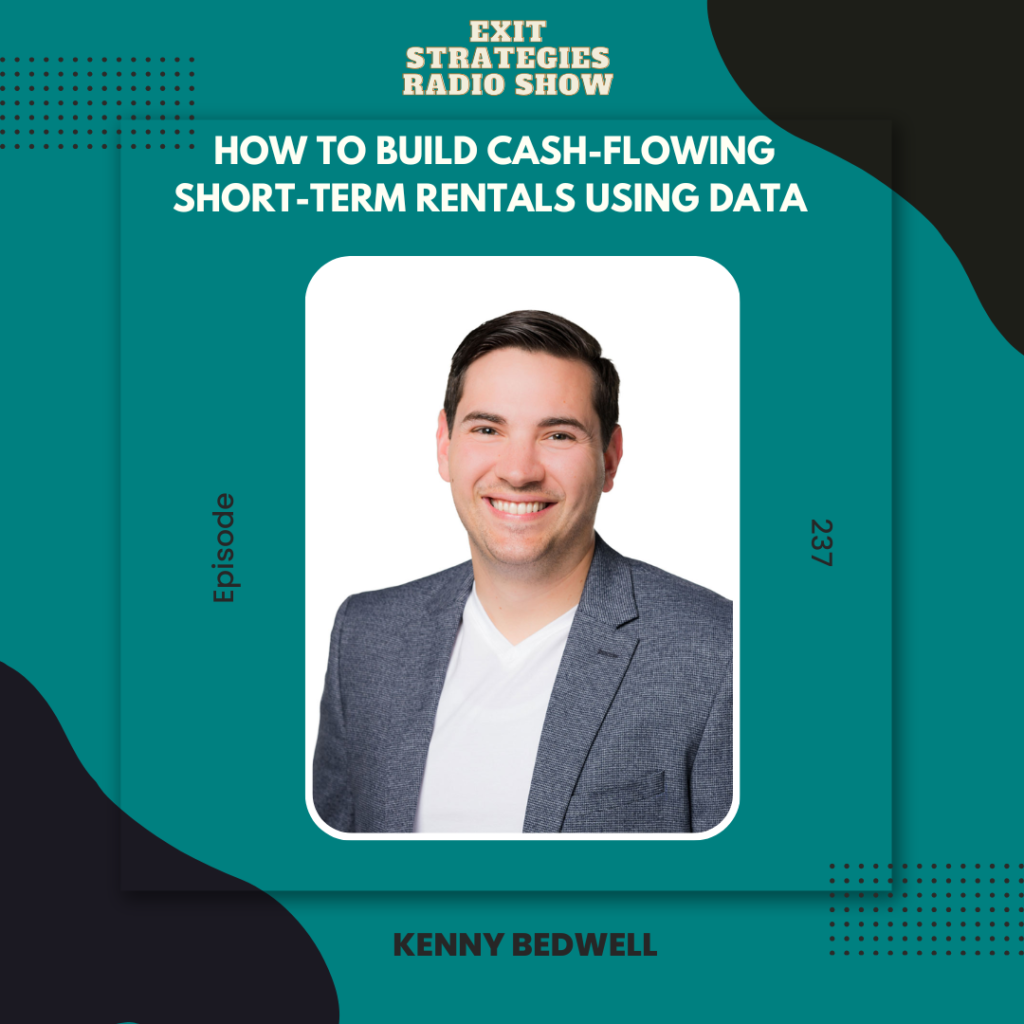
In this episode, Kenny Bedwell shares how investors can move beyond guesswork and start making decisions based on real numbers.
Learn how to identify high-performing markets, evaluate deals using ROI, navigate regulations, and take advantage of tax strategies that can significantly impact your bottom line.
If your goal is to build income, scale strategically, and create lasting wealth—this episode gives you a clear starting point.
Key Takeaways:
- 03:34 – How Kenny started with one duplex and scaled into a multi-state portfolio
A simple Airbnb experiment turned into a system for building consistent income. - 05:00 – The data formula that identifies profitable markets
Using revenue vs. purchase price to calculate ROI and rank top-performing locations. - 07:05 – The 5-step framework to find winning short-term rental markets
Budget → Drivable markets → Revenue data → Regulations → Local resources. - 10:50 – Why ignoring regulations can cost you everything
Skipping one phone call can lead to major losses—and even force you to sell. - 13:20 – The importance of community sentiment in choosing markets
Invest where short-term rentals are welcomed, not resisted. - 16:23 – Why removing emotion leads to better investment decisions
Smart investors rely on numbers—not ego or assumptions. - 20:00 – The tax advantage most investors overlook
Short-term rentals can be treated as active income—unlocking powerful deductions. - 21:40 – How depreciation can offset your income and reduce taxes dramatically
Strategic investing can lower your tax bracket and increase your net wealth. - 27:05 – The costly mistakes Kenny made (and how to avoid them)
From unusable land to overlooked property limitations—due diligence is everything. - 27:30 – The “guest avatar” strategy to maximize revenue
Design your property around your ideal renter to increase profitability.
Legacy Building Takeaway:
Wealth isn’t just about making money today—it’s about creating systems and assets that continue to provide for your family long after you’re gone. Data-driven investing helps you build something sustainable, not temporary.
Connect with Kenny:
- Website: https://www.strinsights.com/
- Instagram: https://www.instagram.com/kenny_bedwell/
Connect with Corwyn:
- Contact Number: 843-619-3005
- Linkedin: https://www.linkedin.com/in/cmelette/
Shoutout to our Sponsor: Country Boy Homes
You served your country with pride. Now it’s time someone serves you. At Country Boy Homes, we believe every veteran deserves a safe, beautiful and affordable place to call home.
We proudly offer VA loan friendly, manufactured and modular homes built with integrity, quality and your family and mine. Whether you’re retiring to the peaceful low country or starting fresh with your family, we’re here to build the future you’ve earned. Give us a call today, 843-574-8979.
Country Boy Homes, Built to Honor, Built to Last.
Support this podcast: https://podcasters.spotify.com/pod/show/corwyn-j-melette/support
CORWYN:
Short-term rentals are the rave, the crave, and all that other stuff right now is kind of the peanut butter and the jam. But it aren’t just side hustles anymore. They’re serious wealth-building tools. But a difference between quote-unquote another Airbnb and a lasting legacy lies in the data.
Good morning, good morning, and great morning to you guys. Welcome to another fabulous episode of Exit Strategies Radio Show. Hey, I am your host, Corwyn J. Melette, broker and owner of Exit Realty Low Country Group in beautiful North Charleston, South Carolina. Hey, if this is your first time listening to this show, you sir or ma’am are in for a treat because our mission here is very simple. That is to empower our community through financial literacy and real estate education, guys, with legacy building. Y’all know what we do. That’s how we do it. And we’re going to keep getting on until we can’t get it on no more. So look, I’m super excited about this conversation today. Our mission, mantra, theme, title, whatever it is you want to put on that thing, our text, and y’all there to follow, y’all know what I’m talking about. Our text for today is building financial freedom and legacy through short-term rentals. So short- term rentals, guys, we know are the rave, the crave, and all that other stuff right now was the peanut butter and the jam. But they aren’t just side hustles anymore. They’re serious wealth building tools. But a difference between, quote unquote, another Airbnb and a lasting legacy lies in the data. So our guest today, Mr. Kenny Bedwell, is going to break down how to find the right markets, structure your deals, and use analytics to build a portfolio that supports your family for generations yet to come. Now, Kenny’s a real estate investor, so he speaks my language, and an entrepreneur specializing in high cash flow short-term rentals. So I’m super excited to have this conversation. He’s helped over 300 clients identify and acquire properties that deliver consistent returns. He’s a former data analyst at Citibank, so that means he’s been working with money for a long time. So he brings an analytical and results-driven approach to real estate investing. That’s huge. But he’s also the host of Cash Flow Positive, a top-ranked podcast that has reached number 30 on iTunes Entrepreneur category. That’s huge as well. Major shout out there. And he’s passionate about helping other professionals replace, quote unquote, their nine-to-five income. So I need y’all to dial in here, all right, and to achieve financial freedom through real estate. So if y’all would, please, I want y’all to give them the slow clap, but I want y’all to do it fast. Look here, y’all, please welcome Mr. Kenny Bedwell to Exit Strategies Radio Show. Kenny, how are you doing today?
KENNY:
Good, good, Corwyn. I love that introduction. Thank you. I feel amped up. I’m ready to go, man. So giving out all secrets today. I love it. So let’s do it, man.
CORWYN:
So look, I’ve given mine, right? So look here, I want you to tell them your version of who you are and what you do.
KENNY:
Yeah, for sure. So my name is Kenny Bedwell. My company is called SDR Insights. But before I got involved with, had my own company and doing my own thing, I started investing about eight years ago in real estate. Now, at that time, I was living in Buffalo, New York, and I bought a duplex. I was living in one half with my wife and the other half we were renting out. This is in 2017. And we’re like, hey, you know what? We’ve used Airbnb before. Let’s try that. Let’s see how it goes. If it doesn’t work out, we’ll just long-term rent this thing and slowly build both that way. And the Airbnb model obviously worked at that time. You know, you could literally throw up any property, rent it out and make money at that time. And that’s exactly what we did. We started buying houses in Buffalo is really affordable. I bought that duplex for $145,000 in 2017. Unfortunately, it’s not that today, but it’s more. But even then, it’s still relatively affordable. And we started doing that in and around Buffalo and growing a portfolio, but I ran into a problem. So I realized that over time, I started seeing this in other bigger cities where they were starting to ban or regulate short-term rentals. And I knew I needed to look outside of my current market, but I had limited information that was available to me. Meaning like there was not really like, if you wanted to know other places to invest in, you basically had to go online and just Google it, go on bigger pockets, go on social media and just ask people, where should I invest? Where are you investing? And just learn markets that way. And at the time I was working at Citibank and doing data analytics in the equities market. And I really, I took that the skills and I said, Hey, what if I took average revenue of properties in all these different markets? And I looked at the housing prices that fit my budget. And I put the two together to get a what I call a gross ROI. So revenue and purchase price, I put them together and I compared based on their percentages. So like a 20% return, 21, 19, whatever I compared and sorted the top markets. And I did that. I had all these spreadsheets. I compiled them together and I found a list of the best markets for me. And I bought a property in a vacation market, about four hours away from me on a lake. I bought it for $350,000. That property nets me each year, $80,000. That’s net profit. That’s not gross. That’s the money after all of my expenses, mortgage and utilities and insurance and whatever, $80,000 a year. So that alone helped me start to scale and grow and get other properties. And so now I own short-term rentals and those are in New York, North Carolina. That’s also where I live too in Raleigh, Kentucky, Texas, Arizona. And I have a hotel, a small 14 unit hotel in New Orleans downtown. So yeah.
CORWYN:
Oh, look here, man. Look here. You’re giving me chills. Give me chills, my man. I love it. I love it. I love it. Let me kind of, obviously you aggregate all this data, right? And I mean, first of all, you got to have an eye for it. If you don’t have an eye for it, you’ve got to have somebody who does. So I know that’s part of what you guys do. And we’re going to kind of circle back around on that, but how do you spot these opportunities? I know you, you’re asking analytics and all that stuff, but how do you identify these opportunities? Are you pulling data from listing services? Are you just kind of keying in and honing in when these certain markets and certain areas, what does that look like for you and your team?
KENNY:
Yeah. So for me and my team, I guess there’s, there’s the heavy analytical way, which yes, we are pulling listing data and we’re doing all this like technical stuff behind the scenes. But what I teach people to do, I have found a way to do it without having to basically like rely on different cert like technology to help you. What I mean by that is I teach people that in order to find profitable markets, you need to do five key things. So number one, you need to understand what your budget is, your goals, what you’re trying to achieve. So basically when you see a deal, you know it’s a deal. So being able to recognize, start from the beginning, like I have X amount of cash on hand to invest. I know what I can afford to buy. Then you need to go in number step number two is the markets you’re interested in. They need to be markets that are what I call drivable within one to three hour max of a major city. They need to have tourist attractions and other reasons why people are traveling there. And then step number three, we need to see revenue. So this is where I would use a data tool or data provider and there’s free tools out there and I can go through those as well. And there’s paid ones. There’s air DNA. There’s STR insights is free. There’s data Rabu, there’s price labs. They’ll tell you the revenue of these properties. So basically if I know I can afford a three bedroom in this market that I’m interested in, how much money are three bedrooms making? And then I can take that revenue, that average revenue and compare it to the prices of homes there to know if that market is quote unquote investable, meaning if I’m going to get a decent return. So if I find three bedrooms in this market or $500,000 and they’re grossing $80,000, that would be a 15% return and that’s decent. Or if you have higher standards and it’s not decent, I don’t know, but start there. And then the fourth step is I look at regulation, which you can go online. You can start. I actually, I use chat GPT. I go, Hey, what’s the regulation in this market? And then it spits it out then. And this is important that this is a step that everybody misses because they think chat GPT and they’re like, that’s cool. Pick up the phone and call. I always call the municipality. And so I checked the regulation and make sure I can legally STR there. And then finally I check resource or their cleaners or their like short-term rental resources to handle the operational side of not the management side. I don’t do property management myself managed, but are there my cleaners? Are there my handyman? If I had something that happened to that property, could I get somebody over there? How hard is it to find those resources? And if you follow those five steps, I mean, you can find some really cool investable markets near you. So.
CORWYN:
Let’s take a short break.
AD:
Do you remember your grandma’s front porch? That spot where stories were told, kisses were stolen, and sweet tea was always being sipped. Now imagine giving your family a place to make those same memories, but in a brand new energy efficient home that was built just for you. At Country Boy Homes, we help folks just like you find that forever feeling, whether it’s your first home, your next home, or your we’re done with rent forever, like seriously home. We specialize in affordable and durable manufactured and modular homes, the kind that make room for muddy boots, big dreams, and second helpings. Come see what coming home really feels like. Call 843-574-8979 today. Country Boy Homes, built to last, priced for you.
CORWYN:
That is wow. Okay. So you touched on a number of things in there. So I want to start with kind of the last thing that you touched on, which is the regulation component. Because oftentimes people just jump, you know, with my years of working with investors and things like that, they sometimes say, Oh, I just do this. And well, no, you got to verify because a lot of municipalities are imposing regulations or otherwise they are restricting at times, you know, what you can do with STRs. So if you don’t mind kind of throw that out, like what is maybe the most restrictive that you’ve seen? And obviously I guess the least restrictive was be a municipality or a particular area where there is no regulations currently, whatever reason. So what’s kind of like the most restrictive that you’ve seen?
KENNY:
Well, Charleston’s pretty restrictive. That is true. Yeah. And man, when I actually funny story, is it, what’s the name of that area? Is it Mount Juliet? It’s one of the suburbs. Is that the name of the area?
CORWYN:
Mount Pleasant. Yes.
KENNY:
So in 2014, I lived in Somerville where you’re at and I was doing door-to-door sales just for the summer while I was in college selling pest control. I happened to be knocking doors and Mount Pleasant is really strict, like very strict. And I was in a neighborhood that was in whatever town was next to Mount Pleasant, but little did I know that the other half of the neighborhood was in the city limits of Mount Pleasant, but there was, it was the same neighborhood. And so I’m literally at the boundaries and I knock on this guy’s door and he’s a cop and he just gets super mad at me. And I’m like, Hey man, I’m just a college kid, like trying to earn income. You know, like I’m just like pest control. Like you can just say no and I can move on. And anyway, he had his like cop buddy come and they literally like had me sit in the cop car and like decide if I should, I’m like, guys, this is ridiculous, but never go back. I will never go back to Mount Pleasant again. So anyway, but yeah, so number one, this ties into how I look for good markets, investable markets. Number one, I always think about what is the community sentiment towards short-term rentals. I take that example with Mount Pleasant, like obviously the community sentiment there is very negative towards people knocking on doors, peddling or whatever you want to call it. And so like I’m kind of setting myself up for failure there by just going into a market that’s, you know, I’m going against the current. So I love to go after vacation markets where people love vacation too. Now that you could argue urban markets are vacation markets and that could be true, but they also tend to have a lot of regulation as well. And so I don’t look for no regulation. I look for areas that are just looking for, that have standards that are looking to protect their residents, but also they welcome short-term rentals because it provides value to the economy. And so the number one thing I, that’s really the number one thing I look for with these markets is, Hey, how do people feel about short-term rentals in the community? Because am I going to be fighting an uphill battle? Like my goal isn’t to just, I mean, yeah, we all want to get rich quick, but it real estate is a build wealth. It’s not a get rich quick. And so this is a long-term play. This isn’t a buy this year and then get out the next year. And so if that’s the case, like I really need to be, I really need to understand the community and their sentiment towards short-term rentals. And so that’s like, number one, I think of New Orleans, their regulations are, they, I would say they hate short-term rentals, but they, it feels like that. Like they’re the rules. There’s a lot of hoops, there’s limits on occupancy and all these different things for short-term rentals. But for hotels, it’s a lot easier. You know, they welcome hotels. That might be because there’s a really strong hotel lobby there. That’s paying them money to do that. But the reality is like they welcome hotels. And so I literally bought a hotel there because they are kicking and shutting down short-term rentals in that market. That’s the competition for hotels or short-term rentals. So like, I’m not going against the current by trying to open a short-term rental there. I’m going with the current. I have a joke I tell people all the time is like, we’ve all heard this before. If you can’t beat them, join them unless it’s illegal. Like with politicians, it boils all of our blood. When they’re sitting here like, oh, they have $150,000 a year salary and they’re multi-multi-millionaires once they leave politics. And I saw an ad a few years ago, it’s a auto trader thing. And it said, if you can’t beat them, join them. I was like, you know what? That’s right. I subscribed to the app and I started following trades. I know we’re not talking about trade, we’re talking about real estate, but it’s just a fun story. Trades of the politicians and that portfolio that I have, that money and those trades I’ve made in the last three years has a 48% return on investment compared to my like normal 401k. That’s like barely 10%. Like you can’t beat them, join them. And it’s the same thing with the regulation, right? Like don’t fight in those areas. Like our natural tendency is to only want to invest in places we personally know. And so we need to use data. There’s so many places that people vacation to. And so if you’re wanting to get to the short-term rental space, look for those areas that short-term rentals are common, that they’re welcomed, and it just makes life so much easier for you in the long run.
CORWYN:
Makes perfect sense. So you hit on something in there, Kenny, I want to pull out. True investors take the emotion out of it, right? So oftentimes that’s something that we struggle with as we’re getting into. Sometimes even when we’re into it for a while, we have all these feelings and all this other stuff that we want to play in or add or incorporate into our decision-making. Why is it key to remove the emotion as you’re considering building a portfolio, if you will, of short-term rentals?
KENNY:
Well, not to get like too deep in, you know, in the feelings and everything, but it ultimately comes down to your why. Why are you doing this? If you’re doing this to have like, so I’m going to pick on short-term rentals. So I’m going to say focus on short-term rentals. So if you’re doing this to own a property in a vacation market that you like to vacation to, and you’re going to use that property vacation and you just want it to pay for itself by renting it out on Airbnb, then that’s your why. You know, go buy in that vacation market you want to vacation to. But if your why is to make money, whether that’s for to quit the rat race, leave your nine to five, build legacy wealth for your kids or whatever it is, basically make money, right? If that’s your why, then you really have to try your hardest. It’s not, it’s difficult, but try your hardest to set the emotion aside and rely on the numbers. I see too many investors today, especially when they’re offering on properties, they feel like they got a, it’s ego starts to creep in when they’re making offers and trying to negotiate with sellers. And they’re trying to get the best deal possible and win the deal and get one up on the next guy. And it’s just like, look, let’s cut all the crap. If the seller’s playing games, look at the numbers, do the numbers make sense as is. And if they do great, if they don’t walk away and move on and go on to something else, it’s all about the numbers. If you’re trying to make money, go back to your why stay rooted in your why. And that’s what will help you like get through and make those logical decisions, not the emotional decisions.
CORWYN:
That’s about how to save some money, man. I mean, the reality is that, you know, as you’re investing, the goal is the creation or end or accumulation and growth of wealth. We talked a lot about legacy on this show about generations to come, what we do now and how we can set them up for better success and leave them in a better situation. So Kenny, one of your things is tax saving structures, if that makes any sense as to how to essentially save money by investing. So let’s go there.
KENNY:
So the nice part about short-term rentals or short-term rentals are considered active income. So meaning it’s not passive like long-term rentals because you have to actively manage your property. There’s guest communications and revenue management and software and all these like things that make up a short-term like managing a short-term rental. And then unless you hand that responsibility over to someone else, like a property manager, you are managing those things. They’re actually pretty easy. I self-manage. I don’t hand over 20, it’s 20% pretty much to pay someone to do that for you. So for me, I self-manage using technology and these things. But the tax benefits side, now when I am doing or my CPA is doing my taxes, I get a lot more active benefits. I can start writing off certain things. I can take advantage or I can take advantage of depreciation and something called accelerated depreciation. That was actually a law that was just recently passed where you can actually accelerate the depreciation of an asset of a short-term rental all the way up into the first five years. I mean, so you think about it, a normal property, a long-term rental is I think 27 and a half years, short-term rentals are 39 years. So basically every single year you can depreciate things in your property like the roof and the hot water tanks, but it’s split up, it’s divided by 39 years. So it’s like a very minimal tax savings amount that you get every single year. It’s kind of the government’s incentivizing us to buy and purchase real estate rather than just renting. However, with short-term rentals with a new law that was passed to incentivize people to buy commercial properties and active income properties like short-term rentals, we can take all that depreciation and get it really into the first five years and majority of it bulked up in year one. So I can buy a, we’ll take a $500,000 home, I can buy a $500,000 home and save 20, 30, even $40,000 in taxes depending on where that property is off of my tax bill. That’s huge. I can go from the highest income bracket, tax bracket, all the way to like the fourth or the third or whatever, like go from 37% down to 22% by just buying the right property. And you can’t do that with passive income. You can only do that with active income and commercial properties and short-term rentals. And so there’s a whole lot of benefit on top of if when you’re starting a business and being able to deduct writing things off and expenses and things like that, there’s a lot of benefits from short-term rentals on the tax side as you start a business because it is an active business. We are entrepreneurs even though we’re owning real estate.
CORWYN:
Kenny, look, man, for our listeners, guys, if you come back and listen, pull this episode, I need you to get to this point. I need you to go back about two, three minutes and catch it because Kenny, what you just said, man, I mean, you just gave me something I didn’t know. I didn’t realize, oh my gosh, I didn’t realize that short-term rentals, if you manage yourself, you take care of handle that is active, which then completely shifts the dynamic tax-wise. I mean, I’m familiar obviously from passive income, but I didn’t think about it that way. That is huge. Man, that’s huge. So basically, you can almost, I mean, acquire a short-term rental and you handle internally your own management of it. According to what your money look like, you might can zero out, right?
KENNY:
Yeah, that’s the goal. That’s exactly the goal. So like for example, this year, so a couple of weeks ago, I sat down with my CPA, my tax strategist who understands these things and he’s like, all right, let’s look at your income. So I’m an entrepreneur, I’m self-employed, whatever, and I don’t pay taxes until the following year. And the reason why is because that money that I could pay taxes on, I use to invest in other things. And so I have to do apply strategy or I have a fat bill at the end of the year or at the beginning of the next year. And so my CPA is like, hey, you need to go buy property. You need to go buy short-term rentals and we’re going to depreciate it. So we depreciate the hotel, we depreciated the short-term rentals I bought this year and basically offset all of my income to where it looks like through depreciation, I’m not going to owe any taxes where I should probably owe about $50,000.
CORWYN:
Man, look, that right there, man, we still got stuff to talk about, but that right there is kind of like the mic drop right there, man, for real. I mean, seriously, like as people are looking and thinking, people are afraid to purchase real estate because of what money, right? And then, okay, I don’t want to have this rental property because it might change my, I mean, I’ve heard all kinds of stuff, right? And the reality is now that this is huge, especially as it offsets other income. Let’s say that your short-term, you’re just setting it up, but you can depreciate this much, but you have income from other, that is huge. I mean, I got a client right now that I need to have this conversation with and make sure his people is doing this.
KENNY:
Yeah. No, it’s a really, a lot of our clients, once they learn, they’re like, hey, we need to get property. And that’s exactly what my company does is we help people find properties so that they, a lot of them are doing this strategy. But the beautiful thing about real estate, whether it’s short-term rentals or long-term rentals or whatever midterm rentals is you really get four key benefits. You get cashflow, you get appreciation, you get tax savings, and then equity pay down. And all four of those things build what the true ROI is of that deal. And it depends on where you’re at. Some of us today, like a lot of people listening, they’re not going to be in the high tax bracket. They’re not going to need to take advantage of the tax savings. They really should be just focusing on deals that make them money. But at some point in time, you’re going to be flipping. You’re going to be like, wow, I’m making a lot of money and I’m happy to pay a lot of taxes. Crap. I need to get rid of the taxes and offset that. And so real estate is just a really cool wealth vehicle that you can take advantage of in multiple ways. And so it’s like understand where you’re at and then attack. And then as you scale, your position’s going to change and you can leverage the strategy that works best at that time.
CORWYN:
So Kenny, look, I got to make sure I get your contact out and I’m going to be very transparent and say this right now. We have got to get you scheduled to come back. I mean, like seriously, there’s so much more that we can unpack in this conversation for people who are, one, people who are doing it, the stuff they don’t know, two, people that want to do it and is trying to figure out how to get started and everybody kind of in between on both sides of the spectrum, if that makes any sense. So how can people connect with you and connect with STR?
KENNY:
Yeah, yeah. So I’m not like that cool and popular yet. And so I tell people, just reach out to me on social media at Kenny_Bedwell, B-E-D-W-E-L-L, on Instagram, Facebook. I think there’s a TikTok out there, but I don’t know. I’m not a TikTok person, but I created an account. But just message me. You can find me on Instagram, all the social media platforms. Just reach out to me. I message people back personally and talk to people all the time. So I’m happy to, if you have questions, if you’re interested, my company website is strinsights.com. You can check us out there. We have some really cool free resources that you can use. But at the end of the day, just reach out to me. I try to answer general questions or whatever when people reach out.
CORWYN:
Well, that’s awesome, man. That’s awesome. I mean, I’ve already looked, I’ve already pulled you up and followed you on Facebook, just FYI. So our listeners, look here, y’all better get on this train. Some of y’all can be an engine, but don’t mess around and be no caboose. Don’t come out here too late. You know what I’m saying? They don’t use cabooses on trains too much now. So I’m just saying, I’m going to tell our listeners, man, to get this thing here right, Kenny. Because I mean, I mean, this is a game changer. Like seriously, I’m saying it jokingly, but throughout the conversation, you have dropped so many jewels and nuggets that it’s straight up ridiculous. So I’m going to ask you, quote unquote, I do call it, I might drop question at times. It’s a hindsight question. It’s that old adage, 2020, if you go back and bubble up, look at this thing and do this thing all over again, what would you have done differently? So I’m going to ask you that because I think based upon where you are, I’m pretty sure I can imagine some of the things that you might say. So if you don’t mind, drop that on our listeners.
KENNY:
Yeah. So, I mean, I give the classic adage, start sooner, you know, like get more aggressive, leverage more debt. But the reality is like, that’s just not like, I don’t know. I don’t feel like that’s like, most people take that as good advice. They’re like, okay. So for me, for short terminal specifically, I think if I could have taught them, because I’ve made some mistakes, it’s not been a perfect, I own some land in the middle of the desert that I can’t build on. And I know I couldn’t build on until I spent over $10,000 trying to figure out if I could build on it. And it could have been solved by one simple phone call. I had to sell a property because I didn’t have any parking. And it was a really beautiful house. It made a lot of sense. But the one thing I didn’t think about, and this is so important. So number one, I’d say like, go back to the regulation conversation. Don’t be afraid to pick up the phone. That was my mistake. But the other thing though, that I would teach myself going back is whenever you make a real estate investment, especially with short term rentals, always think about the person you’re going to be renting to. What things would they enjoy, especially with short term rentals? Like what amenities would they enjoy? What things are they going to do? What’s going to make their experience? And if you do that, you’ll actually make more money by adding the correct things to the property for them than trying to just cheapen out or half, just do it halfway. Like just keep focus. I call it the guest avatar. Focus on the who and the why and build everything around that. And that’s how you actually maximize revenue, the riches and the niches. I know everyone’s heard that before and that’s cheesy, but it’s so freaking true, especially in the short term rental industry. If you can be more targeted and more specific, you’ll actually make more money.
CORWYN:
Wow. That’s huge. So Kenny, look, we have gotten to the end of today’s show. I mean, first and foremost, I want to say thank you for taking time out to be here.
KENNY:
Yeah.
CORWYN:
Yeah. It’s great. Really appreciate it. Let me drop a couple of things for our listeners. Now, first of all, look, guys, y’all need to do something. Real estate is not just about passive income. Y’all have heard it today. Active income, like active income might be the way to go, but it’s really about creating assets that continue to serve your family long after you’re gone. Again, we’re big on legacy here. So whatever we’re doing today, we wanted to benefit our family on tomorrow. Now, Kenny, look, my takeaway from what you’ve been saying, what you’ve been talking, building a legacy starts with smart data, like really starting out with analysis and analyzing so that you’re disciplined in your investing. That’s one of the things I think a lot of people miss. They’re not disciplined because they don’t look at it. They look at what they want or what they think or how they feel. But it endures through the systems that you leave behind as well. Because again, in our legacy, by being disciplined, by teaching that discipline to our generations yet to come, we inherently give them or allow them to inherit from us that discipline in their investing going forward, which will continue to serve our families for generations yet to come. So Kenny, one more time, man, I want to really say thank you from the bottom of my heart for being on the show, for being part of the Exit Strategies Radio Show family. I really appreciate it.
KENNY:
Yeah. Thank you for having me on. This was fun. Awesome. It’s awesome.
CORWYN:
So for our listeners, look, y’all got it. Y’all better do something with it. If y’all don’t, somebody might come take it away from them. And look here, if we can do anything to help you know where we are, please come check us out. But most importantly, please get in contact with Kenny and his team because they are doing some amazing work and helping people make an amazing and phenomenal amount of money. So look. y’all know how I feel, you know what I say You know, I always put the two of those things and I give it to you this way Which is to tell you that I love you. I love you and we gon’ see you guys out there in the streets