



What if business ownership isn’t the destination… but the engine that powers your legacy?
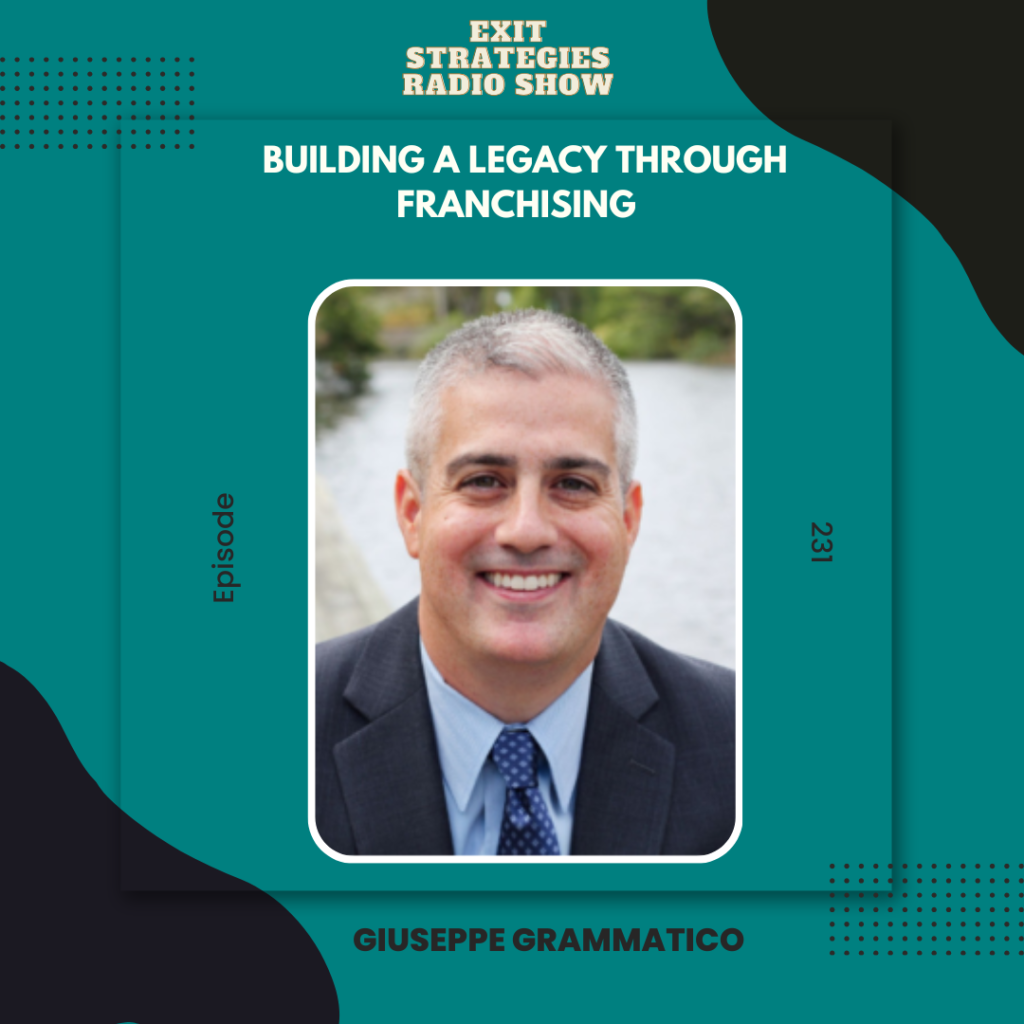
This week our guest, Giuseppe Grammatico unpacks how franchising can become a strategic vehicle for freedom, cash flow, and long-term wealth — not just another job with a bigger paycheck.
With over 20 years of experience in corporate finance, Wall Street, and hands-on franchise ownership, Giuseppe shares practical insights on how to choose the right business model, scale strategically, and reinvest profits into wealth-building assets like real estate and stocks.
If you’re exploring entrepreneurship, considering a franchise, or thinking about your exit strategy before you even start — this episode is for you.
Key Takeaways:
- 03:57 The “Training Wheels” Advantage: Why franchising offers a 90-day head start compared to the years of trial-and-error required for a traditional mom-and-pop startup.
- 06:36 Mindset Shift: The Widget vs. The Vehicle: Why successful franchisees focus less on the specific product (the “widget”) and more on the systems and support steering the ship.
- 09:55 Planning Your Exit from Day One: Understanding the “Item 7” and “Item 19” in disclosure documents to project your investment range and financial potential.
- 12:47 Avoiding the Comparison Trap: Why a business that works for your neighbor might not work for you, and how to find your “Franchise Avatar” based on your unique skill set.
- 17:38 Failing Forward: Giuseppe shares his personal mistakes, including the high cost of waiting too long to hire a manager and the importance of “Phantom Equity” for retention.
- 22:03 The Diversification Strategy: How to flow active income from a business into passive streams like real estate and the stock market to cover your lifestyle expenses.
Legacy Moment Takeaway:
“Don’t chase income — build an engine.”
Connect with Giuseppe:
- Website: https://www.ggthefranchiseguide.com/
Connect with Corwyn:
- Contact Number: 843-619-3005
Shoutout to our Sponsor: Mellifund Capital, LLC
Need funding for your next real estate flip or build? MelliFund Capital makes it fast, flexible, and investor-friendly. Visit MelliFundCapital.com and fund your future today. Again, that’s MelliFundCapital.com, M-E-L-L-I-L-U-N-D, Capital.com.
Support this podcast: https://podcasters.spotify.com/pod/show/corwyn-j-melette/support
CORWYN:
Legacy comes when you use business ownership, not as the end goal, but as an engine, you know, it powers that vehicle, if you will, that powers lasting wealth and as well as impacts. Good morning, good morning, guys, and great morning.
Welcome to another fabulous episode of Exit Strategies Radio Show, guys. Hey, I am your host, Corwyn J. Mellette, broker and owner of Exit Realty Low Country Group in beautiful North Charleston, South Carolina. If this is your first time listening, hey, buckle up, tune in, you’re in for a treat. Our mission here is very simple, that is to empower our community through financial literacy and real estate education. Quick shout out to those that love us and that we love as well. Elder Pastor Evans, thank y’all so much for tuning in. My mom out there in Monks Corner and all y’all out there in Hollywood and everywhere in between that. And also always got to give a shout out to my folks in beautiful, wonderful, as I like to call it, Muddy Mullins out there in the PV. Thank y’all so much for tuning in. Today, today, look, starting a business can feel overwhelming, but those who’ve done it, those who adventure to do it, guys, it can be overwhelming, but the right vehicle becomes the foundation for freedom, wealth, and legacy. Today’s guest, Giuseppe Grammatico, has helped countless entrepreneurs using franchising, not just to build businesses, but to create lasting opportunities for them and their families. Now, Giuseppe is a franchise consultant with over 20 plus years of experience, both in the corporate finance world, as well as he, look, entrepreneurs with cereal. I tell people all the time, look, we can find a business and everything. You figure out how you’re going to roll the grill out to the backyard and we probably can figure out how to make a business out of that too. His background includes roles, UBS, and JP Morgan plus hands-on success as a franchise owner and master franchisee. He is known for guiding aspiring entrepreneurs to choose the right business model. That’s very important, secure funding, very, very important in that capital stack and reinvest profits into wealth building vehicles like real estate and stocks. So if you all please would, let’s give a drum roll, but most importantly, let’s give a round of applause. Giuseppe, thank you and welcome to today’s strategy radio show.
GIUSEPPE:
All right. It’s a pleasure. Very, very excited. Thanks for that intro. That was awesome. I really appreciate it.
CORWYN:
Well, just so you know, I’m available. You can rent me out for introductions on stage and stuff. I love this.
GIUSEPPE:
I love it. I may take you up on that.
CORWYN:
So Giuseppe, if you don’t mind, give our listeners high level overview, who you are, what you do, and let’s get into a conversation.
GIUSEPPE:
So Giuseppe Grammatico, it’s a mouthful. So a lot of guys just call me G and yeah, I help individuals that are stuck at their jobs and figuring out what their next steps are. In New Jersey, born and raised, grew up in the Italian restaurant business, was in the investment world for many years and just didn’t like great pay, great income, just didn’t like what I was doing. So I was looking for that, what else was out there? I knew employment wasn’t the right fit and couldn’t then figure out what the business was. What was that business that I should launch? And came across a franchise coach online, sometimes called a franchise consultant. And I said, yeah, I need to learn about franchising because the franchise kind of has everything figured out for you and opened up some franchises. I sold those businesses, became a coach and get to help people figure out what those next steps are. As you mentioned, what is that vehicle that’s really going to help me get to where I want to be?
CORWYN:
So Giuseppe, why franchising? I mean, oftentimes people start business or think to start business and they always, I say always, but a lot of times they focus on the mom and pop approach. So I want to open a ice cream shop. If I want to open a burger restaurant or a chicken restaurant or what have you, oftentimes we think about it from our own perspective. So why franchise? Why franchising?
GIUSEPPE:
Yeah. So a franchise is a business on training wheels. A franchise gives you an unfair advantage over a mom and pop. Now, thinking a step back, franchising is not for everyone. You have to be open to the following systems. You’re not buying McDonald’s to change the menu, but there are 4,000 franchises in every industry. So for example, you look at a roofing franchise. What’s the advantage there? Well, you’re up and running in 90 days or less. You have the systems that everything already put in place for you. You get to leverage your relationships with franchisees all over the country, as well as national accounts that the franchisor may be able to feed you and refer to down the road, as well as economies of scale. Just the pricing alone makes a franchise really attractive in what you’re paying for shingles versus a mom and pop. National brand with 500 franchisees can have so much more buying power. So there’s so many advantages, but the biggest thing is what is your time worth? Some startups are great. You may not have to pay a franchise fee, but you’re paying for time. It may take you a few years to make that company a reality, a franchise, a non-brick and mortar type of business. Three months and you’re really attractive when it comes to business.
CORWYN:
So that’s important. I mean, obviously, when we look at starting a business, the sooner the better, so to speak. The sooner we get customers, clients, or what have you, whichever they fall under, and the sooner we can get to deals or business or transactions or what have you, the sooner we start bringing in revenue, because everything leading up to that, it seems like every time you turn around, you get thrown it out. So that definitely makes sense. So you have been a franchisee, but also a master franchisor as well. Give us some of those experiences that you’ve had personally, as well as some that the people that you’ve assisted have experienced as far as their startup.
GIUSEPPE:
Yeah. So the nice part is sometimes it’s not what you’re reading, you’re actually experiencing it. So the master franchisee and master franchisor, I’ve worked in corporate America, been laid off, been downsized, and I’ve also owned an Italian restaurant with my family. So it’s nice to have those experiences to kind of compare the things you like, things you don’t like. The franchise side, check off all the boxes. I had everything created for me so that I can follow that system. When we had the Italian restaurant, we were figuring things out. Well, at the time, shouldn’t we have a website? That’s how far back we go. What about social media, creating a Facebook page? You’re really figuring everything out. And there wasn’t really much assistance aside from, let me hire a marketing person. With the franchise, they really figured it out. And I’m not saying it’s perfect, but they know how to go about doing business. They know how many leads it’ll take to get a new customer. So when you look at a franchise, so this is kind of the thing I learned over the years versus a startup, you have to look at it a little bit differently. A startup, that’s your baby. You’re creating everything from the ground up, from the low note of the colors to just about everything else. A franchise I look at is more as a vehicle. I’m not necessarily as concerned about the widget. I’m not concerned about the service offering. As long as obviously there’s demand, I’m looking for the support from the franchise. That’s a little bit of a mindset shift because going back to roofing, it’s a very simple business model. I want to know that I can hit the ground running. I have all the roofing and all that stuff to be taught, but what is my main role in the business and my main role in a roofing franchise is typically networking, going out there and maybe doing some sales calls and building a team, which is what you’re going to do with many branch. You’re building a team. You’re putting those systems in place that you can back off the business. So you’re not working in the business. You don’t want to be on the roof replacing shingles, but you want to be creating agreements with property managers, commercial accounts and things like that. So if the demand’s there, it’s really figuring out, okay, do I meet the requirements of an ideal franchisee? They call it a franchise avatar. And who’s going to support me the most? Who’s steering the ship, which is usually the founder or CEO, and who’s going to support me the most? Because ultimately there’s going to be good days and bad days. And when things aren’t going right, you need that coach or that individual to go to. So those are some great advantages, as well as your colleagues. You have a built-in group of mentors and other individuals, which are essentially the franchisee system that can help you operate and get that business out and running quick.
CORWYN:
Let’s take a short break.
AD:
You found the perfect property. You got the vision. Now you need the capital. At MelliFund Capital, we specialize in funding real estate deals for investors who want to build, blip, or hold, and don’t have the time to chase after banks. Whether it’s new construction, a fix and flip, or long-term rental, we offer simple terms, fast approvals, and access to private capital. We even work with manufactured housing projects because we know what it takes to build value from the ground up. Simple. You bring the deal. We bring the money. Visit mellifundcapital.com or call 843-619-7038 to get pre-qualified today. MelliFund Capital, we fund what you build.
CORWYN:
So I’m going to add in, I guess, one more piece on that from my own experience, but you also have fellow franchisees as well that you can share experiences with. But let me shift this up a bit and let’s get on the other side because people talking about starting a business, buying a franchise, or what have you, they got to understand the numbers, right? So what is your experience with that and how do you advise and inform people or coach people on what they need to understand before taking that type of endeavor?
GIUSEPPE:
Yeah. I keep it simple. It’s a business just like any other business. It’s what you make of it. Franchise is giving you a system to run with. The advantage you’re going to get with the franchise is, well, first off, what is the goal? It’s Exit Strategies Radio Show. I always start with what’s the plan? Is it the plan to grow this and sell it in five years or to create a legacy for your kids and grandkids? Those are probably going to be two different strategies and two different types of businesses we’re going to look at. But when it comes to the financials, the franchisor is providing you as much data. They can’t guarantee or tell you what you’re going to make, but they’re going to give you… There’s two sections in a franchise. That’s a franchise disclosure document. The item seven, it’s going to be an investment range. This is all the data that they collect from the franchisees. It’s going to be a low and a high, and there’s going to be big swings. It may say 100 to 300,000, 200 to 500,000. Why is there a big swing or big range? It’s because it depends on how you’re running that business. If you are running it full-time, you may not need the salary of a general manager. You have a general manager, obviously that’s going to increase your investment, which is typically the startup that you need to get it up and running, plus the first 90 days of operation. So 200K investment doesn’t require you to come up with 200K out of pocket, but that’s the amount you’re going to incur roughly over the next 90 days to get that business up and running. So that is your investment. Franchisors can help you with the pro forma, and then they’re going to give you an item 19, and that’s a financial representation. They’re going to give you data collected from all the franchisees that have had at least a year in business. So if they had 11 and a half months, they will not be in that agreement, they’ll be in the following agreement. Based off of all that data, they’re going to say, the top 25% are doing this, the middle is doing this, the bottom is doing this. In some occasions, they’ll include every profit loss for every franchisee that has a year’s worth of data so that you can look at it and then come back and say, these are ranges, right? Realistically, we’ve had a lot of people in the business two years, and they’re averaging about a million in revenue to 100,000 bottom line. It’s not an earnings claim, it’s not saying what you’re going to make, but it’s going to say, this is what the top guys are doing, these are the bottom, these are the guys in the middle. Ultimately, you have some numbers to work off of. The expenses are pretty easy to figure out, but ultimately, you’re kind of guesstimating what that revenue is going to be. So they’ll give you historical data on that, but ultimately, it’s up to you to kind of follow through it and plug in your own number. So you’re given kind of these spreadsheets and you can do kind of a worst case, a best case, and that kind of an average scenario. And the numbers are really what you make out of it. So some brands have a lower profit margin, but they make it up in AUV, average unit volume. So maybe a cleaning business, they have a little bit lower of a profitability from a percentage standpoint, but they tend to do twice the amount of revenue. So they’ll break that down for you so you can plug in and run your different, not different scenarios.
CORWYN:
So what are the pitfalls? Inevitably, there are pitfalls to what we do and what a business owner does. So what are those pitfalls?
GIUSEPPE:
Pitfalls in franchising? I mean, I don’t know if it’s necessarily a pitfall, but franchising is not for everyone. Just because your neighbor is doing well, owning a Subway or McDonald’s doesn’t mean you’re going to do well. A lot of people fall in that trap. They assume, well, if he’s doing well, I’ll do well. Well, you and I have different skill sets. You may be an extrovert and I’m an introvert, and you may have management experience that I don’t. So it really depends on what you bring to the table and finding that right match for you. As I mentioned, there’s 4,000 franchises in just about every industry. I will tell you this from doing this for two decades, close to two decades, not every franchise is built the same. So just because you’re looking at a roofing franchise to keep it consistent and you’re looking at two brands, one may not give you the same support. One may have you full-time on the roof and the other one is going to have you kind of working from a distance and networking and things like that, more bigger picture. So if you are not okay with following systems or going back to the McDonald’s example and you want to recreate the menu because you’re a chef, I wouldn’t call it a pitfall. I would just call it not a fit, but some brands will have less autonomy in running the business. They’re a lot more structured. We’ll have more flexibility in the home services space. If you love to talk on radio and video and podcasts, you have autonomy to market your business that way. Whereas if someone’s more introvert and they just want to do paid ads and things like that, that’s fine. So that’s going to be a case by case depending on the brand. But yeah, if you’re buying a roofing franchise, you’re in the roofing business. And then if you add complimentary businesses, like something that’s not competing, like a cleaning business, we’ll call it servicing the home. Then you have the option of saying, okay, do I want a franchise or a non-franchise business as a bolt-on business? And you have those options. So it really comes down to the match and if a franchise is even the right fit for you.
CORWYN:
So that brings me to afterwards, because obviously you kind of layer this stuff. And what I mean by that Giuseppe is that you have the first piece that is, well, look, this is what I want to do. You then have, okay, should I do this? So let me explore what this looks like, et cetera, et cetera. But let’s make the assumption that we’re going to take the plunge, right? Because we jump around here and that’s what we do. So if we take the jump and the leap, then let’s get on the other side of it. Once you’ve started a business, once you’ve figured out that it’s successful or otherwise it’s throwing off revenue, throwing off cash, you also advise, okay, what to do with this money when it comes in and how to grow and leverage. So let’s talk some about that. What do you advise your folks to do?
GIUSEPPE:
One last thing I forgot to mention is you have to be a word of the franchise at the end of the day. So it’s not, I’m going to invest in this, obviously the franchise or you and the franchise don’t have to agree together that it’s a fit. When it comes to building a business, everyone is bringing different things to the table. I always recommend if you can, two things. One, if you could run the business full-time, give it your full-time effort to start. I think that’s my recommendation. That’s the way I did it. Plenty of brands will allow you to run it part-time, but it’ll help you grow faster, get a better appreciation, wear all the hats so that you can kind of figure out what your role is going to be. Second is use year number one in any franchise as your builder year. If you can, reinvest all the profits, find the right team, get all the marketing dialed in. So that’s your builder year. So then you can start growing exponentially from there. So that first year is crucial. That first hire may not be the right hire. It happened with me. I had to replace that person. So get the right hire, learn the systems, decide kind of what your role is in the business. You may have a sales background, but you may realize it’s really like the bookkeeping and customer service. I’m looking at the complete opposite. So you can start figuring out and saying, okay, this is going to be my role. So these are now the roles I need to hire. I need a general manager. This is what I have to pay that general manager, and these are going to be the roles. So for that first year, build it, grow it, reinvest back in the business, get the additional truck if need be, buy that second territory if that’s an option for expansion of that future growth. Just getting everything in order. And then if you want to start taking money out, if you can hold off to the second year, but if you want to pull back and you can, but definitely don’t withhold from the business. If you’re paying yourself too much of a salary and you can’t pay for marketing, this is the groundwork that you’re laying to build something big.
CORWYN:
So you kind of brings us back on that back end because you’re advising people or advise people how to make sure that they are fully engrossed, engaged, quote unquote, full-blown, hands-on couple of years, and then identify who they may need to replace themselves with as they grow and go. What has been your experience? And if you don’t mind, I mean, inevitably we tend to fail forward. So what was a learning, what was a situation that you learned, but you failed forward on and from your own journey, if that makes any sense? Yeah.
GIUSEPPE:
I learned a lot. I failed a lot and that’s going to be a whole nother show. I joke. This is what I learned. I learned that you can find employees that will do most of the work better than you. I felt like I had to be the expert in all areas and marketing and sales and all. And there were plenty of people that were much better than me that could just focus on sales, that could just focus on marketing. And I should have hired sooner than I did. I waited a little bit longer than I should have. I just kept saying I wasn’t comfortable. And maybe it was because it was the first business that I was a hundred percent on my own. And the franchisor suggested that. So again, it’s the franchisor’s recommendations I held back. So again, franchisor can only guide you, but it’s up to the franchisee, business owner to take that into those recommendations. So I waited a little bit too long to hire. When I did finally hire a general manager, it took a lot off the plate. I think compensation-wise, I screwed up too. I offered sand inequity, which I’m still a big fan of where you’re getting a percentage of the profits, but I was doing it on an annual basis, which makes it very difficult because you don’t know unless you have access to the P&L where you stand. So doing a quarterly distribution to your general manager, person that’s running the day-to-day, maybe they earn 2% a year for the first five years to say, we’ll call it 10% or more, just making these numbers up. That’s something I would have done differently than a quarterly distribution via phantom equity. Hired better people than me much sooner because I was in the weeds and I was like, all right, well, I was figuring out the social media, I was figuring out the website. So yes, I saved a ton of money doing it on my own. What did I give up? The opportunity costs of meeting another two or three property managers per week, which could have turned into millions of dollars when you annualize it on the amount of work. So everything comes at a cost. There’s an opportunity cost for a startup. I don’t have to pay a franchise fee, but I just lost two years figuring out how I’m going to create this system when I just bought, invested in the franchise and maybe paid a $30,000, $40,000, $50,000 franchise fee. So if the systems are in place, run with it and always look for ways to eliminate yourself because when you do sell that business, write the name of the show, how am I selling this? What’s my exit planning? They’re going to want to know what’s your growth, what are your financials, but more importantly, what’s your role in the business? Because if you’re working 100 hours a week, they’re going to have to replace you and they’re going to come back and say, well, I need a manager. And if you’re showing 200K in profit, they’re going to come back and say, well, you may need a manager at 100K. So you’re only making a hundred, not making that 200,000. So those are the things I wish I had done a little bit sooner. I learned, I advise people not to make those same mistakes and hopefully they’ll take my advice.
CORWYN:
Well, again, failing forward, Giuseppe, failing forward. Yes. That’s the thing. I’ve learned in my years in this particular realm, some of the things that you made mention of and it’s quite interesting to see, but what I also love, and I do want to kind of drive this point home as we bring it home, so to speak for our listeners, you strongly advise like, okay, once you get it balanced out and this thing is doing what it’s supposed to do, that you expand and grow that business and you diversify by getting into stocks and things of that nature. So a tidbit, if you don’t mind, but give it to us now. Your experience with this and why this is what you advise and why.
GIUSEPPE:
Yeah. I come from Wall Street and that’s primarily where, and that’s where I learned the game and I learned about investing and that there are a lot of vehicles out there. Number one, you don’t have to invest in everything. If you don’t understand crypto, if you don’t understand commodities and gold and things like that, you don’t have to invest in everything like that. My uncle Warren Buffett always tells us, invest in the things you understand. But I believe in having a couple of drivers when it comes to some of the big revenue. For me, it’s my franchise consulting business. That’s where a majority of my active income comes in. And then I reinvest. I reinvest in real estate, real estate syndication. I’m a big believer in the stock market. So I have a considerable amount of percentage, I should say, of my assets in the stock market. It’s tough. It does take up a lot of my time. There’s a lot of history there. There’s always going to be risks. I know that my time commitment is going to be minimal. Real estate’s going to be a little bit more. Running a franchise is going to be a lot more. So kind of look at what the time… But yeah, I flow everything from my consulting business and then I diversify. I have a retirement plan. That’s 100% in stock market. I have investment accounts, real estate. So I like to diversify. So I have passive streams of net income specifically from real estate. And if the stock market’s down, well, will that affect my real estate portfolio? Possibly, or maybe not. So there’s a lot of also tax benefits as well. So in any investment strategy, my background, always look for the tax advantages. I hired a team of an attorney, a financial advisor, as well as a CPA, three women that live just south of my town. And they all talk with one another and they always put together a plan looking at the legal, tax ramification and everything else and kind of what the entire financial plan looks like. So have that true to income, your bread and butter, and then consistently reinvest. And I’m trying to get to the point where my past income covers all our expenses and we’re getting there. We’re not completely there. So that you kind of have that base and then everything else is just a bonus.
CORWYN:
Awesome. It’s awesome. So Giuseppe, where can people reach you? Let’s make sure we get your contact information out here for our listeners. Where can people connect to you for advice, insight, or otherwise for your assistance?
GIUSEPPE:
Yeah, we’ve got my website. It has everything there. So GG, my initials, the franchise guide, G-U-I-D-E, so ggthefranchiseguide.com. You have 250 episodes of the podcast with a search bar, type a topic in like exit strategy planning, pull it up. We have a webinar as well as my book here, Franchise Freedom. It’s my exact blueprint of finding a franchise. If you’re going to do it on your own or work with folks like myself, free download on the site. And if you just want to say, you know what? I’m ready to have a chat. You could book a call. We do a 20 minute call. Guys, the best part about this is my services are free. There’s no cost for anything. We’re paid directly from the franchise companies, a referral fee, just like a real estate agent. So even if you just have a general question or you’re thinking about it in a few years, the time is now to just book a call, figure out if the franchise is even the right fit and then putting together. Maybe it is, but credit score is too low. The timing isn’t right. I had someone recently go through a divorce and we just, we sidelined it, but I gave them additional resources to check out. I’ll reach out. No silly questions, no dumb questions. I give straight advice. I don’t sugar coat. And in many cases, the franchise is not the right fit and that’s okay. We have other people and individuals in real estate market, career transition that we refer you to. So it doesn’t cost you anything but 20 minutes of your time.
CORWYN:
Awesome. It’s awesome. So Giuseppe, thank you so much for taking time out to be with us on today. You have been a wealth of knowledge and insight. I really appreciate it. And most importantly, I’m so glad that you were willing to share that information with our listeners. For our listeners, guys, look, let me give you these takeaways today. Don’t chase income. Don’t just chase the money, guys. Choose a business model as you explore opening your own business that creates freedom, security and opportunities for your family. We’re all about legacy and that is what we do. And Giuseppe, from my takeaway from what you talked about today, that legacy comes when you use business ownership, not as the end goal, but as an engine. It powers that vehicle, if you will, that powers lasting wealth and as well as impact. So I want to thank you so much again for being part of the Exit Radio Show family and dropping those jewels and nuggets for us today. I really appreciate it. From the bottom of my heart, thank you.
GIUSEPPE:
Thank you. It was an honor to be on the show. I really appreciate it. And yeah, just here to help as many people as possible, empower them in their decision making process and challenge them to look at things a little bit different. That’s it.
CORWYN:
Awesomeness, awesomeness. So for our listeners, guys, y’all know what it is. We’re going to give it to you anyhow. Y’all know how I feel. Y’all know what I say. You know, I always put those two of those things together and I give it to you this way, which is to tell you that I love you. I love you. I love you. And we’re going to see you guys out there in those streets.