


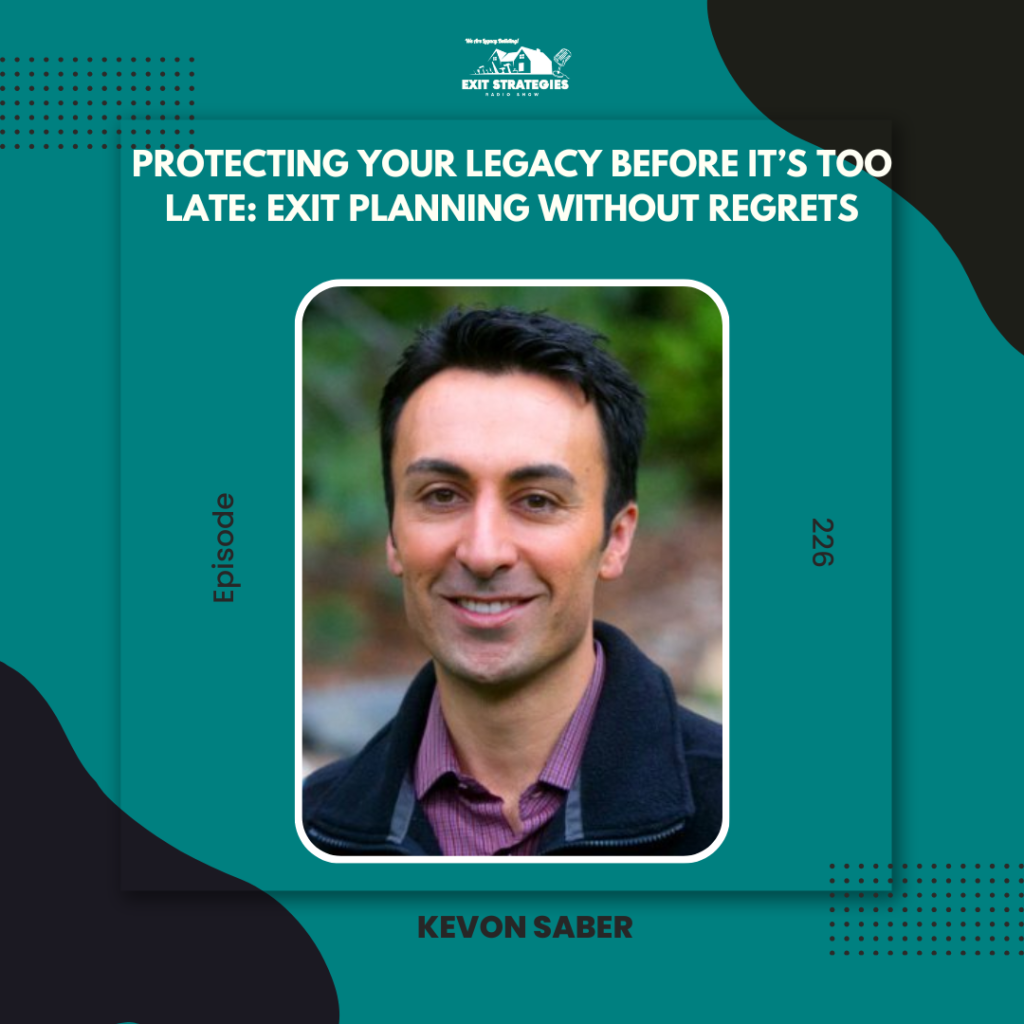


What happens to everything you’ve built if you don’t plan your exit?
Most business owners spend decades perfecting their craft but less than a year planning their exit—a mistake that leads to “seller’s regret” for up to 90% of entrepreneurs.
In this episode Kevon Saber, Co-Founder of Legacy Outcomes, reveals how intentional exit planning — executed early and with purpose — can protect your business, your legacy, and your family’s future.
Kevon reveal why the M&A (Mergers and Acquisitions) market is often rigged against mid-sized owners and how a disciplined, team-based approach can protect your life’s work for generations to come. Rather than reacting at the last minute like most sellers, he breaks down why legacy transitions often fail and how a disciplined, process-driven approach can dramatically improve outcomes.
Key Takeaways:
- 2:30 – Who is Kevon Saber? (From Med-Tech to Legacy Outcomes)
- 6:43 – Defining M&A: Mergers vs. Acquisitions explained.
- 7:29 – Why starting your exit plan late leads to “suffering.”
- 9:34 – The startling stats: Why only 19% of businesses actually close.
- 12:08 – The power of an M&A Team vs. a Solo Broker.
- 14:01 – The Legacy Outcomes Framework: Prepare, Create, Attract, Evaluate, Legacy.
- 18:21 – Handling family dynamics and owner objectives.
- 20:50 – What happens when it goes wrong? (A $24M to $7M cautionary tale).
- 22:51 – Kevon’s closing advice: Life is a buffet table.
Connect with Kevon Saber:
- Website: https://legacyoutcomes.com
- LinkedIn: Kevon Saber
- X (Twitter): @KevonSaber
Connect with Corwyn:
- Contact Number: 843-619-3005
- Linkedin: https://www.linkedin.com/in/cmelette/
Shoutout to our Sponsor: Country Boy Homes
You served your country with pride. Now it’s time someone serves you. At Country Boy Homes, we believe every veteran deserves a safe, beautiful and affordable place to call home.
We proudly offer VA loan friendly, manufactured and modular homes built with integrity, quality and your family and mine. Whether you’re retiring to the peaceful low country or starting fresh with your family, we’re here to build the future you’ve earned. Give us a call today, 843-574-8979.
Country Boy Homes, Built to Honor, Built to Last.
Support this podcast: https://podcasters.spotify.com/pod/show/corwyn-j-melette/support
CORWYN:
Our show is about solutions. We got questions, but we need answers. So today we have the answer to this particular dilemma. So let’s say you spent years building well, either through real estate or your business or combinations thereof. And in that scenario, you don’t want to leave your legacy just a chance, whether you own a single business rental or properties or portfolio businesses, what happens next should not be by, or is oftentimes not by design, it’s by default. And we want to fix that. So today’s episode is all about protecting what you built and ensuring it benefits the next generation on your turn.
Good morning. Great morning guys. Welcome to another fabulous episode of the Exit Strategies Radio Show. Hey, I’m your host. Corwy J Melette, broker and owner of Exit Realty Low Country Group in beautiful North Charleston, South Carolina. Yeah, that’s where we at. We down here in this crock pot. If y’all know what I’m talking about, we down here cooking, but look here guys, we’re off to an amazing start today to a fabulous episode, and I cannot stress to you enough guys, make sure you’re buckled in strap and that you tie yourself down. Cause there’s going to be a lot of great information going by you today. And we want you in a position that you’re able to gravitate, that you’re able to grab on to it and hold on to it because it’s going to be relevant to you and your future endeavors. Guys, we want you in place. We don’t want you to get away. I want you to fly away. We want you to get this information. So for our listeners that listen to it faithfully guys, you know what our mission here is about is to empower our community through financial literacy and real estate education. Shout out to those who listened to us all the way from muddy Mullins, all the way back down to Hollywood, what you know, no good. I’m mom in between there y’all and monkey’s corner and elder and pastor Evans that listened to us faithfully. You guys rock. I really appreciate you. And y’all know that I love you. So look here, I’m going to pose this because our show is about solutions. We got questions, but we need answers. So today we have the answer to this particular dilemma. So let’s say you spent years building well, either through real estate or your business or combinations thereof. And in that scenario, you don’t want to leave your legacy. Just a chance, whether you own a single business rental or properties or portfolio businesses, what happens next should not be by, or is oftentimes not by designers by default. We’re going to fix that. So today’s episode is all about protecting what you built and ensuring it benefits the next generation on your turn. So the answer to that is none other than Kevon Sabre. Now Kevon is like the guy, right? Cause he is a co-founder. That means he was there at the beginning of legacy outcomes. So Kevon, welcome to the show. Corwyn, so glad to be here. Thank you for having me. Well, you’re quite welcome. Quite welcome. Now look here, I’m a big fan advocate of people, you know, telling their own story, their own narrative. I may have my version, but look at your version is best because you know it better than anyone. So if you don’t mind Kevon, give us that high level overview of who you are and what you do.
KEVON:
Absolutely. So Corwyn, I’m 45. When I was about 20, I went through a really powerful spiritual transformation that made me ask a question. The question was, how do I make the biggest possible difference with all of the blessings that I’ve had in this life? And I thought it would be entrepreneurship because as an entrepreneur, I could create, I could influence people, I could generate wealth that I can use to help the least of these, right? I can affect a culture inside of a company. I can make an impact on customers. Solving whatever problem I think needs to be solved, whatever problem I don’t think other people are solving. And so I built and scaled and sometimes sold businesses and it’s 2017. So I guess that’s seven years ago. I had an opportunity to restart a medical technology company that was the first low cost method to catch vision diseases in children. Vision diseases affect one in five kids in the US. It’s the most common disabling condition. And if you’re not seeing well, you’re not learning well. If you’re not learning well, it affects your whole life, including your income, right? And so I did that for five years and it was absolutely motivating, fulfilling to get these calls from moms and dads and doctors saying you saved my kid’s sight, or in some cases you saved his life because eye cancer will spread from the eye to the brain, right? I did that for five years. It was incredibly fulfilling. Like I said, and one thing was really obvious. My health was negatively being affected. My marriage was going the wrong direction and I just wasn’t as close to my kids as I wanted to. So I took a sabbatical and just spent the next six months reading, reflecting, working on those three areas, health, marriage, and my family, my kids. And then I decided, well, I don’t really know yet what I want to do. I haven’t found that next big challenge, that next big hill I want to climb. And so I began just investing, sitting on boards of businesses and nonprofits. I’m on the board still of a glazing company in Southern California called Denali, like the mountain D-E-N-A-L-I. When one of the other board members said, Kevon, I know what you should do with your professional life. There’s a joke that God loves us all, but someone else has a plan for us. My friend said, Hey, I got a plan for you. Why don’t you dedicate your professional career from this point forward to helping business owners exit their businesses without regrets? And as he explained to me how, depending on which study you look at, 70 to 90% of business owners have regrets over how they sold and how most business owners bring assumptions that are not founded on reality and how most representatives, the brokers and other M&A firms out there are not doing the business owners and their legacies justice. And then ultimately how the buyers are pros, 4.7 trillion of private equity in the U.S. is buying businesses. They buy businesses all the time. When someone’s selling their business for the first time, they’re not prepared. They don’t have the same level of expertise. Well, I left money on the table twice when selling my companies. So I recognized that the market was rigged against midsize business owners. When I say midsize, I’m focused on businesses that are in the 20 to 90 million in enterprise value range. But this market being rigged against business owners also applies to smaller businesses. And so after reflecting and realizing how many regrets I had over how I sold my companies, I decided to join this other board member in taking the 30 years of refined process that he had created after borrowing an initial playbook from Goldman Sachs, JP Morgan, Lazard, and adjusting it for the lower middle market and middle market so that ultimately we could protect the legacies of business owners across the U.S. in a much bigger way than he was already doing.
CORWYN:
So Kevon, thank you for that. So I want you to get back to just a basic, but then accelerate this conversation very quickly, because I want you to emanate. Some people know what it is, some people don’t, but if you could define that and then let’s go much quicker, further along to discuss how that plays out in today’s world.
KEVON:
Yeah. So mergers and acquisitions, right, is simply the market of buying and selling companies. Of course, there are family offices that are buying companies, private equity firms, strategic buyers, or corporations that are going to buy a company that has some sort of synergy with their existing business. If the businesses are about equal in size, whether that’s enterprise value or revenue or employees, we’re more likely to call it a merger. Where one company is a lot bigger than the other, we’re typically going to call it an acquisition. So mergers and acquisitions are basically the changing of ownership of at least one, if not multiple companies.
CORWYN:
So why should someone start planning this now? Oftentimes people start a particular endeavor and they don’t think about what they want it to end, what do they want this to look like, et cetera. So why should people start early in that process?
KEVON:
Well, you want to start early because you don’t have time, right, to start late. If you try to do it at the last minute, you end up suffering. Either your valuation suffers, your terms suffer, your sanity suffers, or your team or culture suffer. Usually most of those will suffer if you wait till the last minute. At the end of the day, right, most of the same investments that are going to make your business successful before you sell it. I’m talking about an A-plus management team, very clear and defined responsibilities, documented processes, high margins, repeatable revenue from customers that can’t imagine either living if they’re people or doing business if they’re companies operating without your solution. Those are the same things that a buyer cares about when they’re buying your company, but they’re also the same things that make your business an enjoyable experience for you and your team and ultimately enables your business to grow at the rate you want it to grow. So I’d say the first reason is you don’t have time to do it at the last minute. The second is you’re going to suffer if you don’t start early. And the third is you’re going to have a much better experience that fulfills your reasons for starting the business if you start early.
CORWYN:
Let’s take a short break.
AD:
You served your country with pride. Now it’s time someone serves you. At Country Boy Homes, we believe every veteran deserves a safe, beautiful, and affordable place to call home. We proudly offer VA loan friendly, manufacturing modular homes built with integrity, quality, and your family in mind. Whether you’re retiring to the peaceful low country or starting fresh with your family, we’re here to build the future you’ve earned. Give us a call today, 843-574-8979. Country Boy Homes, built to honor, built to last.
CORWYN:
So you kind of touched on this earlier when you made a statement that the system quote unquote is rigged or potentially, I’ll say potentially, but if you don’t mind, let’s go deeper into that. I mean, do you feel, believe, and what supports that belief if it is or isn’t that it’s rigged against smaller business owners or midsize business owners?
KEVON:
Yeah, I’ll give you a few different angles on that. The first one is the stat I mentioned earlier, depending on which study you look at, 70 to 90% of business owners have regrets over how they sold. And so if the proportion of business owners who are unhappy about how they sold is that high, that tells you there’s something that is not serving them in the market. When you look at every hundred business owners who try to sell, 60 don’t even get an offer, right? 40 will get an offer. And the number is going to vary a little bit if we’re talking about a $15 million enterprise value business versus a $40 million enterprise value business versus a $90 million enterprise value. But I want to average out the numbers just to keep it simple. So for every hundred business owners that don’t sell, 60 don’t get an offer, 40 get an offer, but only 19 of those will actually close. Meaning about half of the signed letters of intent that sellers sign don’t actually materialize into a deal that has cash go in the bank. There’s a lot of reasons for that. We can cover them if you want to. Of those 19 businesses who actually do transact, out of the hundred, depending on which part of the market you’re talking about, one, two, or three will sell at the high end of the valuation. So 19 will sell, some of those at the midpoint, and only one to three of those at the high end. I don’t know about you, but I don’t like leaving money on the table. And when the stats are that bad, I think it’s fair to say that it’s rigged. It ultimately comes down though to those three things I mentioned earlier. Sellers have untested assumptions. Their representation, usually brokers or M&A firms, are bringing knives to gunfights with the buyers. And thirdly, buyers have an incredible set of tactics and maneuvers to outsmart the sellers who are doing this for the first time.
CORWYN:
So thank you for that, because that definitely gave some insight and leads me to probably a few other questions. Because ultimately what I’m seeing is or hearing is that because it wasn’t planned far enough in advance, now at the critical moment of we need to do something, we have a situation scenario which is, well, if you need to do something that desperately, then I’m going to give you this low ball off and they’re kind of stuck or caught with that. Now, you also mentioned in there the difference between, well, you said they’re bringing a knife to a gunfight, which I appreciate that analogy. So question for you, the advantage of bringing someone to the table early. So your company, what you guys do, you operate as a team versus a single person. You guys are a team that has this. So how does that allow your outcomes to differ? And that’s a good play on your company name, Legacy Outcomes. How does that allow the outcomes to differ for those business owners?
KEVON:
Yeah, you nailed it, Corwyn. Let’s talk about that specific example you gave, a single business broker compared to a full M&A team. A solo practitioner is going to be juggling valuation, forecasting, buyer outreach, negotiation, diligence. I don’t know about you, but most football players cannot be a great running back, quarterback, wide receiver, offensive lineman, hunter, et cetera. So when one person tries to do everything, they’re going to have a bunch of blind spots, usually going to have a bunch of cookie cutter documents. And that’s not how you win championships. The buyers are fielding full M&A teams across the deal. So the sellers need a robust M&A team that is going to be a specialist at every position. A transaction architect is like the quarterback and the coach, looking at your objectives as a business owner and then creating the strategy, the plan, and adjusting the playbook to get that championship. Think about, we have buyer experts that are specifically looking at earnings calls, the annual reports, the communications between PE general partners and their limited partner investors, and then finding the small handful of unicorn buyers who will pay the most for your business because it’s a transformational and indispensable part of their strategy. We have valuation specialists that are looking at the strategic, operational, and financial building blocks of your business to see the positioning opportunities that those unicorns, again, can’t imagine operating without. And so specialization sharpens every play, driving the peak outcome that you deserve as a business owner.
CORWYN:
So you guys have built out like this entire platform. That’s the best word I got for right this moment.
KEVON:
That’s very accurate.
CORWYN:
Okay, perfect. So you guys have built out this platform to kind of guide people through. So essentially, oh, we got you on deck and we want to get you across and we want to raise you kind of like Panama Canal, going to kind of raise you and get you the way you need to be. That’s all the material you can use that wherever you want to, Kevon. But this platform that you guys have built, please give our listeners the name of, and let’s talk about when is it right or when is it not right for a particular business?
KEVON:
Absolutely. So I would say our firm, as you know, is Legacy Outcomes. And what is really unique about what we do for these mid-sized businesses is take them through a methodical process to go from, hey, I’m thinking about selling or I have a first offer to sell my business to Legacy, to them being able to lift that championship trophy above their head and say, I have no regrets. This was a perfect capstone to the years or decades or even generations of hard work, the sweat and the tears and the sleepless nights and the stress and the risks they took in building their company to that point. So first we prepare, right? We’re looking at their objectives. We have 15 different objectives. We literally lay out these 15 cards on a table and we say, all right, let’s sort these cards into high, medium and low priority. Because again, that transition architect is going to create the strategy and the plan. They’re going to refine that playbook to meet your objectives. Then we go to the next part of our preparation phase. You used that word earlier, Corwyn, and it’s the perfect word for it. Preparation is looking at the objectives. It’s doing a bulletproof forensic valuation. Again, identifying those building blocks of value that a buyer will care about. We’re recasting the financials so that they’re assembled through the buyer’s lens. If you’ve been purchasing boats and Ferraris and extra real estate through your business, that’s okay, right? There’s nothing that we’re going to say about that, except those are extra expenses that a buyer’s not going to have. We’re going to add those expenses back and therefore your EBIT dollar net income is going to grow, which means your valuation is going to be higher, right? This is all part of our prepare phase. After the prepare phase, we’re going to go to create. That’s where we’re building specific narratives. We’re doing storytelling that are for different buyer types that are the right fit for your business. We’re selling a medical distributor right now and we are creating one story for search funds, one story for private equity buyers and one story for strategic buyers. Each buyer cares about something different, so the storytelling and the financials, the assumptions in those financials are going to be different, right? We want them to look at it and say, wow, this is exactly what we need or wow, we don’t have to do a lot more work because the legacy team already did so much, not, oh my gosh, I don’t see how this is relevant. Delete that email, right? The buyers are going to build their own story if you don’t give them one, so let’s give them a good one. The other thing I say about this is we don’t just present the business, right? We craft what it could be in the hands of the buyer. The next stage is attract. This is where our positioning specialists are taking those building blocks that were already identified that are uniquely positioned for each of the buyers and describing to the buyer in a summary form, this is why you should look deeper at the business. This business that you could buy unlocks massive value for you. I already talked about looking at the annual reports and earnings calls, so that’s where this comes in handy. The next stage is, wow, we have all these offers. So we sold a company recently, we had 36 offers, 23 of them conformed to the original objectives of the seller. We need to evaluate those, all the terms, and then what is the probability that each of these buyers is going to actually close? What is their track record? Do they end up retrading the sellers halfway through the transaction? For example, hey, we’re going to offer you $35 million, but after we got you into a contract where you’re not going to be talking to any of their buyers, we’re going to discount that by 30%. I went through that, Corwyn. It’s painful. That’s why we do diligence to make sure we’re not talking to buyers who have a history of doing that. We also make sure that the buyer’s not pushing unfair liability on the sellers post-closing. When you sign that paperwork and that money hits the bank account, you want to think about, okay, how do I now shift from the financial piece of my business legacy to my family’s legacy, to the generations and generations and generations after me, right? How do I impact the charities that I care most about? Which ones do I want to prioritize? You don’t want to be thinking about liability and having trouble sleeping over that. After the evaluate phase, obviously we are down to a few offers and now we’re driving each of those offers higher. We’re trading them up while pushing the weak ones aside. We’re driving the pace. We’re holding the line. We’re ultimately keeping the buyers competing, like you said earlier, on the terms of the seller. That’s where all the plays, all the planning, all of the work thus far is culminating in a negotiation with multiple buyers that ultimately leads to legacy, which is our last stage. Financially, you feel great about the outcome. You feel great about the custodian or steward of your business that are now taking care of your employees and the career ladders that they have. And you feel great about your reputation because you know that that buyer is not going to do something that’s going to hurt the customers or anybody else.
CORWYN:
So you touched on something in there. So, you know, family, how important is it? I mean, I have an idea, but how would you say important is it for people, business owners to have the family, if you will, engaged in the conversation early?
KEVON:
You know, it really depends on a few factors. The first one is how mature are each of the family members? Okay. We have relatives that are mature and I have relatives that are not mature and I don’t need any clowns in this parade. And so the second question is what role do these family members have in the business? Are they co-owners? Are they employees? Or are they just people who might get a check someday because my wealth is no longer totally locked up or mostly locked up in the business. And now it’s actually in my bank account available for real estate investing or donations or otherwise. And so if you have family members who are owners, let’s say that, let me give you an example. You got a husband and wife who are co-owners. They’ve been building this thing for 30 years. You know what? We’re going to sit them both down in separate rooms and ask them about their objectives. And in all of our key meetings after that, we’re going to have both of them. So it really depends on the situation.
CORWYN:
Okay. That makes perfect sense. And for our listeners, guys, as part of this conversation, Kevon, just so you know, we talk about generations yet to come. We talk a lot about this on the show. And oftentimes when we’re building things, we think we’ll build it as far as we can. Then we’ll leave it for our children for them to build it further. But the reality is, and I’m very open and honest about this. My children told me repeatedly, they don’t want to do this. I got one that might. So we got a little bit longer before. But after that, I got to figure out the way out. I got to have that exit strategy to get out. So short version is for those who may have similar, maybe you don’t know what you’re building. You have that in your mind. This is the conversation to be having. And you want to be having this conversation with Kevon because, hey, this is what he does on a day to day. So how often does it just go completely wrong?
KEVON:
If you take this discipline process, it starts with preparation. It doesn’t go wrong because we mitigate let’s define wrong. First of all, because there’s different kinds of wrong, right? There’s the kind of wrong where the buyer gets one over or multiple ones over on the seller. There’s the kind of wrong where the seller doesn’t really know what their objectives are, and therefore they can’t decide between the various offers. And eventually the buyers will walk, right? There’s a kind of wrong where your competition finds out that you’re selling and they come in and steal your customers, poach your employees, talk to your vendors who end up tightening terms on you. Those are common ways that it goes wrong when you don’t take a discipline process. So with our discipline process, we’ve never had it go wrong. 97% of the companies that we’ve tried to sell, we’ve sold. There are some times where things were out of our control, such as when those kids ended up fighting over the business and dad didn’t have the heart to step in and say, no, y’all can’t handle this. I’m selling. Well, in that case, in that particular case, the business went from $24 million in enterprise value down to $7 million in enterprise value over the next few years. So you can be sure that everybody had regrets in that situation. So yeah, it doesn’t go wrong on the things you can control. If you take the discipline process, we’ve refined this process over 30 years to mitigate the different risks. Now, if you don’t take a discipline process, depending on how large your business is, you have a 70 to 90% probability things are going to go wrong because your assumptions are not validated and those buyers are fierce.
CORWYN:
That’s interesting. And I literally had the vision of how the disputes, because we see that in other areas in real estate where the inner family dispute ruins a situation or what have you. Kevon, I want to take this as an opportunity here. Where can people reach you? Where can people find out more about your company? Where can people connect to ask questions and those who are so inclined with it, can they connect with you so you can help?
KEVON:
Thank you so much, Corwyn. legacyoutcomes.com is our website. There they can find various field notes on everything we’ve talked about today. What are the different seller objectives? What are those deadly seller assumptions? What is the path to regrets actually look like? How do I avoid that? What is the seller’s power path? How do I think about M&A team selection, like an individual broker versus a whole M&A team? So we have a field note on all those topics and many more. I’m also on Twitter at Kevon Saber and on LinkedIn at Kevon Saber as well. K-E-V-O-N, like Kevin with a note. Saber, like Sabercat.
CORWYN:
I love it. So for our listeners, guys, look, our question really for today was what do I want to be remembered for and how do I protect that now? And Kevonsaber, Legacy Outcomes, their solution, their answer to that question. So Kevon, in closing, what advice do you have for all of our listeners today?
KEVON:
Do you want me to stick to M&A or do you want me to go broader than that? Go broader than that. All right. So what I’d say is that we all have one life to live. We only get to trade our hours for something, right? Life is sort of like a buffet table. Our stomach can only fit so much. And so I would just say be intentional. What do you really want? And go after that.
CORWYN:
Wow. I like that. That’s profound. So Kevon, thank you so much for being on the show with us today. I appreciate you taking time out of your business schedule to be a part of the Exit Strategies Radio Show family. Really appreciate it.
KEVON:
Thanks for having me. And thanks for all the ways that you support entrepreneurs and investors across the country.
CORWYN:
Well, thank you. So for our listeners, guys, look, y’all know what it is. Y’all know how I feel. Y’all know what I say. You know, I put the two of those things together and I give it to you this way, which is to tell you that I love you. I love you. I love you. And we’re going to see you guys out there in those streets.