

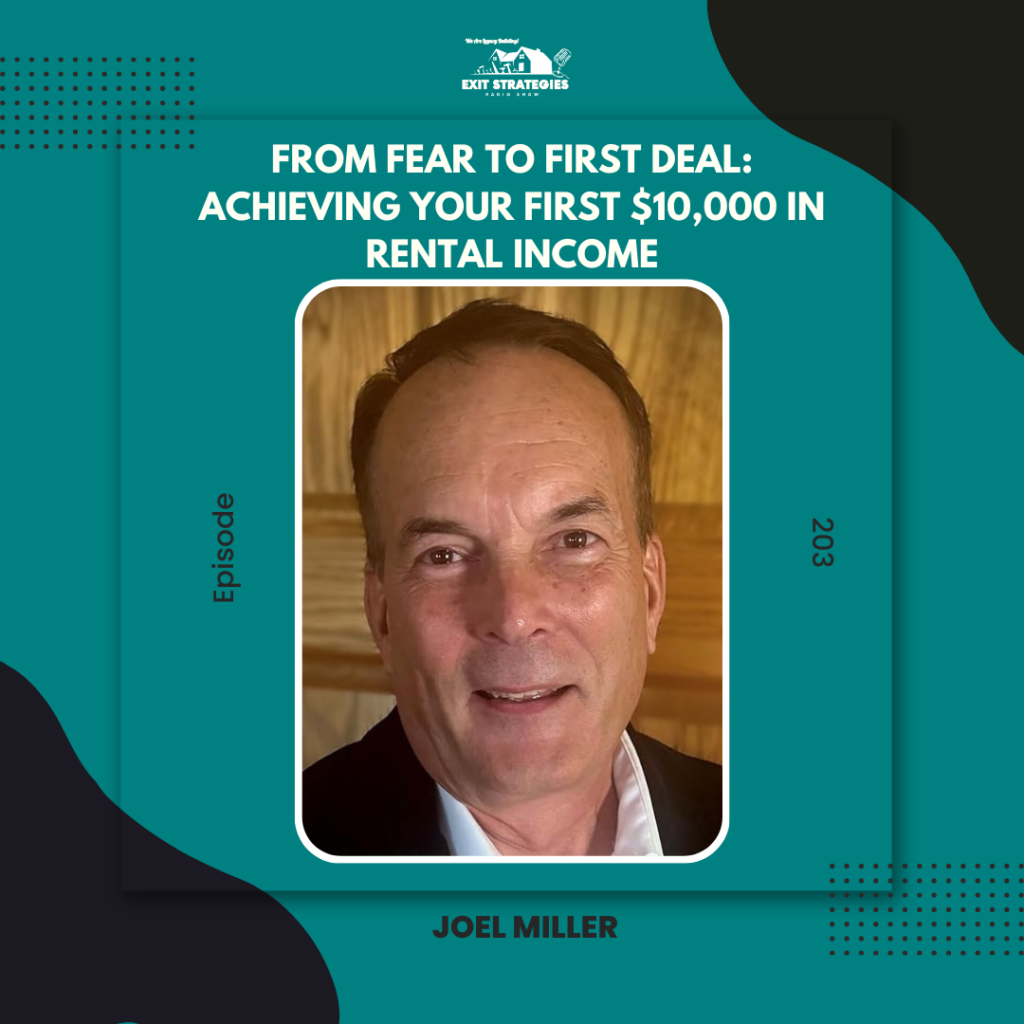


Practical, no-fluff steps to turn fear into cashflow — Joel Miller breaks down the mindset, financing moves, and repeatable strategies that helped him build a lifetime in rental real estate (and write a 460-page how-to).
Returning guest, Joel Miller is a 48-year residential landlord, veteran house flipper with over 100 flips, hard-money lender, longtime leader in his local landlord association, and author of Build Real Estate Wealth: Enjoy the Journey — a comprehensive 460-page guide written for both beginners and experienced rental property investors is back to help you break through those mental barriers and start building a legacy.
With nearly five decades of experience, over 100 house flips, and a thriving rental portfolio, Joel has seen it all — and now he’s sharing practical advice for beginners and seasoned investors alike. From the importance of education and networking to overcoming fear with action, Joel’s insights will inspire you to stop waiting and start creating your own wealth path.
Hear Joel’s personal legacy story — how he inspired his teenage son to invest in rental property right out of high school, proving that it’s never too early to start building generational wealth.
Key takeaways:
- 04:17 Joel’s background: 48 years as a landlord, 100+ flips, now a hard-money lender and long-time landlord association leader.
- 05:56 Book spotlight: Build Real Estate Wealth — Enjoy the Journey — 460 pages, designed as a go-to resource; already receiving strong praise.
- 09:42 First step for beginners: join a local real estate/investor/landlord group — networking + ongoing education dissolves fear.
- 12:01 Real estate lets you control value and cashflow in ways stocks can’t (improvements, rents, property management).
- 13:44 Education + action + commitment = results. You can’t just learn — you must follow through.
- 15:59 Legacy example: Joel’s son bought multiple rental units right after high school (owner-financing and DSCR loans were used).
- 18:55 Landlord 101 course (4 sections): preparing property, advertising, property management vs tenant management, and eviction/PA law specifics.
- 19:44 Joel’s book covers the broader journey — mindset, entity setup, deal finding, negotiation, and financing — and can be used as a textbook for investor courses.
- 22:34 Zero → $10,000/month net cashflow (chapter highlight): practical tactics — target 2–4 unit owner-occupied purchases (FHA/VA), seller finance, or use DSCR loans so other tenants’ rents cover your mortgage.
- 25:16 Nugget: “Education removes fear. The lack of fear creates confidence.” (Then: confidence reduces discouragement — sometimes you win, sometimes you learn.)
- 25:56 Book & contact info: JoelMillerBooks.com (detailed TOC + sample content available). Book sold on Amazon and ~15 other platforms; Joel is on Facebook, LinkedIn, X, Instagram.
- 28:05 Memorable line: “Don’t take advice from anybody you wouldn’t want to trade places with.”
📖 Grab Joel’s book & free resources: Amazon: https://www.amazon.com/Build-Real-Estate-Wealth-Investment/dp/B0DG48NHPC
Connect with Joel:
- Website: https://www.joelmillerbooks.com/
Connect with Corwyn:
- Contact Number: 843-619-3005
- Linkedin: https://www.linkedin.com/in/cmelette/
Shoutout to our Sponsor: Mellifund Capital, LLC
Need funding for your next real estate flip or build? MelliFund Capital makes it fast, flexible, and investor-friendly. Visit MelliFundCapital.com and fund your future today. Again, that’s MelliFundCapital.com, M-E-L-L-I-L-U-N-D, Capital.com.
Support this podcast: https://podcasters.spotify.com/pod/show/corwyn-j-melette/support
JOEL:
Work needed on a property can be performed by others. You don’t have to know how to do everything. You just have to know who to call. You don’t have to do it. You said you got to know how to get it done. And that leads into the next thing here. I talk about knowing, you know, you don’t have to know how to do stuff, but here’s the thing you need to get some education before you get started. Now you were talking about what to do when you’re trying to get started. And I’m going to say, get some education. A lot of people get caught up in the whole, I need to know everything before I take one step kind of thing, the paralysis of analysis. You got to understand that you just need to take a step. Once you take that step, then it puts you in different situations and around other people. And then you start learning the things you need to know to go further and further.
CORWYN:
Good morning. Good morning. A great morning, guys. Welcome to another fabulous episode of Exit Strategies Radio Show. Hey, you know who I am. I’m your host, Corwyn J. Melette, broker and owner of Exit Lowcountry Group and beautiful, beautiful North Charleston, South Carolina. Hey, this is your first time listening to this show. You sir or ma’am are in for a treat because our mission here is very simple. That is to empower our community through financial literacy and real estate education, guys. Legacy building. That is what we do right on this show. Got to give a shout out to those who listen to us faithfully. I’m extremely humbled at all times when I hear someone say, hey, I tuned in. I listen. The content has been great, et cetera. So again, I got to give a shout out. I got to give a shout out to Shanice, who fairly recently said, Hey, I listen to you every Saturday morning. I’m like, what? You do what? So thank you so much, Shanice and your family for tuning in. How folks in muddy Mullins, Marion County. That’s how we get it out the mud. That’s how we do. We build up from the ground up. I appreciate you and I love you. People out there amongst corner. My mama live out there. Y’all, y’all know it all the way back, all the way over to the coast to Hollywood. What you know, no good. Thank you all so much for doing what y’all do. And got to give a shout out to some of my favorite people. Elder Pastor Evans, senior. He’s senior. If I put that senior on, that dude will jack me up. Now he will snatch me up. So thank you guys for tuning in. So guys, look, we got a good show today. So our guest today we had with us previously some time ago and they essentially cracked the door open, you know, salesperson or somebody to come over, they used to sell this thing on TV that the person, they kind of, the person opened the door a little bit and the salesperson was taking a foot in the door so you couldn’t close the door. Well, he cracked the door and I ain’t saying we trying to close it, but he got his foot in the door into what today I’m looking forward to is amazing conversation about overcoming some of those fears, some of those, if you will, objections, some of those things that hinder us. So we have with us an author. He wrote a book guys, build real estate. Well, by Joel Miller. So Joel is here with us today and we’re going to get a little bit deeper into some of those things that may be hindering and holding some of us, if you will, back. So Joel, I want to welcome you to the show. How are you doing today?
JOEL:
Oh man, Corwyn. I’ve been looking forward to this. I’m doing great up here. I’m sure it’s not as warm in Erie, Pennsylvania, where I’m at, as it is in beautiful South Carolina.
CORWYN:
You know, look, you know, look here, the soup kitchen is open now. Cause look here, it is high temperatures and humidity. I tell people it’s like being on a crock pot. Imagine what your chicken, your beef or your pork go through. So Joel, thank you for taking some time out to come back on with us. We had a great time. Last time you were on for those who want to go back and look for that episode. That’s episode 190. The title of it is tenant selection secrets. Every real estate investor must know. So guys, please go back and take a look at that as we kind of continue this conversation today. So Joel, look, I want you to give our folks a recap who you are, what you do. Let’s hit them high and let’s bring them on down to the ground.
JOEL:
Okay. Thanks Corwyn. Well, I’m in Erie, Pennsylvania, halfway between Cleveland and Buffalo, north of Pittsburgh. I am here because I have had a, well, I’m in my 48th year as a landlord, primarily residential landlord. And about 1991, got into flipping houses before flip was a real estate term. When they start saying it on TV, we just call it quick turn. And I flipped over a hundred houses. And then about 2018 got into hard money lending, which has kind of moved into the main thing that I do at this point. I’m just real, real pleased to be a part of the equation for other investors that are earlier on in their journey. You know, I lend to investors just in our area here for flipping projects, or if they are buying and rehabbing, for example, a keeper rental property that they need to stabilize in order to get permanent financing on it from a bank. But I’ve been heavily involved with the professional organization of landlords in this part of the state for, since late 70s, early 80s, when it was created, I eventually got on the board. I’m our second longest serving past president. I was six years president and I’m still vice president because everybody keeps asking me to stay on as the vice president. And along that way, I started teaching our landlord 101 class to not only beginning our investors, but investors that have been in a while that just want to brush up and hear class taught by somebody that’s different from the last time they took it, for example. Then in COVID time, I started making notes about a possible book to write. And four years later, last fall, that book came out, it’s become a bestseller already. It’s called Build Real Estate Wealth, Enjoy the Journey, a rental property investment. And it’s a little different for most of the books that you might find in that genre, which are normally like two, 300 pages long and talk about simply acquiring property and managing property and the math involved with rentals and all that. So this is a 460 pages, Corwyn. It’s a big book. In fact, we got that. We decided to own it. They said, Hey, Joel, that’s too big of a book for this thing. Well, I just couldn’t take anything else. So we just owned it. We just write on the front. It says the big book on rental property investing, and it’s really becoming the go-to resource for people that want to change their lives with rental property investing, which I believe your audience is trying to do. In many cases, they might have landed on this whole real estate thing and they just need to know a little bit more about how to do it. Ron Legrand, I think you probably know who that is. He’s kind of the guru to the gurus, the real estate guru. And he reviewed the book and Ron’s older. I mean, he’s like in his mid to late seventies now. No, but he reviewed the book. He says, I wish I would have had his book when I was getting started. So we’ll go with that. But it’s a book. The reviewers say this, they say, it’s not a book you just read and say, Hey, that was great, put it on your shelf and maybe never look at it. It’s a book you read and you park on your desk. You’re doing, or this is your book to get for referrals. It’s written for the established investor, but it’s also written for people that are just getting started and want to change their life.
AD:
Let’s take a short break.
You found a perfect property. You’ve got the vision. Now you need the capital. At Mellifund Capital, we specialize in funding real estate deals for investors who want to build, flip, or hold, and don’t have the time to chase after banks. Whether it’s new construction, a fix and flip, or long-term rental, we offer simple terms, fast approvals, and access to private capital. We even work with manufactured housing projects because we know what it takes to build value from the ground up. You bring the deal. We bring the money. Visit mellifundcapital.com or call 843-619-7038 to get pre-qualified today. Mellifund Capital, we fund what you build.
CORWYN:
So Joel, I’m going to jump in here because for our audience guys, you can go to Amazon, you can Google and find it easily. And it does say right across the top, the header, but down there is that the subtitle, if you will, is enjoy the journey of rental property investment, which is huge. So I want to kind of take this as kind of the opportunity to introduce. So some of our listeners obviously are folks that invest, whether they do flips, whether they do buy and hold, they have maybe a small portfolio or even a larger portfolio of properties. But there’s also a fair amount of people who are sitting here and saying, I just want to get started and I am scared to death. So Joel, what is your, I’m going to frame it in the context of advice, but the reality sometimes is not necessarily as much advice as much as it is encouragement. So what is your advice and or encouragement that you have for someone who is like sitting on gold, like they have passed gold, they got a $200, but then they stopped at the next square?
JOEL:
Well, the biggest advice that I have, the overarching advice, no matter where you are in the country is find your area, real estate investors group, whoever is thinking to what you’re trying to do, be it a landlording group, an investor’s group or whatever. We have the apartment association, Northwestern PA, that was the organization I was telling you that I’m involved with. They are all over the country and that is where you’re going to be able to network with other people that have done or are trying to do the very same thing that you’re doing or you want to start doing. And hopefully that organization is having meetings where you can network with these people and ask questions and get education, which leads me to the second part of that answer. And that is education. As you mentioned the word fear, afraid to start, what takes away fear? Knowledge, education. And that is part of the premise of the book. In fact, I kind of have a couple of points here just to answer your question. The premise of the book is that you can add real estate to your life, even though you might want to hold on to something that you have a passion for, like another career or a job you really love, but you know that maybe it’s not going to provide you any retirement. So you got to do something about that. And you’ve figured out that rental property can not only provide you some income along the way, but also bolster your retirement. It doesn’t have to be an all or nothing, either or thing. I had another career as a professional mobile disc jockey. I think we talked about that the last time, which I pioneered the mobile DJ business in this part of the country. And I did that for 35 years, 5,051 appearances. And I retired from that in 2011. But my whole real estate rental thing was parallel to that all that time. And it kept going, you know, after I retired from DJing, I continued to expand on the rental property stuff. But having said that, here’s the further answer to your question. You need to clear your mind of overly negative and overly positive preconceptions about the rental property business. It’s not all bad tenants and broken toilets, and it’s not a get rich quick thing. You got to be in the middle and not having those two extremes of preconceptions. Education is how to bring you back to the center. So the other point I want to make is you can control the value and cashflow from rental properties to a much greater degree than with stocks or any investment bought on an exchange, because that’s what a lot of people gravitate to when they have extra money, they are involved with some other job or something that they figure, well, it has to go into stocks. I just need to, that’s what I have to do. But I don’t know, you can’t do anything yourself to affect the value of even one share of stock that you buy the same way that you can affect the value of a piece of real estate that you own by making improvements, increasing rents, all sorts of things like that. Another point, rental income is residual and not related to you performing a specific task. They got to send you the rent every month, whether you’re sick in bed or you’re out doing something at the property, it doesn’t matter. They still owe you the rent. And you say, well, Hey, he just mentioned working on the property. Well, that’s the next thing. Work needed on a property can be performed by others. You don’t have to know how to do everything. You just have to know who to call. You don’t have to do it. You gotta know how to get it done. And that leads into the next thing here. I talk about knowing, you know, you don’t have to know how to do stuff, but here’s the thing you need to get some education before you get started. Now you were talking about what to do when you’re trying to get started. And I’m going to say, get some education. A lot of people get caught up in the whole, I need to know everything before I take one step kind of thing. The paralysis of analysis. You got to understand that you just need to take a step. Once you take that step, then it puts you in different situations and around other people. And then you start learning the things you need to know to go further and further. So you don’t need to know it all before you get started. And here’s the thing though, no matter how much education you get, it takes action to see results and beyond action, it takes commitment. I mean, you can get a little education and take some action, but if you don’t commit to following things through, well, then you’re really not all that much further down the road. You have to come in and get it done. So those are the mindsets for somebody to take in whenever they’re getting started, because you had asked about it.
CORWYN:
Thank you for that, by the way. And let me come back in because sometimes I tell people, I said, I hear things, you know, at times, and when you were talking about being a DJ and how much you travel in my head, I heard a Lil Wayne song, Go DJ, because you was everywhere, 5,000 and some odd gigs, man. That’s a lot of DJing, man. So kudos to you for holding it down and keeping the party going. But you know, that whole fear and analysis paralysis, if you will, is very real. Now you have a son, if I recall correctly. That got into, or essentially is following in your footsteps. And if you don’t mind, give us an introduction, if you will, on his journey. Where is he at now currently in his process of reaching his goals?
JOEL:
He’s doing great. When I mentioned that right around the time of COVID, I started making notes about the book. That was because he was in his early teens at that point. He’s 19 right now, and it was becoming apparent that he did want to follow somehow, some way in this whole rental property thing. So Corwyn, I got to tell you, I got inspired to write this book as though my son, and he’s my only kid, my wife and I, she’s a little younger than me. And we were married six or seven years before we finally were lucky enough to get him to come along. I wrote it as though he was going to be the only person reading. If that was all that happened, that was going to be okay. So there’s nothing in that book that I haven’t done or that I wouldn’t do if the opportunity arose. And I did not write it for somebody that’s an audience that I would never meet, that was just faceless and who would never hold me accountable. The person who holds me accountable for what’s in that book lives down the hall and I have to get it right. So that’s what’s in that book. And he has started on his journey. He graduated from high school last year, 2024. He bought his first rental property about a week after high school. Closed on a few weeks later, three units, fully occupied, owner financing, didn’t even help him on that. And I’m happy to tell you that since you and I talked the last time, he closed on a second property a few weeks ago, two units also fully occupied. This time he got a DSCR loan. It’s a type of loan and he’s a college student. He got that loan. He doesn’t even have any income. Those loans are based on the income from the property that you’re getting the mortgage on. And of course, I want to see that he had some reserve cash and had some experience and so on. And he’s also taken the landlord one-on-one class with me and the guy that wrote the bonus chapter on the book, real estate, Steve ZumaGale. We were the two teachers for that. He took that last month. And that you talk about legacy wealth or having a legacy. That’s my legacy now to him is the book. And then he’s my legacy for my family. And that’s, I think what a lot of your, your viewers, listeners are wanting to create is some sort of legacy wealth. You know, they don’t want to just make a lot of money and spend it all and die broke. I mean, some people have that as a philosophy, guys, you can’t take it with you, but some people want to change the position that their family might have had in their lives for generations. They want to raise up, they want to have some generational wealth. And I can tell you that, I don’t know what you could say to me, but tell me that investing in income property is not the best way to do that.
CORWYN:
So you’ve referenced a couple of times, Joel, real estate one-on-one course. And when we think one-on-one, we think fundamentals. We think basic, we think root of the matter. If you’re going to do anything in advance, you got to start from the beginning. So this real estate one-on-one course, what does that look like? And I don’t think you may mention, but is that an offering or something that’s available to folks, a lot of people look, we got to, as we joke from where I’m from, my hometown, we got to get out the mud, we got to get it from the bottom, but we’re going to build it up. So is that how they have to figure it out? So tell us about that. What does that look like?
JOEL:
Well, we’re lucky enough that one of the founding members of our organization back in the late seventies, who is still on our board, it’s an emeritus board member, John Baldwin is his name. He’s like about fifth generation of one of the largest developers in our area. And in fact, in the country, and he, yet, even though that’s the case with his family, and there’s many people in his family, now they’re involved in that business, about 10 years ago, while he’s still active on the board, he authored this landlord one-on-one class is what it’s called. It’s actually proprietary just to our organization. We’ve never licensed it out or it’s not available any place other than if you’re a member of our organization, you happen to take the class, but I’ll come back to that. So to answer your question, the course is in four sections and it takes you from after you’ve acquired property. It’s not at all about acquiring property. It is how to deal with property after you have it. It takes you through preparing a property for rent, advertising the property, managing the property and managing the tenants, property management and tenant management are actually two different things. They go hand in hand, but they’re different skill sets. And then ultimately the last part of it is where you are either renewing police or maybe evicting somebody and it takes you through Pennsylvania eviction law, that sort of thing. So it’s very specific to Pennsylvania with what’s talked about in there. Now, having said that, that class is a part of the inspiration for my book. It is essentially the middle part of my book because the book starts with mindset and takes you through even entity organization and then finding, negotiating and financing a deal. The landlord 101 class doesn’t do any of that stuff. Preparing the property to sell or rent, finding your tenants, the tax implications of owning and operating rental property, preparing financial statements for the bank, which is so key. I’ve spent so much time on that. I got all kinds of tricks in there. I wouldn’t call them tricks, strategies. That make you look good to the bank first time you see the banker. Because at some point, you know, not everything’s going to be owner finance for you or seller finance, you’re going to have to go to the bank sometimes for properties as you get bigger. So it’s got a lot in there about preparing financial statements. Then understanding, it goes into philosophical things like understanding the difference between riches and wealth. Some good best practices for not only operating rental property, but actually your life and any kind of business that you’re in. So what I want to say was like, I’m trying to figure out a way to encourage the investor groups, like I am referring to that I’m a member of here, to use my book as a basis for them to create their own courses, like landlord 101 courses. Because it’s all in there. It’s more than just landlord 101. You could go beyond that. Like we have a 201 class. So I teach part of that where it’s coming up in a few weeks. So that would be my encouragement is to, as an individual, get my book. But if you’re involved with any of these organizations, encourage them to consider using the book to, as a textbook for your own class, because that’s the key is getting the education. So you don’t get caught up in the paralysis of analysis, like flitting from here to there to that seminar. Oh, I just need one more bootcamp and all that. And then I’m going to be taking a step and getting rich.
CORWYN:
Exactly. Exactly. So, Joel, let me ask you this one and we’re getting pretty close to our time for today. But let’s talk about, we’ve really kind of hovered around that beginning, those things, just the initial step and getting people over the hump of fear. But when this thing is right, so when you get it right, you get in and starting to get my bearings. What strategies do you suggest that people employ to get them to one of the first milestones? Obviously for the very first milestone is, Hey, I just want to be making some cashflow. But one of those special milestones is when you get to that first $10,000 a month in net cashflow. So what strategies do you suggest, give, share, encourage people to pursue to help them to get to that, that magical number, getting from zero to 10,000. Some people say zero to a hundred, but no, we’re trying to get zero to 10,000. So give us that.
JOEL:
You’re referring to the chapter in the book called Zero to $10,000 in net cash flow for a month. I love it. Thanks for the lead in that chapter starts with a guy making $40,000. It’s like a fictitious investor. Okay. He’s making $40,000 and he’s a tenant. So one of the first best steps that you can take, first of all, you have to get your mind straight. You know that you’re going to do this. You’re going to commit, you’re going to follow through and you’re going to discipline yourself to be able to continually put aside money that you’re going to use for investment. Yeah. There’s such things as no money down deals. I get that, but that takes some skill that you need to learn and some marketing to find those sorts of deals. So hopefully you can get your foot in the door with some sort of a seller finance deal where you are able to put a low amount of money down and have a reasonable interest rate, like right now going interest rate for that sort of stuff is 6%, maybe 5% down and you’re paying the seller, the sellers to bank. But to expand on that more specifically, I’m not talking about getting a single family home for you to live in or to rent out. I’m talking about getting a place that has anywhere from two to four units, but you are going to occupy one of those units. And since you’re going to occupy it though, you actually have the availability to get an FHA loan, which I think is three and a half percent down. I think is the going thing right now. And you have to live, I think it’s only a year in one of those units, and still rent out the other three. And then you can move on and do it again. You just can’t have more than one FHA mortgage at a time. So, you know, you would have to, let’s say you’ve moved in one unit of a four unit, you’d have to be there a year or so and then refinance that into some sort of a different type of mortgage. Now you can go get another FHA mortgage on a different place that you’re also going to live. So the seller finance things and the FHA type loans, and of course, I shouldn’t leave out VA loans, same idea, but that could be 0% down. The point is to get into a place that you’ve got income coming from other people that live in the other units on the same property, so that you’re almost there for nothing. There’s enough rent coming in to cover your mortgage payment and maybe more. Certainly that would be the case if you had one year living at four units. I would hope that there’s enough money coming in from the other three rents to pay almost everything for you. Even your maintenance taxes and insurance, not to mention your mortgage. But you mentioned fear. I guess I’m here. Education removes fear. The lack of fear creates confidence. Confidence minimizes discouragement from setbacks. Not feeling discouraged means regrets are quickly forgotten, and sometimes you win, sometimes you learn. So either way, you’re further ahead, having learned one more thing, not to fear.
CORWYN:
That’s huge. That’s huge. So Joel, how can people get in contact with you? How can people reach you, get connected, get the book? Where can they get you at?
JOEL:
Well, you can find Joel Miller or Joel Miller Books on Facebook, LinkedIn, X, Instagram. But mostly I would direct you to the website that is created for the book, which is JoelMillerBooks.com. And on the homepage there, you can see there’s a button you can click on. You can see the entire detailed table of contents. So you know what we’re covering there. Another button will show you some sample content, two or three paragraphs of the best stuff from each of the 16 chapters. And if you really want to contact me, you can also do that through the website on the contact button, type in a message, hit send, comes through the same email that you and I communicate on. But of course there’s several buy buttons on there. And if you click on the buy button, it takes you right to the Amazon page where it’s for sale. We don’t sell the book from the website. You just can do that through Amazon or about 15 other platforms. It’s an ebook or a paperback. And I would add one thing. Some people might say, oh man, I don’t want to read a 460 page book. I wrote it for you. I did it with you in mind. Here’s what I did. I put in a whole bunch of bold type words, sentences, paragraphs, and so on. So that if you did nothing besides skip from one bold type to bold type to all the way through the book, you’d get the whole idea. And if you found something and said, well, I need to know more about that. Just stop and read all the work.
CORWYN:
So it’s an easy read. Good deal. Good deal. Well, Joel, I want to thank you again for coming on and giving us those nuggets today. I know that it encouraged someone. I’m going to be blunt and frank about it. Every time I get an opportunity to talk with someone, quote unquote, speak in my language, I pay attention to what they saying. So with that being said, I literally have gleaned some new ideas from our conversation today. So I cannot wait to implement those and work to put that into play. you use a joke. I told you the last time we talked. Give me the joke again. I don’t think I did.
JOEL:
The landlord that was seeing a psychiatrist, a clinical psychologist and a licensed counselor for a personality disorder, he had an apartment complex, that’s a good one.
CORWYN:
I love it. I love it. No, I haven’t. I’ll have to keep that. We have to re air that for sure.
JOEL:
I got one more nugget for you. Go ahead. Don’t take advice from anybody you wouldn’t want to trade places with. That’s huge. I know that some of your listeners right now are thinking, yeah, I want to do this. My family is going to put me down for trying. They’re going to tell me I can’t do it. Don’t take advice from anybody you wouldn’t want to trade places with. If you don’t want to make an improvement for yourself, then just keep listening to the same old advice. But if you want to do something better and new for yourself, start listening to the people that have been where you want to go.
CORWYN:
That’s huge. Joel, I thank you for that. So thank you so much for being on with us today, Joel. I really appreciate it from the bottom of my heart, man. Thank you. I’m taking time out to be on the show and a part of the Exit Strategies Radio Show. So family for our listeners, guys, look, y’all know, and I’m going to give it to you just as plain as I can, which is to tell you guys, to tell you that we have an opportunity here for greater because greater is within us and greater is he who is us, who is a part of us. So guys, please make sure that you take this information today. Don’t let it fall. As old folks would say on deaf ears that you take it, that you grab it, that you apply it, and most importantly, that you share it because there’s somebody else who can utilize this and what they endeavor to be and endeavor to do so they can change the trajectory of their family and the outcome of their family for generations and generations yet to come. Guys, I know how I feel. You know how I say, I always put the two of those things together and I give it to you this way, which is to tell you that I love you. I love you. And we want to see you guys out there in those streets.