


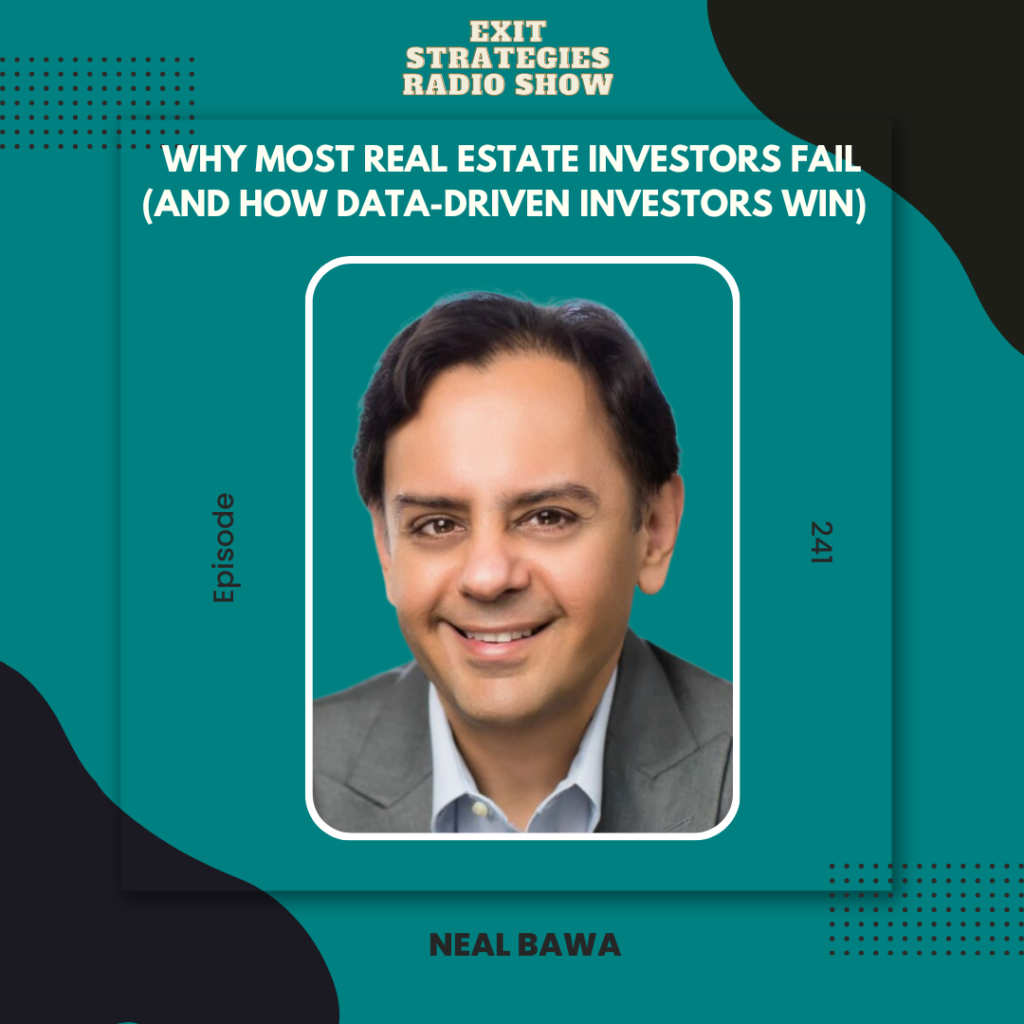


If you’re investing in real estate based on location, opinion, or “what feels right”…
you might be making one of the biggest mistakes investors make.
Neal Bawa, widely known as the “Mad Scientist of Multifamily,” challenge one of the biggest misconceptions in real estate investing:
👉 That using spreadsheets or investing locally means you’re “data-driven.”
It doesn’t.
Neal breaks down how most investors are relying on assumptions instead of actual data—and how that mistake can cost them long-term wealth.
More importantly, he introduces a clear, repeatable framework to identify the best markets in the U.S. using real metrics—not opinions.
This episode goes beyond strategy. It reshapes how you think about investing, opportunity, and how wealth is actually built.
Key Takeaway:
03:20 – “The geek inherits the earth” mindset
07:05 – Why most investors aren’t data-driven
08:53 – The myth of local investing
11:40 – The 5 key metrics that matter most
16:40 – Why top cities aren’t always the best investments
21:33 – You don’t need money to invest
22:47 – How investors actually attract capital
27:30 – Building legacy through data-driven decisions
Legacy Takeaway:
Real estate isn’t about guessing. It’s about understanding the data, making intentional decisions, and building something that lasts.
Connect with Neal:
- Email: info@grocapitus.com
- Website: https://grocapitus.com/
- Contact Number: +1 415-326-8878
- Facebook: https://www.facebook.com/navraj.bawa
Connect with Corwyn:
- Contact Number: 843-619-3005
- Linkedin: https://www.linkedin.com/in/cmelette/
Shoutout to our Sponsor: Mellifund Capital, LLC
Need funding for your next real estate flip or build? MelliFund Capital makes it fast, flexible, and investor-friendly. Visit MelliFundCapital.com and fund your future today. Again, that’s MelliFundCapital.com, M-E-L-L-I-L-U-N-D, Capital.com.
Support this podcast: https://podcasters.spotify.com/pod/show/corwyn-j-melette/support
NEAL:
The first thing that you should do is forget this blocker. The first thing is I need money to invest in real estate. No, you don’t. You need to learn to invest in real estate. And when that learning occurs, the money appears.
CORWYN:
Good morning. Good morning. Great morning, guys. Welcome to another fabulous episode of Exit Strategies Radio Show. Hey, I’m your host, Corwyn J Melette, broker and owner of Exit Realty Low Country Group in beautiful North Charleston, South Carolina. Hey, if this is your first time listening to this show, you sir or ma’am are in for a treat because our mission is very simple, is to empower our community through financial literacy and real estate education. Some of y’all out there, that’s the first time you heard it. Hey, look, that’s what we do around here. We legacy build. So I always tell you, put a hashtag on it, tell folks what you’re doing. Legacy building. That’s what we’re doing. Hey, got to give a shout out to those who listen faithfully. Pastor Vanderbilt Evans, Sr. Love that guy. And I always had to put that senior on his name, but if I don’t, he going to jack me up in his beautiful pride. Sandy Evans, thank you guys for listening. McKellar’s Liqueus, you guys listen faithfully. For y’all out there in monkey’s corner, y’all know my mama live out there, y’all. So got to give a shout out to y’all. And back to Hollywood, what you know no good. And then obviously my folks and Mary Mullins, the PD. Well, thank you guys for tuning in. We got a great show set for you today. So, you know, every now and again, you got to get into the lab, right? You got to get into, and you got to put things together. You got to make things happen. And today we have none other than not self-professed. He didn’t say this about himself. The people around him say this, they call him the mad scientist of multifamily. I love it. I was intrigued from the start. So as we take this to the lab today, guys, I want to make sure I introduce to you none other than Mr. Neal Bawa. Now, Neal is the CEO and founder of Grow Capitalist. Now look here, when I saw the name, I said, wait a minute, that’s Grow Capital right there. We going to grow some money. So I was all excited to begin with, and also mission 10K. He’s managing a portfolio guys of over 4,400 units valued at over $660 million and is serving more than a thousand investors. So that means he’s serious. That means he knows what he’s doing. He’s a highly data driven real estate leader using advanced analytics to identify and develop commercial properties nationwide. So again, he is an expert in the field. He’s educated over 10,000 investors through his real estate data analytics course, and is a respected speaker at major industry events and conferences guys. So look, I don’t want to steal no thunder from him. I don’t because look here, we could lay this on his stick and we can take this out. But end of the day, we got the guy here. So I want y’all to make sure I grab a pen and pencil, whatever it is you can write, jot, make notes on and pay attention. Neal, I want to welcome you to the show. How are you doing today?
NEAL:
Thank you. Thank you. You’re doing well. And thanks for having me on the show, Corwyn. Thanks for that delightful intro. My friends call me the Mad Scientist of Multifamily because I believe that data is the differentiator between those that succeed today and those that don’t. And Corwyn, I’ve only come up with one original saying in my time, but I think it’s a good one to start the show with. And the saying is that the Bible got it wrong by one letter. Oh, the Bible got it wrong by one letter because it is not the meek that shall inherit the earth. It’s the geek. It’s the geek. I love it. Right. Richest man in the world. Geek. Second richest geek. Third richest geek. Do you see a pattern there, Corwyn? Do you see a pattern?
CORWYN:
I love it. That’s funny. That’s good stuff right there. So Neal, look, this is your space. This is your arena. We’ll define this as being a Spartacus day for real. And this is your arena. This is what you do. So tell our folks high level what it is that you do and let’s get into it today.
NEAL:
Yeah. So I am a recovering technologist, a computer science degree. Data science is my background. I ran a technology company from 1999 to 2014. So not a startup. Hundreds of employees sold it to a Chicago-based private equity firm. And while I was doing that, I lived in California, big fat tax salary, big fat tax check. And so for a decade from 2003 to 2014, I was basically doing real estate just to reduce my own taxes. No investors, no third parties. Most of the projects didn’t even have lending involved. We were just doing it in cash. And we were basically building office campuses that we had in our own name and we would basically lease them back to our own company. And so we had a guaranteed tenant. And so we did that for 11 years. And so most people, Corwyn, when they start out in real estate, they start with a fix and flip or they start with a rental. My first experience in real estate was building a 27,000 square foot office campus from scratch. And I made every possible mistake that you could make and even some impossible ones and learned. And so I made mistakes before there were investors. I made mistakes before I had banks involved with our own cash from our own company. And that sort of helped, you know, because you really need to make mistakes to learn. And I made plenty of those in those 11 years. Until 2014, I hadn’t taken any investors’ money. But when I sold my company, I had this massive tax event. And my CPA told me about something called syndication, where you want to buy a $20 million building. You don’t have $6 million in cash to put down as the down payment. And so what you do is you maybe put a million in from yourself and then you find the remaining $5 million from other investors and you pool the money together. That’s the word syndication, means pooling. And then you basically go out and buy the building and you own a piece of it and the investors own the rest of it. So I looked into syndication. It seemed very interesting. We did one and it just sort of the ball kept rolling from there because for five, six years before I did that first syndication, Corwyn, I had been publishing data science on real estate to tens of thousands of people without ever asking for it. And that’s really what got the ball rolling. But that’s a different story. I’ll stop here.
CORWYN:
No, no, no. So data, that’s your arena. That’s your arena. Spartacus, all right, look here, you’re the man in the field with the sword. So what does that mean and how does that apply? So matter of fact, let me also get you, let me go and put this on the field, if you will, because you also work financial tech prop tech. I mean, I want you to define that for our listeners as we kind of go through this conversation today. But that data, how does this mesh with everything that you do?
NEAL:
Sure. So my team and I, we rank 390 metros in the United States or MSAs, metropolitan statistical areas. We rank over a thousand cities that are in those areas. And what we’ve learned is this, that the vast majority of real estate investors consider themselves to be data driven. And maybe they are at some levels. Maybe they use an Excel spreadsheet when they’re buying a single family home. Maybe they use an Excel spreadsheet when they’re building a single family home or a multifamily home. But that’s not being data driven. What that means is you do the math, the basic math. Being data driven actually means that you should be able to compare. So I’m at a party that Corwyn’s hosting and the party is in Charleston. And there’s people talking about lots of different markets in this party. So one person says, I really like Wilmington, North Carolina. So that’s further up from Myrtle Beach. Another person’s like, no, I think Myrtle Beach is a lot better. And Corwyn’s like, no, I like Charleston. And then somebody else is like, no, no, no, none of these Southern California markets are good. I like Raleigh and Charlotte. So we’re having this conversation and water cooler conversation, or it’s a party. How does anyone objectively say which of these five or six markets that I mentioned is better? What is the objective way of measuring this? In the stock market, there are objective ways of measuring things like price to earnings ratio, or how much profit does a company make? There’s lots of different objective ways of saying X company is better than Y company. But how do you do that for real estate, for metros, right? People didn’t really have a way of doing that. And so as a data scientist, I was very curious about the fact that there aren’t really benchmarks to be able to compare cities and figure out which one’s best for real estate profit, which one’s going to have the most rent growth, which one’s going to have the most job growth. So I was very curious about this. In 2008, I got very interested in real estate. Great timing, by the way. I mean, I was buying homes for 90,000 that are worth 500,000 today, and I was buying them in cash. But one of the things that I was conflicted about is, where should I be buying? I don’t understand this concept of, well, it should be local to me. I’ve always found that to be a truly **** idea. There’s no data that supports that. As far as I’m concerned, we live in a country. And so we should basically be able to consider every single city in that country if we want to. And if you want to go local, you should only do it if one of the top cities on your hit list in an objective fashion is local to you. If it is, it doesn’t have to be number one. Maybe it’s in the top five. Go for it. Do local. Good for you. But maybe the cities in your local area, the 50-mile area, none of them are in the top 25% of cities in the U.S. to invest in. Then when you invest locally, you’re not data-driven. You just feel that way. You’re telling yourself that, but you’re lying to yourself. Because what you’re saying is, I’m only going to invest in cities that are close to me, regardless of whether they compare well or they don’t compare well. So I was obsessed with this idea of, how do cities compare with each other? The ones that I just named, I named a bunch of South Carolina cities because I actually talk about South Carolina a lot these days. Did you know, by the way, for the first time in history, last year, the U-Haul annual report ranked South Carolina as the number one state for inbound migration, beating North Carolina, beating Texas, and beating Florida. That has never happened before. South Carolina has never, in all of the decades that U-Haul has been ranking states, and so this is one of my favorite reports to read. It always comes out in January. We’ve never had South Carolina be either number one or number two. Typically, you have Texas, Florida, and North Carolina are at the top. So is Idaho. It was amazing to see South Carolina beating all of these sort of big boss states last year. So I study South Carolina quite a bit these days because of all of the trends that are happening there. But within South Carolina, how do you know which one of these places is better? And this is before ChatGPT. I’m having this conversation in 2008, so I can’t really go to AI. So what I did was I started mining the Bureau of Labor Statistics website, the BLS website, and then sites like Zillow and Trulia and Redfin and their predecessors, and putting that data into a statistical analysis software. In my world, in the statistics world, data science world, there used to be a software called R, just the letter R. It’s a very famous software. And that software, if you put a lot of data in it, you can ask it questions. These days, of course, you don’t need to do that. You could just stick the data into a ChatGPT window and ask questions. You get really great answers. But back then, no such thing existed. So you just throw it in the software, and then you massage it, and then you get answers out of it. And what I learned was that if you were consistently trying to figure out which cities in the United States were best for real estate profits, there were five things that kept coming up again and again and again. Five. And these five may be different from the ones that you think about, but I’ll give you these five just based on my objective data-driven research. First, population growth, job growth, income growth, home price growth, and crime reduction. I’ll go through it again. Population growth, job growth, home price growth, income growth, and crime reduction. And these five turned out to be more important, for example, than the quality of schools or some other measure that you might have. And the reason for that was that crime reduction and job growth are inversely proportional to crime. So if you have a lot of job growth, if you have a lot of home price growth, if you have a lot of population growth, crime automatically decreases. And when crime goes down, education goes up. And so I was factoring in education through crime and others, and I was still coming up with the same list of cities. So when I would have 10 parameters, I’d come up with a list of cities. When I had just these five, it would be the same list of cities. I stopped looking at schools and other things because I was ending up with the same list of cities. Now, within a city, as you can imagine, this side of the road might be a great school, and that side of the road might be a smaller school, but we’re still at the city level, right? We haven’t dug down into the neighborhood level yet. So at the city level, these five were really important. Then I started asking the software, okay, just simply saying population growth is not enough. How much population growth is necessary? What is the tipping point beyond which more population growth than that just leads to people going a little bit insane with home prices? Because I wanted to be in a city where people were insane with home prices. I didn’t want to go to a city that was irrational. I wanted to go and buy in a city that was irrational or was going to become irrational after I purchased. You see what I mean? Because irrationality is great for real estate investors, as long as you’ve already purchased. So I was interested because the way things work in all of these five metrics, you get this slow increase, and then you get this hockey puck. You get this point beyond which things go upwards in a really nice way. So I was like, how much population growth? How much job growth? How much home price growth? At what point does the city become sexy for real estate investment? And so much money pours in that if you’ve already purchased, you’re good. And so what I did was I figured out how much population growth is needed, and that changes every year. And I published the specific numbers. So what I don’t say to people is go to any city that has population growth, job growth, income growth. I tell them, no, what I just said there, that’s actually worthless. I say things like, go to cities that have 0.9% per year population growth, at least 1.2% job growth. I’m making these numbers up. I don’t have them memorized because they change every year. But I basically give people specific amounts of numbers. And then I tell them where to go get these numbers. Because the worst possible thing would be if Neal Bawa were to say, you need these five numbers, and you can only get them from Neal Bawa. That’s not what I was interested in. I was interested in something like a Wikipedia. Nobody controls Wikipedia. Nobody makes money off of Wikipedia. So what I do is each year, at the beginning of the year, I publish these five metrics. And I tell people how much growth you need in each of these areas. And then I tell them where to go get this stuff outside of my control. So I never tell them, come to my website and do this. I just basically tell them, here’s an Excel spreadsheet. I’ve designed this over 15 years of research. Take this spreadsheet, go to this public website, grab this number that’s on the second page, grab this number, plug it into the spreadsheet, and it’ll give you a thumbs up or thumbs down. And you’d now be able to compare any city in the United States to any other city in the United States, objectively. And say things in your water cooler or Corwyn’s party that, no, Myrtle Beach is better than Charleston, or Charleston’s better than Myrtle Beach. And be right, because when people challenge you, you basically say, yeah, but did you know that the job growth in Charleston is twice as high as Myrtle Beach? Did you know that the home price growth in Myrtle Beach is 1.1%, but in Charleston is 3.6%? Now, all of a sudden, you’re data driven. Now, all of a sudden, you’re making your decisions based on what’s best for you, as opposed to what’s closest in terms of driving distance.
CORWYN:
You don’t need money, but eventually you’ll need capital. Let’s take a short break.
AD:
You found a perfect property. You got the vision. Now you need the capital. At MelliFund Capital, we specialize in funding real estate deals for investors who want to build, flip, or hold, and don’t have the time to chase after banks. Whether it’s new construction, a fix and flip, or long-term rental, we offer simple terms, fast approvals, and access to private capital. We even work with manufactured housing projects because we know what it takes to build value from the ground up. Simple. You bring the deal, we bring the money. Visit mellifundcapital.com or call 843-619-7038 to get pre-qualified today. MelliFund Capital, we fund what you build.
CORWYN:
First of all, that’s phenomenal. I’m going to come back around to the mistakes and stuff you made because I’m very interested to hear about some of those, but the application of this. This is wonderful information. You’ve got it. Obviously, it tells you this place is better than this, or these are the trends, or this is what you’re looking at. The action item then comes in. How are you advising your folks, your clients, to act on this information? Are you going for what is, quote unquote, the top one that comes up and not factoring in other information? Are you dialed in to maybe the second choice? Are you telling them to diversify amongst those top five? What does that look like for you as your advice?
NEAL:
It really depends on what they’re doing. No, I do not. I barely ever go for the top city in my rankings because what happens is that the top city is well known to most people. By the time it gets to the top, most people know. I typically will go for a city that’s not the top city, but is in the top 10% in the US because it’s rising, but it’s not at the top where every single person knows that this is the best city in the US for investment. The best city in the US for investment is also often the most expensive city for investment, so I tend not to go there. Then what we do is we publish the list each year at the end of January in a webinar. The webinar is one hour long. I go through city by city. Then at the end of the webinar, there’s usually 500 people on the call. I open it up to any city in the US that they’d like to talk about. Until I reach 100 cities, I keep taking cities. People will just throw cities at me like so-and-so city, Idaho Falls in Idaho. How does that compare to Twin Falls? Things like that. I’ll take 100 cities. It usually takes me another 30, 40 minutes to go through those 100 cities and offer my opinions. It’s a one and a half hour webinar with 70 slides with our published data and also data from 10 or 15 other sources like Zillow and Trulia and Redfin and Realtor.com and Fannie Mae, Freddie Mac. All of these sources, the data is on the slide. Basically, everyone has their own beliefs. Even through the data, you’re going to basically cherry pick amongst the beliefs, and that’s fine. That’s perfectly fine. I’m okay with that. Then we pick a best city, an up-and-coming city each year. For the last 20 years, I’ve picked two cities a year, so that’s 20 total. Charleston has not been on the list, but it has been a finalist once. Raleigh has been picked in the past. I’ve picked Las Vegas. I’ve picked Indianapolis, and I’ve picked Austin multiple times. I’ve picked Boise, Idaho multiple times. I’ll pick basically my favorite city, and then I’ll pick an up-and-coming city, which generally is a little bit cheaper to buy in, but it’s up-and-coming. Indianapolis has been up-and-coming for a while, and this year, finally, in 2025, I picked it as my city of the year to invest in. Bottom line is, the answer to your question is, each year we do a webinar. The webinar is free. You don’t need to pay for anything or subscribe to anything. You just go to our website, which is Multifamily University, so you can type in Multifamily University. Go there and register, and we’ll send you an invite in January to go to this webinar. 70 minutes, very data-driven, but very entertaining because we talk about what’s causing cities to go up and cities to go down. It’s for single-family and multifamily people. It does not work for self-storage people. It does not work for people that are planning to do student housing. It’s very important that you understand that my data is designed for single and multifamily, but it does not work for other areas, and you actually should not use it for that because it can be counterproductive. Self-storage doesn’t track with single-family and multifamily, so don’t use it for anything else. If single-family and multifamily is your groove, that’s what you want to learn, come to Multifamily U, sign up for our email list, and we’ll send you an invite. Some people actually want to do it as a course, so twice a year, I teach these five metrics that I just mentioned as a course, an actual course, like with screenshots, and let’s go to this website. Let’s type in this information. Let’s pick a city. Maybe it’s Columbus, Ohio. Maybe it’s Charleston. Let’s compare these two cities. Let’s go to this website and compare job growth. Let’s go to that website and compare population growth. Let’s go to this website and compare crime, and then let’s plug it all into an Excel spreadsheet real-time in front of you, and so now you can see which of those two cities and how they compare to each other, right? So think of it as a live lab where I’m picking two random cities and going through the process, and it takes me about 45 minutes to do that. Once you’ve seen it, you can do it in about 10 minutes for any city pair that you come up with in the U.S. It can be small. It can be big. Remember, 1,016 cities in the U.S., so I have no idea what cities you’re interested in, but I can tell you, no matter which city it is, you can compare two of them using the system. So that’s taught twice a year. It’s called location magic.
CORWYN:
Man, look, I understand now why your friends call you the mad scientist of multifamily. Look, mind blown. I get it. I get it because it’s, oh, my God. So, Neal, let me kind of change this, and again, I’d love to, let’s say, get to some of the quote-unquote mistakes, but let’s define this for our audience, right? So a lot of information, a lot of ways to kind of figure out where to invest and where to be. You know, really focus on legacy here on our show about setting your family up now for generations to come. So when you apply what you’re doing, like, you know, application of what you’re doing, how you’ve impacted the investors, and moreover, their future and other people’s future, if you will, as well as your own in real estate, what does that mean to you as far as legacy? And for our listeners, their families, how can they begin to utilize information like this to start building a lasting financial foundation?
NEAL:
The first thing that you should do is forget this blocker. You know, we do a lot of things to block ourselves. We have lots of these stupid ideas that get stuck in our heads. The first thing is I need money to invest in real estate. No, you don’t. You need to learn to invest in real estate. And when that learning occurs, the money appears, and I’ll give you, I’m not **** you, so I’ll give you examples, specific examples. So if you’re thinking, I need to learn to get into real estate, you’re thinking right. That’s the right side of your brain. If you’re thinking, I need money to invest in real estate, that’s the side of your brain that actually doesn’t want you to learn. It doesn’t want you to get off the couch. It wants you to spend your time watching Netflix. That’s the demon side of your head, and you need to get rid of that because it’s a very, very stupid thing, but everyone does it. And you have to either get rid of it or just completely ignore it because learning is what gets you into real estate, not money. There’s tons and tons of people that got into real estate without a dime to their name. In fact, I happen to know hundreds of these people because I presented conferences. There are usually 500 to 1,000 people in the room, and I’m presenting eight, nine times a year. And I’d tell you, Corwyn, about 80% to 90% of those people don’t have money, but they’re very hungry for learning. And you might say, how do they get the money? Eventually, when you need to buy real estate, you need money. The idea is that they create a brand. Did you know that in the United States, we have 337 million people, 337 million as of the last year. Six million are influencers. That means almost 2% of the American population are influencers. Now, those influencers are there in all sorts of medias these days. Obviously, you’re an influencer. There’s people listening right now to you, so you’re an influencer, and you’re doing it through podcasts, but people do it through TV and radio and 5 million other ways. People do it on Instagram and TikTok, so many different ways. And the point is this. Once you learn something that’s very exciting that other people don’t know, the path to money is to tell other people that story. And the first day, one person will be listening. Just like the first time I taught location magic in a Panera coffee shop in the San Francisco Bay Area was in 2013. No, actually, it was 2011. And there were three people there. Two years later, the Panera people would complain because they only had a capacity of 50 and 100 people would show up. I mean, everyone starts at zero, and I didn’t start anything differently. I am not real estate royalty. I didn’t even know anything about real estate. I’m a technologist, and technologists, we usually suck at real estate. We’re awful at real estate because the way we think is very different from real estate. So I had to overcome the way I think to get into real estate and to be successful in real estate. What I was interested in is to figure out really powerful ideas and then find ways of transmitting that ideas to other people. And that was my path. And that can be your path. No money is needed to do that. The more you transmit, the more people come to you and they bring resources. One guy comes to you and says, hey, Corwyn, I really like what you’re doing on the show. I know this really rich guy, and he lives in Charleston, but he really likes Myrtle Beach. And so recently I’ve realized you’re talking more about Myrtle Beach than Charleston. Let’s go to his house and let’s talk about what your ideas are. Now, as time goes on, more and more people come to you with that concept, with that idea. They bring basically resources to you of rich people that can invest in your ideas and thoughts and projects. That’s how you get started.
CORWYN:
Neal, thank you for that. One, you just, you eliminated a myth or you just literally blew a hole in the middle of a myth that a lot of people, a lot of our listeners are, hinder themselves because of that belief. And that’s a very common one, fortunately or unfortunately. So Neal, you may mention on the website, I’m already on it, but you may mention a website. How can folks reach out to you? How can they get in contact with you and get connected?
NEAL:
One of the simplest ways is type in my first name and last name into Google. I am the only Neal Bawa on the World Wide Web. As long as you get my spelling right, I use the Irish spelling N-E-A-L. The first 5,000 links are about me. That’s one way. But a more organized way is type in the word multifamily, one word, university, and then maybe type in my name next to it. The first link that comes up is multifamily university. Go there and you’ll see dozens of webinars. You’ll also notice that there is no subscription. You just simply have to sign up for the email newsletter because we always wanted knowledge to be like Wikipedia. My belief is knowledge is meant to be given away. Knowledge, no one should charge for knowledge. I know it’s an antiquated idea, but that’s what my mom thought. And that’s why I think like her. She was a teacher. Most people in my family have been teachers. Go there to multifamily university, sign up. We won’t ever send you an email saying, could you please sign up for this $50 subscription? That will not happen. What we will do is we’ll invite you to webinars eight times a year. That’s a good way to get this data-oriented way of thinking. We have lots and lots of people that have told me that they’ve raised tens of millions of dollars from investors by simply taking my ideas, creating their own versions of them and sharing it with their investors. Feel free to do the same. I’m not worried about it. I’m actually flattered if you do it.
CORWYN:
That is impressive. So Neal, look, we’ve quickly ran up on to the end of today’s show. So I’m going to say it to you now. I’m going to tell my team, we got to get you back on because there’s a lot more here to unpack. What I really appreciate is your passion for what you do that matters, that’s relevant, and that’s what makes the difference. That’s what makes you who you are, but more importantly, makes you the leader in this field because you are passionate about it, educating people, giving people tools, technology, resources for them to do better. So I want to thank you for taking time out of your busy schedule to be on with us today. Thanks so much for having me on. So listeners, look, guys, look, I’m going to give it to you right now real quick. I’m going to give you a takeaway, a couple of them, actually. Legacy is built through informed decision-making. Neal is giving you guys what you need to be more informed when you use data to guide your investments, embrace technology that widens access, and invest with long-term vision. You’re not just securing returns, you’re securing your family’s future. So that’s why today’s show is important. And a takeaway that I have from Neal’s comments and responses today is real estate becomes real and really and truly powerful when you combine education, data, and innovation. So when families invest intentionally, they’re not only growing wealth, they’re building a legacy that evolves and strengthens itself across generation to generation. So for our listeners, one more time, guys, y’all know how I feel. You know what I say. You can always put the two of those things together this way, and I give it to you this way. Just say that I love you, I love you, and we’re going to see you guys out there in those streets.