


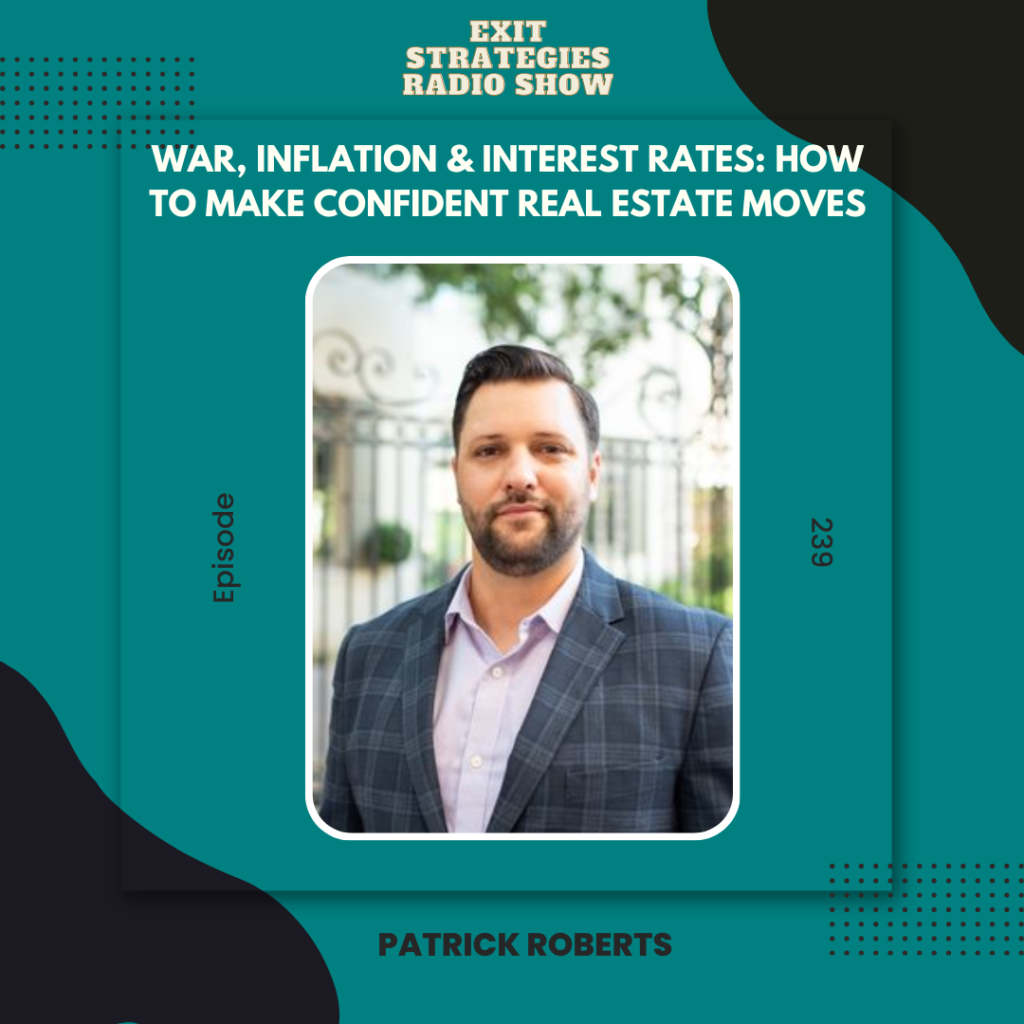


When global uncertainty arises—from international conflict to economic instability—most people freeze and second-guess their financial future. But what if uncertainty isn’t a signal to stop, but rather the perfect moment to make smarter, more informed moves?
In this episode, host Corwyn J. Melette sits down with real estate investor and lending expert Patrick Roberts to discuss how to navigate the current “new norm” of market volatility. From understanding how global events shift interest rates to avoiding the trap of emotional decision-making, this episode is a masterclass in building legacy through real estate, regardless of the headlines.
Key Takeaways:
- 02:30 – The Real Problem with Uncertainty
Most people hesitate when uncertainty rises—but that hesitation can lead to missed opportunities. - 09:21 – Opportunity Doesn’t Disappear
Uncertainty doesn’t eliminate opportunity—it changes how people evaluate it. - 11:09 – The Truth About Predicting the Market
No one can predict the future, so decisions must be made with the information available today. - 11:26 – Action Over Perfection
Waiting isn’t always the answer—progress comes from making informed moves now. - 29:02 – The Cost of Waiting
In real estate, waiting for certainty can cost you opportunity.
Legacy Takeaway
Building a strategy during uncertain times creates a foundation for lasting wealth, ensuring that your family’s financial future is not left behind by a rising tide.
Connect with Patrick:
- Website: www.station28capital.com/
- Facebook: https://www.facebook.com/station28capital/
- LinkedIn: https://www.linkedin.com/in/patrick-roberts-mba-charleston/
- Direct Cell: 844-085-2422
Connect with Corwyn:
- Contact Number: 843-619-3005
- Linkedin: https://www.linkedin.com/in/cmelette/
Shoutout to our Sponsor: Country Boy Homes
You served your country with pride. Now it’s time someone serves you. At Country Boy Homes, we believe every veteran deserves a safe, beautiful and affordable place to call home.
We proudly offer VA loan friendly, manufactured and modular homes built with integrity, quality and your family and mine. Whether you’re retiring to the peaceful low country or starting fresh with your family, we’re here to build the future you’ve earned. Give us a call today, 843-574-8979.
Country Boy Homes, Built to Honor, Built to Last.
Support this podcast: https://podcasters.spotify.com/pod/show/corwyn-j-melette/support
CORWYN:
When global uncertainty arises, whether it’s conflict, inflation, economic instability, most people hesitate. They wait, they pause, they second-guess one of the biggest financial decisions of our lives. But what if uncertainty isn’t the signal to stop?
What if it’s the moment to make smarter, more informed moves? So, as global events such as the conflict abroad continue to impact markets and interest rates and affordability, that question that lingers is how do you make confident real estate decisions when everything else feels uncertain?
Good morning, good morning, and great morning, guys. Welcome to another fabulous episode of Exit Strategies Radio Show. Hey, I am your host, Corwyn J Melette, broker and owner of Exit Low Country Group in beautiful North Charleston, South Carolina. So, if this is your first time listening to this show, you are sir or ma’am, are in for a treat because our mission here is very simple, very simple. That is to empower our community through financial literacy and real estate education.
Guys, we are legacy building. That is what we do. So, I always got to give a shout out to those who listen to us faithfully. Pastor Van Ben-Evans Senior always said, that guy will snatch me up. And I ain’t no little guy, but he’ll snatch me up if I don’t get it right and put that senior on his name and his wonderful bride. I’m Miss Sandra. My mom out there in Monk’s Corner, y’all. Y’all out there in Hollywood, what you know no good. And my folks in Mullins and Marion, thank you all so much for tuning in. I’m super stoked and excited about today’s show, guys. We always like to talk about trends. We’re always going to talk about money, how stuff moves because it’s a currency. So, that means it’s got to flow. It’s got to move, guys.
So, things change. And we have today an amazing guest who’s going to give us some insights, not only into some of that, but also into how to acquire housing in this particular area. So, investment properties in this particular arena, in this particular climate, buying real estate in uncertain times. That is what we’re going to be focused on. Smart strategies for affordable housing and confident decisions. And I’m very honored to have with us none other today than Mr. Patrick Roberts, who’s a real estate investor, a lending expert, the founder of Station 28 Capital, private investment firm based right here in Chucktown, Charleston, South Carolina.
He is, they say veteran, right? But once a Marine, always a Marine, I’ve been told. So, he is a Marine, former law enforcement officer, and he transitioned to real estate after starting with a live-in fix and flip. That’s how you do it right there. And has since invested across multiple states. He’s underwritten, has experience underwriting over $100 million in loans, and specialize in helping investors navigate complex financial options. So, here’s where we’re going to start. We’re going to start with when global uncertainty arises, whether it’s conflict, inflation, economic instability, most people hesitate.
They wait, they pause, they second guess one of the biggest financial decisions of our lives. But what if uncertainty isn’t the signal to stop? What if it’s the moment to make smarter, more informed moves? So, as global events such as the conflict abroad continue to impact markets and interest rates and affordability, that question that lingers is how do you make confident real estate decisions when everything else feels uncertain? Patrick, thank you for taking time out to be on the show with us today. Welcome to Exit Strategies Radio Show.
PATRICK:
Awesome. Thanks for having me.
CORWYN:
So, Patrick, if you don’t mind, give our listeners a high-level overview of who you are and what you do.
PATRICK:
Sure. So, again, I’m Patrick. I’m local here in the Charleston area, both a licensed mortgage loan originator and I also own a small company where we buy and hold real estate notes, which are promissory notes backed by mortgages or deeds of trust, depending on which state it is. I’ve been an investor since about 2008. Bought my first property in 2008 down in Louisiana.
I’ve bounced around a little bit in my career since then, but kind of found a home professionally in lending five, six years ago now. I do have a background in the Marine Corps law enforcement. That’s kind of where I cut my teeth on the investigative side of things, which has lent that skill well to me from the perspective of due diligence when it comes to real estate investing, making real estate decisions, that kind of thing. Mid-career, I decided that law enforcement wasn’t for me and made a pivot into finance and real estate via an MBA at LSU back in 2021, 2022. So, that’s kind of brought me full circle to being a lender here in Charleston.
I serve the South Carolina, Louisiana, North Carolina, and Tennessee markets, and I specifically focus on working with residential real estate investors. Awesome.
CORWYN:
So, I want to kind of get into, we kind of set the tone for this, so I don’t want to go off into another tangent and not have already chopped the weeds that we planted, so to speak, and I’m not going to call them grass or anything fruitful. I’m going to say weeds because people start thinking and asking about this kind of stuff.
So, global events. Well, we know we got a lot of stuff going on, right? There’s always something going on, right? So, how do conflicts that happen abroad influence interest rates and the lending environment?
PATRICK:
Sure. So, the biggest thing and the most obvious thing is the influence in the bond markets. The bond markets in our capital market system here in the U.S. drive how most lending is priced, or in other words, how the rate is set. The mortgage market specifically is very correlated with the movements in the bond market, and the bond market is largely pricing based on risk and uncertainty in this type of environment. So, to kind of give you a real world example on that, mortgage rates, for instance, were near three-year lows at the end of last year, going into the start of 2026.
And when the conflict in the Middle East kicked off about a month and a half ago now, we saw a dramatic shift in pricing in the bond markets, specifically in the treasury market. A lot of that had to do with the understanding that this was going to impact energy supplies worldwide because of the disruption of oil flowing from the Middle East. A lot of it, too, was just the uncertainty. But long story short, we saw mortgage rates increase about a half percent, give or take a little bit, over the past 30 to 45 days because of that. So, in normal historical context, typically when there is something like a conflict or a war like this, there’s typically a flight to safety, which, without getting too far into the math, when people run to safety, they tend to buy bonds, which drives the pricing on bonds up. It drives yields down because yields and prices move inversely.
And as yields in the bond market go down, that’s correlated with interest rates, specifically in real estate. So, generally, what you would see, historically, is war kicks off, conflict kicks off, there’s a flight to safety, yields go down, and rates go down with it. That has not been the case. In generally speaking, the last few years, there’s been so much uncertainty in the market as a whole that any piece of conflict, uncertainty, dislocation like this sends the markets into a frenzy. We see moves now in interest rates in the bond market and yields in the bond market that 10 years ago, where if yields moved this much in one day, it was the apocalypse. And now it’s just another Monday or Tuesday. So, it’s been a ride for sure. It’s probably not over for a while. But I don’t know that things will settle out anytime soon. I would say that right now, what we’re seeing is a lot of volatility.
It’s just the yields as a whole, the bond market as a whole is being whipsawed up and down, up and down, up and down. There’s no real predictability to it at the moment.
CORWYN:
Let’s take a short break.
AD
You served your country with pride. Now it’s time someone serves you. At Country Boy Homes, we believe every Veteran deserves a safe, beautiful, and affordable place to call home. We proudly offer VA loan-friendly, manufactured, and modular homes built with integrity, quality, and your family in mind. Whether you’re retiring to the piece of the low country or starting fresh with your family, we’re here to build the future you’ve earned. Give us a call today, 843-574-8979. Country Boy Homes, built to honor, built to last.
CORWYN:
So, let me take what you just said and kind of carve out a portion of it for this next question. Because one of the things, and Patrick, I know you’ve been doing this for a while, and I’ve been in this particular arena for a while as well. So, what I see is, fundamentally, things don’t stop, right? Things shift, things change, but they don’t stop.
So, if you could kind of touch on that, why is it that quote-unquote, in theory, markets don’t stop? Things just shift. People keep buying, people keep selling, but there’s just a shift in how that stuff happens.
PATRICK:
Sure. It’s new information, right? Every day that goes by, something new happens, whether it’s a ceasefire in the current conflict in the Middle East or some development in Asia or something happens domestically. As new information becomes available, bond traders who ultimately, and other investment firms and whatnot, who ultimately influence yields through buying and selling in the market, make decisions based on that new information.
Now, this is all happening rapidly at scale. A lot of it is algorithm-driven where, I don’t want to call it AI, this is kind of buzzword today, but there’s a lot of models that price this stuff and make these decisions in nanoseconds. But, basically, as new information comes out, the players in the bond market as a whole adjust their positions to correspond or to correlate to that new information. Again, those movements, those decisions that they make influence the yields because yields are ultimately a function of the buying and selling in the market.
So, new information comes out, bond traders, investors, whomever it may be, adjust their positions by buying and selling assets, bonds, or fixed income instruments in this case, which then influences yields, which pushes those changes downstream, where we feel them in a real estate market.
CORWYN:
So, what I frame from what you just said is that uncertainty doesn’t eliminate the opportunity. It just changes how people evaluate it. Would that be a fair assessment?
PATRICK:
It is, right, because you can’t put your head in the sand and just do nothing and say, oh, well, I’ll wait for this to be over because, for one, you have no idea when it will be over. For two, you could be looking at opportunities now that didn’t exist a day ago, five minutes ago, a week ago. So, you have to be on top of it. You have to be monitoring it.
You’re constantly adjusting and reacting. I don’t want to stray too far from the residential market where my expertise is, but even in the residential market, as an individual investor or homebuyer, whatever the case may be, you need to have some type of understanding of where you’re at and how those events impact you and whether that means it’s time to move quickly or it’s time to stay put until you get a situation or a set of circumstances that work for you. Makes perfect sense.
CORWYN:
So, let’s move into something a little bit different. So, how smart decisions, making smart buying decisions in these uncertain times, how these things work out. So, one of the things that we were kind of talking about for our listeners kind of to bring you back on this as far as a recap is that markets don’t stop.
So, once you understand what the environment is and the environment is your market, the next step is knowing how you need to move within it. So, Patrick, what should buyers prioritize when a market such as it is where rates or bond markets are all over the place, so to speak? And some people will say unstable. I think that’s too strong of a term.
Like you said, this is the new norm. This happens every day now. It’s not the apocalypse. So, what should people prioritize in these times?
PATRICK:
Understanding what they’re trying to accomplish and where they’re at right now and what’s within the means for them. I have a lot of clients who are kind of all over the spectrum of this. Some are waiting for the absolute perfect thing. Some are, I don’t want to say agnostic of the circumstances, but they deliberately tune it out. And what I tend to advise people is that no one has a crystal ball to be able to say what’s coming in the future.
There’s no way to predict this stuff. It is by its nature. The future is unknowable. So, what I tell people is understand where you’re at now, what’s within your means and what’s important to you. And just know that it’s not going to be whatever you close with a month, a week, a year from now, may not look exactly like it does today, but it’s going to be somewhere within that framework. I have a client I talked to this morning that is, he’s considering refinance onto his primary home and he is waiting for the perfect moment, if you will, where the stars align, everything pencils out. And what I’ve worked with him to understand is that we may not know that moment until it’s too late.
You may only look back in time at things that have already occurred and be like, oh wow, that was the perfect time. But it’s impossible to know that perfect time at the time being. So, the way I’ve kind of counseled him and advised him is if this is within the means and accomplishes what you’re trying to accomplish, it may not be the most optimized situation. If you’re looking for it to cost exactly this amount of dollars and this specific interest rate, you may never get that exact thing. But if it’s within the range of what’s acceptable to you, you’re going to have to live with a little bit of that uncertainty to just go ahead and move forward.
There’s no way to predict this stuff. And I have clients who have been waiting since 2022 for rates to come down and they’re still not down. So, waiting is not always the answer. You have to make decisions with the information you have in hand.
CORWYN:
So, thank you for that. Emotional decision making driven by headlines. Avoiding this. Or do you advise people to avoid that scenario?
I literally recently had a buyer who was on TikTok and looking at TikTok videos about bad home inspections and all kind of stuff. And they’re in the process of buying, closing on a brand new home. And they freaked themselves out. I mean, like literally to the point of tears and convulsions. They were literally shaking. Matter of fact, they were shaking and crying, like upset.
So, the information that we take in, we have to be mindful of. But Patrick, your thoughts on making emotional decisions based upon what the headlines or TikTok or whatever else says.
PATRICK:
Right. And I’ll try not to be too long-winded. I have a bad habit of over-explaining things. But you definitely want to consider that because if you’re buying a home, you’re buying an investor property. Yes, there’s some tangibles to that when it comes to like return on investment, having a place to live, stuff like that. But the emotional part of it is a piece of that. So, where I try to help my clients understand is you want to acknowledge that. You don’t want to, again, don’t put your head in the sand and ignore it, pretend that it’s not real.
At the same time, if it’s an emotional fear, rationalize it. But understand that may be part of the process for you. Buying a house brings you that much emotional response. Maybe take a second to process that and understand, is now the right time for you? Maybe you do want to wait until you’re a little bit more comfortable with things. I guess what I’m trying to say is you shouldn’t just move forward for the sake of moving forward if it’s going to put you in so much distress that you’re not going to enjoy your investment or be able to make clear decisions. At the same time, you need to acknowledge that some of that stuff is emotional. And because it’s emotional, it’s not necessarily rational. And that’s where you can lean on your professional advisors like in the residential market, your lender, your realtor, your property inspector to kind of put that, I like the term napkin math.
Let’s lay this out with napkin math. If you’re worried about the inspection and this could happen, what’s the worst case scenario? Let’s work backwards from that. If here’s the inspection and here’s what you’re concerned about, if that’s the worst case scenario, what is the impact on you from that perspective? What can you do to mitigate that? And is that an acceptable risk or not? Because a lot of times it’s the uncertainty and the fear that people get worried about without realizing yes, the flooring might need to be replaced in this house, but what is the actual impact of that? Oh, well, it’s only going to cost $1,800 or $2,000 to replace the flooring in this room if it needs it. I can live with it. I can manage that versus, well, this unknown might cost me $150,000 on this house.
Well, let’s be a little bit more careful there. So you have to balance the emotional and the rational where you can’t completely ignore the emotional because some people have a nervous breakdown. It’s rough. I’ve been there. I was a first-time homebuyer at one point and I remember sleepless nights where the wall would creak. It’s like, oh no, the house was falling down. Again, you have to rationalize through that. Houses are bought and sold every day and that kind of thing doesn’t happen. That being said, if there is something there that’s material, investigate it. Work through the process of discovery on that and also mitigating what the potential outcomes could be. So it’s a blend. Again, you can’t ignore it.
You can’t ignore someone’s emotional distress because it’s real. It’s as real to them as anything else. But I look at it from my perspective. My job is as their advisor, if you will, to guide them through the situations to help them understand what are the potential outcomes, put that within the context of what’s realistic, probabilistic, if you will, and then help them make a good decision that fits the criteria of what it’s important to them. I’m not going to sit here and tell you, you should never buy a home because I don’t think that’s the right answer. I don’t think that buying every home you come across is the right answer.
There’s guidelines there. My job is to help them navigate to within what’s important to them, what their value system is.
CORWYN:
So what I heard there, Patrick, was, you know, smart buyers really don’t wait for perfect conditions because, I mean, to be blunt, one, you don’t know it was the best condition until you moved on to worse, if that makes sense. Until it’s too late.
Until it’s too late. So they should make their informed decisions based on the information they have, which may be, if you will, in theory, imperfect information. That’s huge. So let’s move into something different here, which is navigating finance and options and reducing the barriers to entry. So for buyers, the biggest challenge, Patrick, isn’t necessarily the monthly payment.
It’s access and structure, how to put the deal together, understanding various types of, you know, finance and options such as DSCR loans, traditional loans, and private lending as well. I want you to touch on those. So, but if you can kind of package all that in with this question, which is how do these different or do different financing options open or do they limit opportunities?
PATRICK:
No, different options definitely create more opportunities than not. For instance, if the only thing that was available to a home buyer was a conventional loan and they can’t qualify for conventional, there’s no other opportunity. But then you layer in FHA, USDA, Dow Payment Assistance Programs, whether it’s state or county or city based, and now there’s more opportunities there. So it definitely opens the door to more opportunities. It starts, I’m kind of thinking through my process when I answer this.
I start with a conversation with my clients to help understand where they’re at, what their strengths are, what their opportunities are. And that helps me figure out which program is going to be best fit for them. Each loan program that exists across that entire spectrum has a specific tailored use case, if you will. Conventional loans might shine in these scenarios where FHA might shine here or DSCR might be a really good fit for this. And understanding the variables that impact those programs is my job.
So where I can portray that to my client, to a home buyer, to an investor to help them understand like, this is why I think these programs, this program, that program are a good fit for you. This is why these are not. I always encourage people to be educated, to learn as much as they can. I would be leery of recommending that people would go out and try to learn all this stuff on their own, because for one, it’s a mile deep, right? That’s why I have the job that I have, because that is a world in itself. And if we expected someone to go out every time they need a medical care to learn as much as a doctor to treat themselves, and every time they were buying a home to learn as much as a lender or a realtor to know how to buy a home, that’s just not practical.
It’s not pragmatic. So I would say educate yourself at the baseline on those to understand the high level differences. And then from there, find a trusted partner to lean on for financing. It’s a lender for real estate. It’s the realtor or the agent, I should say. But find that trusted professional to lean on where when you have those in-depth questions, where you’re not sure, is FHA or conventional better fit for me on this home? Is DSCR versus a private loan versus a fix and flip loan better in this situation? Lean on those professionals. That’s what they’re there for. Those programs, they’re so nuanced sometimes that you can read the guidelines five times and not know the difference between this one little piece that shifts everything about the structure on that loan.
CORWYN:
I may kind of segue a little bit into the question. We’re going to bridge this a little bit. So I want to talk about like the common mistakes that people sometimes make when seeking to get a loan in regards to choosing a loan structure. And I want to kind of factor in those things that people want to do or try to do at times to try to reduce the upfront costs with sometimes the barriers to interest. So that entry into the market, which is down payment, et cetera.
I’m going to give you this segue in because I have experienced this in businesses. I’ve worked with people over the years. I have a number of buyers over the years that were so caught up on getting down payment assistance when they didn’t need it. They’re so caught up on getting down payment assistance even though they didn’t need it. Sometimes they didn’t qualify and didn’t need it. They missed the opportunity to purchase a home because or walked away from opportunity to purchase a home. So your feedback and such on that.
PATRICK:
I would say don’t miss the forest for the trees. It’s kind of the same concept where I had a conversation with somebody late last year about this, where they were dead set on using these programs the specific way. And in going back and forth in the conversation with them, trying to figure out what was actually important to them, it was very clear to me that they had made an emotional decision that I want to use this program for these reasons that don’t really relate to what’s in their best financial interest or in their best interest with securing a property, right? And what I mean by that is they wanted to use this down payment combined with this with no seller credits in this particular setup.
And it’s like, I understand it’s what you would like to do. We are going out of our way to make this process more difficult than it needs to be when we can achieve this exact same end result that you’re looking for with a simpler, less complex process. Because when it comes to buying a property, whether it’s an investment property, a home, whatever, it’s complex enough, right? You’ve got attorneys involved. You’ve got agents involved. You’ve got a lender involved, a buyer, a seller.
There’s all these different parties. It’s adversarial in the sense that the parties are negotiating against each other. There’s a lot of conformity with the guidelines for loans and with state laws. It’s complex enough. There’s no need to add complexity to that if you don’t need to. So to your point, I’ve experienced this before where people were like, well, I’ve got to have down payment assistance. I want to use this program because I saw this advertisement on Facebook or on YouTube or whatever. It’s like, well, here, let me explain to you how this program works. This program, it’s not actually free money like you’re understanding it to be. This program is a forgivable loan where yes, you get the money right now upfront for free, but if you sell the house, convert it to a rental, move out of it, try to refinance your main loan, whatever, you have to pay all this money back. And then the fees you spent to get this free money, you don’t get back. And they cost you more money and handcuff you in the long run.
To your point, this person didn’t need the down payment assistance. They just thought it was free money. It’s like, no, this is not free money. If it was, don’t get me wrong. This was beneficial for you and was truly free. I’m here to help you get it right. My job, and again, this is where when I say me, I mean advisors, like professional advisors, whether it’s agents, whether it’s the lender, whatever, their job is to help educate the client on yes, that program is available. Here’s why it may be more harmful than good. Here’s the additional risk you’re adding to your deal, what the cost could be for the little extra return that you get. Do you really think it’s worth risking your deal or having your deal fall apart so you could save $300, $500, $1,000? I mean, that’s the trade-off that you’re making. Here’s the extra incremental risk. Here’s the incremental gain. Those things are out of balance.
That’s probably not a good decision. CORWYN:
Makes perfect sense. So for our listeners, guys, look, the right financial strategy can make the difference between waiting and getting started. If you push this thing or try to push it, quote, unquote, trying to push the car uphill, you’re going to find a lot more resistance than what you may be interested in. And the latter part of that is you mess around and lose your foot, and then the car might roll over you. So you may get left behind in the market.
So Patrick, we’re going to shift this thing up one more time. We’re kind of framing and getting pretty close to the end of today’s show, but confidence in real estate doesn’t come from certainty. It comes from being prepared. So I want you to frame this both for investors, but also for the other buyers that you assist and you serve. How to evaluate, manage the risk, but also how to make sure that they don’t over-leverage, if that makes any sense. So how to position yourself better so you can win, being prepared so you can win. What do you advise?
PATRICK:
So conceptually, or I guess philosophically maybe, the way I look at this is there’s an old adage that says, never forget the six foot tall man who drowned crossing the stream that was five foot deep on average. And what that means is that you have to be able to survive the lows, not the average. And where that comes into play with leverage and financing and whatnot is don’t base your scenario that you’re building for yourself. If you’re buying an investment property, building a portfolio, even buying a home, don’t base it around best case scenario. You want to look at what’s the worst case scenario, what’s the downside risk on this, and can I survive the downside? If things go average, great, with respect to rental properties.
If rents increase on average base, if insurance, the taxes increase on average and rates stay average and you plan around that’s fine, that does nothing for you if rents stay flat, but insurance goes up 20, 30, 40% next year, like it has in markets recently. So with that kind of at a high level, when we tie this all up or wrap this all up, what it translates into is don’t have a deal that’s so strong to the max that you have no cushion to absorb or margin for error. Make sure that you’ve got some slack there, if you will, where if things don’t go perfect, if something unforeseeable happens, if God forbid something crazy happens, you can absorb some of that blow and survive. Because what you don’t want to do is over leverage yourself, get into a situation where this deal pencils out on paper on a line, I’ve got my spreadsheet and it says that rents are going to increase 4% next year and insurance is going to be this and vacancy will be this and capex will be this, that may not translate to reality.
You want some crunch space, you want some buffer in that because you have to be able to survive the downsides, whether your spreadsheet or your planning prepared you for it or not. So don’t run your deals so aggressively that you can’t survive some variation. Banks do stress testing in this type of situation where they say, we expect the future to be this, but if this happens, if X, Y, Z happens, does that do to our portfolio and can we survive that? What are our losses? How much capital do we need to absorb? That’s kind of the same concept, right? You want to make sure you’re prepared for the low side, the downside, the unforeseen risk, if you will, where you can absorb some shock and walk away from it.
You don’t want a deal that’s so wire tight that things have to go perfect or you’re in a bind.
CORWYN:
Good deal. Good deal. So Patrick, if you don’t mind, this is a great place for you to get your contact information. Now, how can people get in contact with you? How can they reach you?
PATRICK:
Sure. So you can find me on LinkedIn, Instagram, Facebook. I have, obviously I’m an NLS licensed, a licensed mortgage loan originator. I have my license with Assurance Financial. So if you search Patrick Roberts lender originator or anything like that on Google, on Facebook, you’ll find me with no problem. At the same time, I do have my own company website, station28capital.com. If you’re interested in selling a note, buying a real estate note, you can find me there.
Just request a free consultation. I’m happy to chat with you. And if you want, I can give you my personal cell real quick as well. It’s up to you. Sure. How can I see you, sir? 843-408-5242. Again, that’s my direct cell phone. So you call that number, text that number, you’ll get me directly.
CORWYN:
Awesome, Patrick. Thank you so much. For our listeners, guys, let’s talk about legacy. Many people delay buying real estate because they’re waiting for certainty in the market in the world, wherever they’re waiting for that. Learning to make informed decisions during uncertain times changes the way someone builds long-term wealth and it helps them to create a more stable financial future for their family. So let’s not miss that in all of these things that are going on.
Our takeaways for today, don’t let uncertainty stop you. Learn how to evaluate opportunities with clarity, not with fear. Understand your financing options so you can move when the right opportunity comes along. And last but not least, build a strategy that includes risk management, not just growth, if you’re an investor, especially during changing markets.
Patrick, I want to thank you so much for taking time out of your busy schedule to be on the show with us today. I really appreciate it. It’s been awesome. I appreciate the opportunity. It’s been great. Awesome. In real estate, waiting for certainty can cost you opportunity, guys. You don’t want to miss the boat. Rising tide rises all boats. If you ain’t in the boat, you’re going to drown. Period.
But building a strategy in uncertain times can help create a foundation for lasting wealth, as well as legacy. Again, Patrick, thank you so much for our listeners. You guys know how I feel. You know what I say. I always put the two of those things together and I give it to you this way, which is to tell you that I love you. I love you. And we’re going to see you guys out there in those streets.