


What if the home you build today could lower your monthly bills, improve your family’s health, and protect your legacy for generations to come?
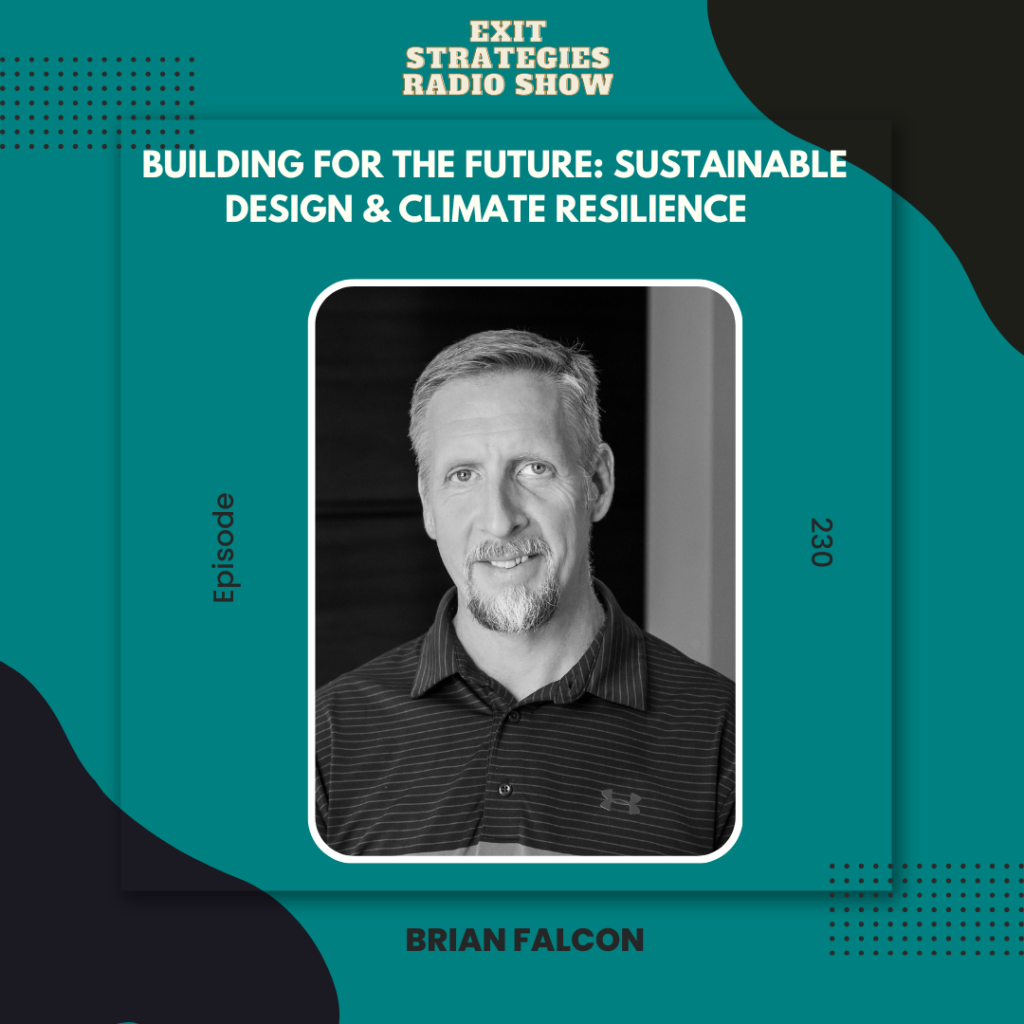
This week on the Exit Strategies Radio Show, Corwyn J. Melette sits down with sustainable design expert Brian Falcon, partner at Alter Eco, to unpack what “zero energy ready” and high-performance homes really mean—and why they’re more attainable than you think.
Brian, a LEED-certified architect with decades of experience, shares how sustainable construction isn’t just about saving the planet—it’s about building smarter, healthier, and more financially resilient homes.
Brian’s work focuses on airtight building envelopes, advanced ventilation systems, electrification, and integrated solar solutions—designed to reduce energy use by 50–70% compared to traditional code-built homes.
Key Takeaways:
- 00 Why sustainable construction matters now more than ever
- 03:13 How building sustainably protects your family and your legacy
- 06:24 What makes a home “zero energy ready”
- 10:00 How high-performance homes protect your investment
- 12:08 The truth about affordability and cost myths
- 15:34 How solar energy locks in your long-term savings
- 16:53 The future of sustainable communities and neighborhood design
- 22:08 The real return: comfort, health, and financial freedom
Legacy Moment Takeaway:
Sustainability isn’t an extra cost; it’s an investment in your legacy. Brian reminds us that building “green” is about more than the environment—it’s about creating a durable, comfortable, and healthy sanctuary that frees up your financial resources to spend on what truly matters: your family and your future.
Connect with Brian:
- Website: AlterEcoBuild.com
- Email: bfalcon@AlterEcoBuild.com
- LinkedIn: https://www.linkedin.com/in/brianfalcon/
Connect with Corwyn:
- Contact Number: 843-619-3005
- Linkedin: https://www.linkedin.com/in/cmelette/
Shoutout to our Sponsor: Country Boy Homes
You served your country with pride. Now it’s time someone serves you. At Country Boy Homes, we believe every veteran deserves a safe, beautiful and affordable place to call home.
We proudly offer VA loan friendly, manufactured and modular homes built with integrity, quality and your family and mine. Whether you’re retiring to the peaceful low country or starting fresh with your family, we’re here to build the future you’ve earned. Give us a call today, 843-574-8979.
Country Boy Homes, Built to Honor, Built to Last.
Support this podcast: https://podcasters.spotify.com/pod/show/corwyn-j-melette/support
CORWYN:
You guys may have noticed, may have seen that we’ve been on this tangent because we’re trying to make sure we expose you guys to affordable and sustainable building options because we want you to know there’s more than just quote-unquote the traditional, if you will, and there’s more to construction and building and design than just the automatic, we just want a roof over our head, how do we make sure our roof is going to be there and it’s going to be sustained.
Good morning, good morning, and great morning, guys. Welcome to another fabulous episode of Exit Strategies Radio Show. Hey, I am your host, Corwyn J. Melette, broker and owner of Exit Realty Low Country Group, in beautiful North Charleston, South Carolina. Look, always got to give a shout out and much love to those in appreciation, those who tune in to us faithfully, the Q family, Pastor Vanderbilt Evans Sr., you know, that guy always jacked me up. I mean, I’m a big guy, that dude will snatch me literally up on my tippy toes if I don’t say that thing here right and make sure I put that Sr. on that God name. Love him so much, his beautiful wife, Elder Evans. Thank you guys for tuning in. Always got to give a shout all the way out the monkey’s corner because y’all know my mama live out there, y’all, and then all the way back to Hollywood, which you know no good, and obviously where I’m from, where we were born and raised, out there in Marin County, Mullins, South Carolina. Guys, thank y’all so much for tuning in, guys. Look, I love you, love you, love you. Can I say that enough? So I’m super excited today for this particular show, all right? You guys may have noticed, may have seen that we’ve been on this tangent because we’re trying to make sure we expose you guys to affordable and sustainable building options because we want you to know there’s more than just quote-unquote the traditional, if you will, and there’s more to construction and building and design than just the automatic, we just want a roof over our head. How do we make sure our roof is going to be there and it’s going to be sustained? So today I’m very excited to have with us a leader and an expert in this particular field, Brian Falcon. Now Brian is LEED certified. I mean, he’s got a number of letters behind his name, AIA, LEED, AP, BD, plus C, CP, and HC. And look, he’s going to tell us what all that stuff there means today. He’s a partner with Alter Eco. I love that play on the name, which is an award-winning architect and sustaining building firm. They’re experts in this field. He has appeared on podcasts such as Home Green Home, Solve for Nature, and Green Building Matters. Look, Alter Eco, again, is a full-service design and building firm specializing, guys, in zero-energy ready homes and sustainable building. They’re based out of Pennsylvania, outside of Philly. Look here. So that guy probably knows something about some cheese steaks, too, having won a tremendous amount of awards at the local as well as national level for net zero-energy ready projects. So look, I’m super excited to have him on the show today. Brian, welcome to Exit Strategies Radio Show. How are you, my guy?
BRIAN:
Thanks, Corwyn. I’m doing great. Thank you for having me. Looking forward to speaking with you today.
CORWYN:
Well, look, so for our listeners, guys, let’s go ahead and set the hook. What if the home that you build today could protect your family, your wealth, or even your community for generations to come? Our guest today, Brian, will show us how sustainable construction and climate, resilient housing, aren’t just trends. They’re essential for building a lasting legacy. So Brian, if you don’t mind, give our listeners that high-level overview of who you are and what you do.
BRIAN:
Sure. So as you mentioned, I am an architect by training, and I developed an interest in sustainability in the late 90s, probably when I first got into the field, where the academic side in college sort of taught you one thing about architecture and what you’d be doing. But then when I got into the real world, I noticed I was working on a lot of projects where the first thing you do is strip the site of everything on it, all the nature, all the trees, everything, to basically make a blank canvas. And I really, being young and real green behind the ears, I wasn’t real, I didn’t quite understand that. Obviously, it’s economics and stuff. But to me, as someone who grew up loving the outdoors and always being out hiking, camping, fishing, and all those types of things, it just struck me as very odd that you’re developing something for people, but then you’re stripping away all the natural environment around what you’re building. So that piqued my interest in the 90s, and I ended up going to graduate school in 2000 to study sustainability specifically. And that’s where my professional interest in this grew and sort of learned the technical side of what that really means. And it’s sort of been a growth process ever since then. And about 10 years ago, my mentor, who is now my partner, Joe Lombardi with AlterEco, he reached out to me asking about my interest in starting a small construction company based on our shared frustrations of designing high-performance or green buildings, and then having them sort of, either the green features sort of being washed out or people thinking you can add it to a standard project cost-effectively, which you can’t. So that got our wheels spinning in 2015. And then we eventually, you know, we started AlterEco to focus solely on residential and small-scale commercial and using the Department of Energy’s Zero Energy Ready program as our basis for our performance standards, and then moving up to passive house and higher levels of getting closer and closer to zero energy before we even need to add any renewable energy to the projects.
CORWYN:
Let’s take a short break. You served your country with pride. Now it’s time someone serves you. At Country Boy Homes, we believe every Veteran deserves a safe, beautiful, and affordable place to call home. We proudly offer VA loan-friendly, manufactured, and modular homes built with integrity, quality, and your family in mind. Whether you’re retiring to the peaceful low country or starting fresh with your family, we’re here to build the future you’ve earned. Give us a call today, 843-574-8979. Country Boy Homes, built to honor, built to last. So let’s break this down and make it simple. What does this really mean for, you know, standard housing, if you will? Break this out for us. What does that look like?
BRIAN:
Yeah, so there’s a few different categories within your project that make it a high performance or close getting you towards a zero energy in performance. So one is the building envelope, and the two components of that is air tightness and added insulation. So those are two things that generally there are code requirements, but some areas are a little bit more lax on what the requirements are. So generally what we do is we super insulate our envelopes, and then we add two levels of air sealing. So we do tapes, caulk sealants, things like that. And then we also use a process which pressurizes the home and then basically blasts a phase-changing gas into the building, which fills all of the nooks and crannies in your envelope, which is where all your moisture and air leakage really is. That’s with the envelope. And then you get into high-performing doors and windows, which have added insulation value to them, and they also have…they minimize solar heat gain with the low E coatings and things like that. And then you get into your systems. So when you minimize the energy needed to heat your home, you can use smaller, more efficient systems. So we try to electrify all of our projects as well. Not all customers like that. Some people, for example, still like cooking with gas and things like that. And we understand that, so we try to be flexible. But the intent of the electrification is if you lower the load and then you electrify, and if you’re able to put solar on the roof, then you can technically be net zero, depending on your demands versus what you’re generating on the roof. And then, of course, we look into low and no-ZOVOC coatings and finishes inside the building to minimize off-gassing and bad smells and things like that. So we often hear back from folks who have either asthma or breathing problems or allergies, and there’s a notable difference in the air quality inside the home. And the other part of that is when you have an airtight home, part of the systems is, in addition to your HVAC system for heating and cooling, we have a fully balanced ventilation system, which where you are would be an HRV, but where we are, it’s an ERV, Energy Recovery Ventilator. And that basically does low volume but balanced supply and exhaust air throughout your home. So you’re supplying all your living spaces with fresh HEPA-filtered air, hospital-level filtration. So your bedrooms, your offices, your family rooms, they’re getting fresh, low volume of fresh air 24-7. And then your dirty rooms, your kitchens, bathrooms, laundry rooms, mechanical rooms, they’re being extracted at the same volume of what’s supplied. So it’s always balanced. So those are the key features from our end to creating these types of homes.
CORWYN:
Now that’s huge, because obviously if you’re going to box it all in, the people, so, you know, for our listeners, and most people think that when you box a house in, so to speak, they don’t think that ventilation isn’t taking place with their traditional HVAC system. They’re thinking that’s where all the air is coming from, and that’s really not it. The house leaks air, it brings in air outside of, and the system recycles air or pulls in air and then cools it, heats it or whatever and redistributes it. But if you’re going true self-contained, like what you’re talking about, then you got to get fresh air in. The only way you can get it in was ventilation. So let’s take this, because obviously climate issues, you know, somebody who’s allergic or have allergens or whatever, this is probably a perfect type house that you just described. Let’s get into those climate issues, building this kind of product or something more self-sustaining in diverse locations. What does that look like? What is that process? How does it protect families and their wealth as we talk about from natural disasters?
BRIAN:
So those are a couple. One, from the building itself standpoint, you’re creating a much more resilient home. When you make an airtight envelope with minimum or excluding any possibility for thermal bridging through the outside of your building, you’re minimizing moisture buildup in your exterior walls and roof and floors. And that’s where mold and all those nasty things start to build over time. And one, it creates health problems with people in the building. Two, it rots the outside of the house. So then you’re going to get holes in your envelope. You’re going to get termites and other things. It just gets worse and worse over time. So the intent of the way this is done is you’re minimizing that or eliminating that from happening. So from the longevity of the building, it helps in that respect. From the homeowners, you know, you have your health. And then also these homes are designed to use 50% to 70% less energy than a typical code home. So if you’re looking at cost versus value, if there’s, say, a couple percentage points of a premium on the front end of building the home, your value turns into a cost savings for the life of the home. So when you add up all these systems into a holistic project where everything, the sum is greater than the individual parts. For example, we use heat pump water heaters, which use a third of the energy of a typical water heater. So you figure probably, what, a three-year payback on that. And then from that point on, you’re using 70% less energy for your water heater for the life of your home. So all those things in tandem create a pretty significant difference in the way you live.
CORWYN:
So that’s a perfect segue into where my next question or questions are going to be, which is the affordability piece. I mean, green homes, and I’m going to frame it very loosely because that’s a very broad term, especially nowadays, but green homes, you know, there was a myth about the cost. I mean, everything that you did that was energy efficient costs more money. And obviously my imagination says today, that’s not the case. I’ll let you as the expert define that for us, if you will. But what does that look like now as we talk about energy efficient green, or that myth, I’m sorry, let’s just call it what it is. It’s a myth about the cost of these types of homes and projects being unattainable or otherwise out of reach.
BRIAN:
Yes, as architects, we get to speak with a lot of contractors and builders that we’ve worked with over the years. And what we found is that we’re at cost parity with those other custom builders for the types of homes we’re doing. Now we’re typically doing custom homes, 2,500 to 3,000 square feet for generally couples who are about to retire or just retired. That’s generally our demographic. Currently, we’re looking to expand that. But generally what we’ve found is that you can incorporate those as you’re making design decisions. And that’s part of the process as architects that we take into consideration. So an example would be we use high performance, triple glazed vinyl windows, a lot of our homes. Now we can use upgraded passive house level wood and aluminum windows for the higher end jobs, but those windows we use meet the same performance requirements at a fraction of the cost. So it’s not that really high-end custom home with those Marvin or other types of windows. But again, we look at the overall performance of the whole as well as the design of it to get you to combine your cost with your aesthetics with your program goals. So another thing we do is during the design process is we’ll get sort of the wish list from a client of, we think we want this many square feet, but we’ll be able to, by different ways of, for example, different visual lines within the floor plan, open spaces, higher ceilings, things like that, be able to create a sense of scale and feeling like you’re in a larger space, but in a reduced footprint. So when you’re looking at generally a per square foot cost for construction, those are some of the strategies we’ll use to reduce the overall footprint, to reduce that dot per square, the overall dollar cost, but get the same effect that we want programmatically within budget and then still maintain the performance we’re looking for. Okay.
CORWYN:
All right. So you guys focus on, on scale, I guess is what I’m hearing. So you guys, obviously my imagination says a lot of your product is designed for it. The efficiency, maybe, I won’t say small, that’s not, maybe not how I want to frame that, but it’s built for the efficiency, if you will, but you can expand or otherwise create larger projects that still maintain as you scale the same relative efficiency. Is that correct?
BRIAN:
Yep. Absolutely. Yeah. So whatever size home someone wants to do, if you implement these strategies, you’re going to be using much less energy than if you didn’t. So if you just met code, you’d use X amount of energy. If you implemented these strategies, it would be great, reduced 50 to 70%, I would say probably.
CORWYN:
That’s huge. That’s huge, especially in light of just where we are in general, just efficiencies, energy costs, everything is going up. You’re talking about the expense of your home, your construction, design, construction, all that stuff now being whatever that number is now, based upon what history has taught us, it will be more later, but the efficiency, the savings that you’ll realize on energy costs, et cetera, are going to carry going forward. So that as energy costs, again, continue to increase, which I don’t think I’ve seen anybody anywhere. I don’t even if I ever remember a time in life, the energy costs came down. Never, never. So while other people are continuing to scale up significantly, you’ll still see a dramatic savings over the cost that someone else that doesn’t have these efficiencies in place is otherwise experiencing. That’s huge.
BRIAN:
Yeah. Another part of that is if you’re able to add solar and purchase a solar, not do it as a power purchase agreement, but if you purchase it, the benefit to doing that is you lock in at the rate of that loan and it never goes up. So for example, where I live, I’m sure where you are as well, energy bills have skyrocketed over the last two years. And I’ve seen some local Facebook groups, people really, really struggling with that, of these bills doubling over the last couple of years. And I have for my home, I have a photovoltaic array on my home and my bill in the summer is $10. So it just feels good to have that freedom of, you know, now you are paying for a 25 year loan, basically on the system if you don’t pay cash for it. But that loan is locked in. You’re paying the same amount every month, no matter how much energy you use. And then you’re generating more than you’re using. You’re actually getting a check back from your utility, depending on where you live.
CORWYN:
That’s huge. Yeah. So as we quote unquote, get in the fifth gear here, what is your thought process on future next generations, right? What does that look like? Why would you advise or tell someone they should be thinking about this long-term, whether it’s family bond for whatever, and what the future may bring and investment and all that other stuff, et cetera.
BRIAN:
I mean, what I see is doing this at a neighborhood scale where these principles that utilize standard materials and assemblies can be implemented at scale where you’re getting your cost savings or even more when you’re doing numerous homes at the same time within a neighborhood. I think you’re going to be looking at localized power generation and storage. So for example, you have a small neighborhood of 20, 30 homes. You could have localized photovoltaic power generation and storage within your neighborhood. So the energy is not going from a coal power plant 30, 50 miles away through power lines. And with high levels of energy loss, by the time it gets to you, it’s literally in your neighborhood. You’re looking at having backup, onsite backup as well. So when your power goes out, you’re still going to have battery use. And I see that being combined with a more ecological landscape design where you’re living. And I see that as sort of the future of how we’re going to be going. It’s got obviously pretty big environmental impacts, reducing our energy use. You’re going to, I think, sort of build a little bit more community if you have these tighter, smaller scale neighborhoods as opposed to 300 or 400 home neighborhoods, sort of do more localized, smaller communities. I see these as potentially smaller scale starter home types, where you can have them be more cost available to younger people. And they could also be available to those who are downsizing after they’ve lived in larger homes for a number of years. Kids are gone. They’re looking to retire. They don’t need 3,000 square feet anymore. And they could be surrounded by other families and have a sense of community.
CORWYN:
That’s huge because people that this is their thing, right? So if this is a person’s thing, then typically they want to be with and around other people that this is their thing too. That creates community. It’s a lifestyle, but it also begins to create and kind of checks those boxes of getting, if you will, into lifestyle. What is the lifestyle? What does that look like? Now, Brian, look, this is probably a very good time for us to get your contact information out. How can people reach you, get in contact, find AlterEco? Again, I love that play on that name, but how can people get connected with you going forward?
BRIAN:
Sure. Yeah. My email is B as in Brian Falcon, F-A-L-C-O-N at AlterEcoBuild.com. And that’s also our website, AlterEcoBuild.com. And I’m also on LinkedIn. You can just look up Brian Falcon, you’ll see me there. I’d love to chat with anyone who’s interested in this.
CORWYN:
Awesome. Awesome. Awesome. So Brian, you say you kind of got into this to realizing that in order to build something sustainable, eco-friendly, you had to basically kind of, you found yourself destroying the current ecosystem in order to do it. And that just didn’t quite make sense to you. So you guys have now managed, what I’ve heard, what I’ve been taking away from our conversation is that you’ve managed to create a system or otherwise factor in current ecosystem into your design and into your build. So the results of that are now something that is also sustainable, energy efficient, and kind of checks all the boxes without having to quote unquote, clear the slate each time. How instrumental has that been and how important does that remain to the clients and to the prospective buyers and people that you all assist?
BRIAN:
For us, it’s huge because we made a decision very early on when we first started that this is all we’re going to do are these types of projects. There’s a lot of really great builders where we live in our area. We work with a lot of, we don’t want to compete with those folks. So when we first started, it was a lot of educating people about all these things, but now the tide has turned and everyone is much more educated and they’re doing their own research on YouTube and looking at different products and systems. So they’re seeking us out specifically because of our expertise in this type of construction. So really we’re getting calls and emails from people saying, Hey, I want to do a really eco home, a zero energy home, a passive house, whatever it is. And you’re one of the very few people we can find in the tri-state area that even do this. There’s architects that do it. There’s designers that do it. There’s a few contractors within a few hour radius of here that do it. There’s not many. So we engage with them. We ask them, what does that mean to you? Sustainability or zero energy? Why do you have that goal? And we learn a lot about them in that early process. And then it’s a continual education process back and forth during the design and construction with them and also with some of the subcontractors. If we haven’t worked with them before, a lot of it is educating people about why we’re doing what we do, what the impacts are, what the big difference is, the cost savings, things like that. And we found a very positive response from everyone we’ve worked with on those details.
CORWYN:
Good deal. Good deal. So, Brian, we have quickly gotten to the end of today’s show, but I want to ask you this question as a final, as we go into our wrap up for today. You have focused on, in this particular arena and area, in order to make a difference. So if you don’t mind, give our listeners what difference you feel you believe that you’ve made and why this is important for them to consider in their home design and construction needs.
BRIAN:
To me, I think it comes down to two very simple things. I guess three. One is you live in a more comfortable home. You don’t have drafts. It’s not leaky. It’s not cold at your windows. Your rooms are all very comfortable. You’re saving money and you’re living in a more durable home. It has a positive environmental impact. Those are really the three key things. So I usually put that last because it’s a big issue for us, but I know not everybody is as concerned about that. So we always tell people it’s going to give you more money to go on vacation with your family and to do the things you love doing. And I have four kids. Three of them have some level of asthma. So I did this with my own time and money and effort in my home. I’ve seen a huge difference in my kids being able to breathe easier in our home and things like that. So I think it’s health and comfort and saving money.
CORWYN:
Awesome. Awesome. Well, Brian, I want to thank you so much for being on the show with us today. And before we do our final, I want to make sure I take this as the moment to put our wrap up in for our listeners. Guys, I want you guys to focus on thinking beyond the price tag of your home. Invest in one that not only protects your family, but also protects your financial future. And Brian just really just articulated that very well with sharing about your children. And a takeaway that I have from Brian’s discussion, our discussion today, is sustainability isn’t necessarily an extra cost. It’s an investment in your legacy. So Brian, I want to take a time here, a moment here to say thank you again for taking time out of your busy schedule to be on with us today. And thank you so much for being part of the Exit Strategies Radio Show family.
BRIAN:
Thank you, Corwyn. I really enjoyed talking to you today.
CORWYN:
Awesome. Awesome. So for our listeners, look, y’all know what this thing here is. It ain’t no surprise. Look here. We do this all the time right here. Y’all know. So let’s get at it. Y’all know how I feel about you and you know what is real about you. And that is this. I love you. I love you. I love you. And we’re going to see you guys out there in those streets.