




Building a business is an incredible feat, but successfully exiting that business and turning it into a true family legacy is a completely different challenge.
Many entrepreneurs find themselves “self-employed” rather than owning a sellable asset—if you can’t take a three-week vacation without the wheels falling off, do you really own a business, or does the business own you?
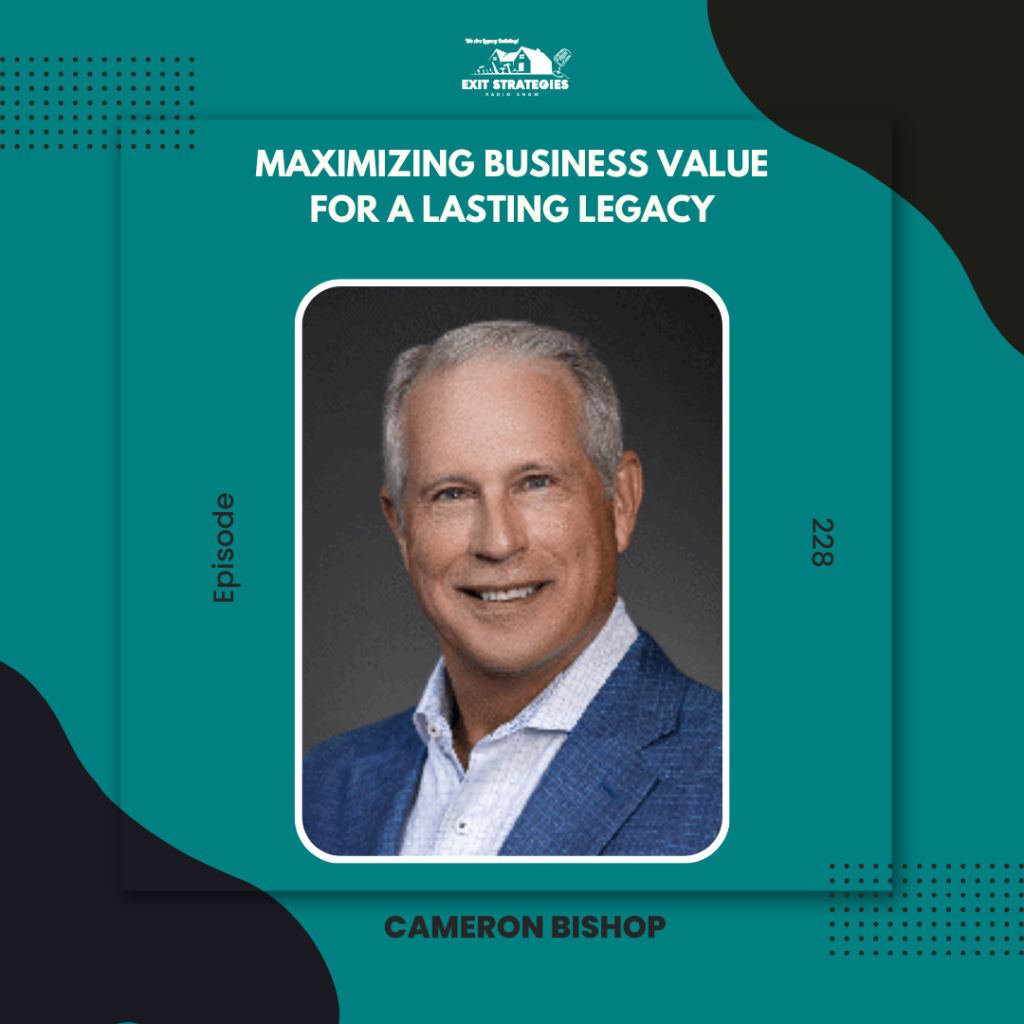
In this episode, Corwyn J. Melette sits down with Cameron Bishop, Managing Director and Partner at Rain Catcher, to discuss how to navigate the technical and emotional rollercoaster of selling a business. With over 35 years of experience and a half-billion dollars in transactions, Cameron reveals the common pitfalls that make companies unsellable and how you can start strategizing for your “personal promised land” today.
Key Takeaways
- 7:56 – The Lifestyle Business Trap: Understanding the difference between a “lifestyle business” (where you are the business) and a sellable asset.
- 10:12- The “Bus Test”: A simple diagnostic to see if your business is ready for exit: If you were hit by a bus tomorrow, would the business survive?
- 12:08- The Silver Tsunami: Why the baby boomer generation is facing a unique challenge with succession planning as fewer children choose to take over family firms.
- 14:13- The “Dr. Phil” Side of M&A: Why selling a business takes 9–10 months and involves as much emotional navigation as it does financial negotiation.
- 15:54- The 5 Critical Deal Killers:
- Poor accounting (Cash vs. Accrual/GAP).
- Owner dependency.
- Customer concentration (The 20% rule).
- Vendor dependency.
- Below-average gross profit margins.
- 24:00- Creative Exit Structures: Why a “full cash payout” is rare and how seller notes, SBA loans, and earn-outs work.
Legacy Moment Takeaway:
“A well-planned exit isn’t just a transaction—it’s your opportunity to turn years of hard work into a lasting legacy for your family and future generations.”- Cameron Bishop
Connect with Cameron:
- Email: Cameron.Bishop@raincatcher.com
- Website: www.raincatcher.com
- LinkedIn: Cameron Bishop
Connect with Corwyn:
- Contact Number: 843-619-3005
- Linkedin: https://www.linkedin.com/in/cmelette/
Shoutout to our Sponsor: Country Boy Homes
You served your country with pride. Now it’s time someone serves you. At Country Boy Homes, we believe every veteran deserves a safe, beautiful and affordable place to call home.
We proudly offer VA loan friendly, manufactured and modular homes built with integrity, quality and your family and mine. Whether you’re retiring to the peaceful low country or starting fresh with your family, we’re here to build the future you’ve earned. Give us a call today, 843-574-8979.
Country Boy Homes, Built to Honor, Built to Last.
Support this podcast: https://podcasters.spotify.com/pod/show/corwyn-j-melette/support
CORWYN:
Building a business is one thing, right? I mean, that’s what some of us, many of us are endeavoring, whether it be through real estate investing or whatever business it is, and y’all know some people out there, but exiting it successfully and turning it into a true legacy for your family, that’s a completely different matter.
And today’s guest helps business owners to unlock. Hidden value and navigate the emotional and financial side of selling.
CORWYN:
Good morning. Good morning and great morning guys. Welcome to another fabulous episode of Exit Strategies, right yo show. Look here. There’s a song that says the second time around, look here. Hey Cameron, know what I’m talking about. We gonna have a great time here today. Look, I gotta give a quick shout out to those who listen to us faithfully, all the way from Hollywood, which you know, no good all the way at the monkey corner. Y’all know my mama live out there. Y’all also Pastor Vanderbilt Evans Senior and his wonderful Rod Elder Evans. And look, I get tickled ’cause the two of them to me are like priceless. I love spending time with them. They’re amazing people. So if you know ’em, you know what I’m talking about. If you don’t, then you need to.
Let’s get at it. Look here. So we gonna jump straight into today’s episode and you know, obviously we always gotta let you know what we’re doing here. Y’all know it. If you’ve been listening, if you’re not, then hey, I need y’all to get on the bandwagon and let’s tell it like it is. Look here, this is what we doing around here.
We’re legacy building. Our mission being as simple as it is to empower. Our community through financial literacy and real estate education, we’re legacy building. Again, that is what we’re doing. So I gotta give you quote unquote what that text is for today. And I’m doing something a little new now, so I need y’all to keep up with me.
Y’all know what I’m talking about. Look here. So I text today, maximizing business value for a lasting legacy. What goes on beyond? I’m very honored today to have as a guest, Mr. Cameron Bishop, y’all call it that last name so y’all know right here today. So he’s the managing director and partner for RainCatcher.
Now we wanna get into a little bit of that, but. Building a business is one thing, right? I mean, that’s what some of us, many of us are endeavoring, whether it be through real estate investing or whatever business it is, and y’all know some people out there. I know a young lady that I’m watching on Facebook, and she’s out here killing with her Geechee crab.
Do y’all know what I’m talking about? So y’all can holler at her, let her know this episode she needs to tune in for, but exiting it successfully and turning it into a true legacy for your family. That’s a completely different matter. And today’s guest, Cameron Bishop, helps business owners to unlock hidden value and navigate the emotional and financial side of selling.
Now he’s got a long resume. He’s, again, the managing director and partner, a rain catcher firm that specializes in helping entrepreneurs maximize business value before sale. He brings decades of experience advising leaders on strategy growth and transition planning, and he’s known for guiding owners. The technical and the emotion because we have emotion about our baby, right? Challenges preparing for a successful exit. Y’all gotta pardon that point because I meant to put that drum roll in there because you know, we around here about exit strategies, about getting on to that next thing and getting quote unquote to our own personal promise land. So I want to take this time right now to introduce an amazing guest.
How to strategize for our future as we enter into our next season and leave our legacy for those who are behind. So Cameron, how you doing today?
CAMERON:
I’m doing fantastic. I like myself even better. Now after your set up there,
CORWYN:
Well look, we do good front. We do what we can and apparently we had a practice run at it. So look here. I love it. I love it, I love it. So if you don’t mind listeners high level about you, rain catching what you guys do.
CAMERON:
Well, first I have to say, Corwyn, I’m really grateful that you have me on your show today because this, my message today is a true personal passion because I’ve spent my whole career primarily buying small companies, and I’ve seen all the mistakes those business owners make.
So I’m trying to help them to prepare when it’s time for them to exit. So for myself. I’m, uh, born and raised Kansas City guy. Today I’m an investment banker, uh, with a firm called RainCatcher out of Denver, Colorado. We help business owners when it’s time to sell their company, but for 35 plus years, I was on the other side of the table.
I was a buyer. So I was supported by private equity firms and I spent about a little over a half a billion dollars and did about 50 plus transactions buying small businesses, and I saw all the mistakes those business owners make. Where they literally walked away and left money on the table. Some of them, because of the things they either did or didn’t do, made their companies unsellable.
CORWYN:
Wow. Wow.
ADS:
Let’s take a short break.
Do you remember your grandma’s front porch? You know that spot where stories were told kisses were stolen? And sweet tea was always being sip. Now imagine giving your family a place to make those same memories, but in a brand new energy efficient and home that was built just for you.
At Country Boy Homes, we help folks just like you find that forever feeling. Whether it’s your first home, your next home, or your We’re done with Rent forever. Like Seriously home. We specialize in affordable, durable, manufactured, and modular homes, the kind that make room for muddy boots, big dreams, and second helpings. Come see what coming home really feels like. Call 843-5748-979 today.
Country Boy Homes built to last. Priced for you.
CORWYN:
So one of the things, we talked about it, our listeners know, look, I’m a business owner, right? So I’m the great grandson of a carpenter side hustler, made wine and barbecued hugs and stuff for people and always tell people all that work that he did on houses, all of that work he did, making wine, all this stuff that he did over the years that I gotta spend with him, which was my upbringing up until his demise.
I gleaned it, but didn’t document what it is that he left or had left there for me. I didn’t understand it. Now, then I have a much better understanding now and I realize it as a missed opportunity. And then here I have children who have no interest in the business that I’m in, that I’m doing, they’re not there yet.
If they get there, great, but if they don’t, what happens? So that’s a conversation that I like to start with. How do you advise people? ’cause you know, I mean, you know in your mind, Hey, I’m gonna take it as far as I can and I’m gonna give it to my children. They gonna go down the road with and take as far as they can and they gonna leave it to their children, so forth and so on. We think that is our legacy. How do you have that conversation with people and what do you see happening in that arena? In space? That’s a whole lot.
CAMERON:
Sure. Great question. That’s the beginning of the process, but first I have to go off track for a second. You mentioned that your great grandfather liked to barbecue hogs a lot in Kansas City.
That’s, we argue in Kansas City. That is the Mecca Barbecue. So you already got my attention, but beyond that, you mentioned that your great-grandfather was a carpenter. Brilliant trade, highly talented. But he is the definition of what is called a lifestyle business. So he doesn’t have a business that he could sell.
The business was his because of his talent. So I spent five years as a consultant and a small firm, and I couldn’t sell that business because I was the business people bought my services and it’s amazing how many people today Corwyn who can make tons of money, or at least a very good lifestyle for themselves, but they don’t have anything they can sell because the whole reason they’re making money is dependent on them.
So that’s the first thing that people need to understand. We have a lot of people who contact us at Raincatcher who wanna sell a business. You know, they might be a writer, for example, or an independent lawyer, or an independent doctor. Any profession that is totally dependent on their personal skills is not sellable in almost all cases.
There are exceptions, of course, but in most cases it’s just not, and they can. I’ve seen businesses where these folks are making seven figures, but they don’t have anything they can pass on to anybody else.
CORWYN:
And that’s interesting. I talk about it all the time when we, you know, bring agents on it into our company. We’re trying to define business. There’s self-employment and there’s business and most people don’t know where to distinguish. Is where the definition changes. We sometimes start, as you said, and we say we’re on the other side of the line. And I’m a firm believer in speaking those things as if they are.
I’m definitely a firm believer in that, but nonetheless, sometimes we are actually truly only resting on the self-employed side and never make it over. So your process, what does that look like? And somebody who is structuring or structured so that they have a truly defined business. What does that look like for you as far as the analysis or the initial phases and stages of what it is that you guys do?
CAMERON:
Yeah, so the simple test is if you have a business, again, can become very successful financially as well as personally rewarding. But the old is, if you got hit by a bus and couldn’t work, would that business survive? And when we have business owners call us, one of the questions we ask them is crazy enough, do you take a vacation? Because many business owners say, well, I could never take a vacation because if I did, my business would crash. That’s not a good sign for a business. It’s not the end of the world, mind you, but in most cases, if business owners can go away for a week or two weeks, or even three weeks and their business continues on and operates normally, that’s a very attractive sign to be able to sell the company ’cause buyers will look at that and know that the business is not totally dependent on that business owner.
CORWYN:
That’s one of the things that’s interesting you say that. I’ve just got, I’ve gotten recently in recent years to where I do and can vacation. It used to be that it would literally gimme heart palpitations, so to speak. Oh, it’s somewhere like, wait a minute, wait a minute. But now it’s like, all right, look, y’all got it. I empower myself, the people around me and trust them. So I empower them to be able to work through and handle those things that need to be worked through and handled. So the reasoning behind this transition oftentimes, again, is you don’t have anyone succession wise to move you forward.
So let’s talk about the emotional challenges, like what are those sticking points that you have to help people navigate? Emotionally, because if you can’t get your mind and your heart and alignment to explore this, then truth told you’ll never do it. Does that sound like a fair assessment?
CAMERON:
Yeah, that’s very true. And you mentioned children, and that’s part of the emotional dynamic because the fact is that a vast number of American companies. Are owned by baby boomer generation business owners. I think the statistic is that 10,000 baby boomers turn age 65 every single day, and their companies are by and large, their primary source of future wealth or hopefully generational wealth. And in bygone days there, one or more of their children transitioned into the company and took over the business. Today we hear very few people who own a company. Who have children that want to move into the business, so what else are they gonna do? They have to sell the company because they have eventually wanna retire some sooner, some later.
So the fact that their children don’t want to come into the business or other family members for that matter, there’s an emotional dynamic there as well. And for most business owners, they eat, sleep, and breathe their company. It’s their baby. It’s their beings of social validation. It’s an ego driven, it’s their social structure, either talking to employees or their vendors or other people in the same field, and they’re gonna leave that business.
And it’s a challenging dynamic for many of them, even if they make tons of money. So in my world, when we’re helping a business owner sell their company. That’s actually part of what we tried to help prepare them for. That’s not normal for an investment banker. Most people think investment bankers just wanna do hard charging negotiations and dollars and percentages and contract terms, and that is certainly true, but I would say on most of the deals I do representing independent business owners about literally about 50% of the work I do. Is what I call Dr Fill. It’s helping those business owners to navigate a very emotional rollercoaster ride because. It takes nine to 10 months to sell a company. That’s a national statistic, regardless of what industry or type of business it is.
CORWYN:
So two things. So I’m gonna start picking up on something you just may mention of, again, obviously it’s a misnomer, misinformation that when people are for what you do, that people are coming in with this aggressive tone, with these aggressive tactics, if you will, in order to get.
People, if you will, out of their business, if that makes any sense. But what I just heard you say is that you guys have a completely different approach as far as how you wanna have understanding. You wanna work to make sure that you are advising the person, assisting, nurturing, all those things so they can come to the decision that works better and best for them.
But my second part, if you’ll as a kind of a segue from that, if that makes sense. What are those mistakes that many people oftentimes make that. To them seeking to sell the business. What are those normally?
CAMERON:
Yeah. Thank you for asking that question because that’s the key. It’s so sad, cor, because so many people call us and wanna sell, and then when I start going through the question, well, the first question I ask them is, okay.
Why are you thinking about selling? Because we try to tailor a process if they’re sellable company, to achieve their personal objectives and their objectives are oftentimes not mine, but we try to help them achieve their goal. But if they’re not sellable, there’s, depending on the business and the industry, there can be a whole myriad of things that can be factor. But the five key things we see are number one, first and foremost, either no. Accounting are really bad accounting, and no buyer is gonna buy a business if the books aren’t accurate and complete. And if they do have accurate books, they’re normally on a what’s called a cash basis as opposed to a gap based basis where the expenses line up with the revenue so that you can track what the gross profits are in the company.
That’s an accrual based accounting method. Almost all buyers borrow money from banks or other lending sources. When they buy a business, they put their own equity in, they often ask for the owner to carry back a loan. As part of that, banks only wanna work on a gap accrual basis, so a lot of our clients have to go back and spend a ton of time and money to restate their financials.
So account number one. Number two, is what we call owner dependency. So we talked earlier about if you got hit by the proverbial bus, would the business survive? Well, if that’s what buyers wanna know, how dependent is the business on that owner? So if all the clients or customers call that owner, that’s not a good sign because buyers are taking a huge risk at spending a lot of money.
And if that owner walks away or transition out over time, then they have risk. So number three, so normally that means they need to have a succession plan in place, which requires time and money well in advance of selling a company. The third thing we see is what’s called customer dependency. So if they have one client that is represents 20% or more of their business. That’s usually a red flag for buyers. In fact, if they have a big enough company that private equity firms or family offices, which are super high, wealthy, net worth people who have so much money, they have a team that buys and makes investments for them.
There’s a crazy number of ’em in this country. I gotta tell you, Corwyn, they almost always check out if you have more than 20% of your business is dependent on one customer. The fourth thing is if you have extreme dependency. One vendor provides raw goods for your business. And a client in, believe it or not, Canada, who had an amazing business. This guy was printing money. It was so profitable, but he relied on one very specialized material. It was made by one other company in Canada. And if he lost that agreement with that other company, which was a family owned business, let’s say hypothetically that other company went bankrupt, wouldn’t be likely.
But if they did, buyer is in deep trouble. So buyers of businesses look at what your vendor structure is. The fifth thing is, and this varies by industry, is what your gross profit margins are. So if you’re a distributor, for example, normally those are about 25, 30% gross profit and 10% and net income or ebitda.
But different businesses like a SaaS platform, software company. Super high gross profits. So buyers look at what your gross profits are and measure it against the industry norms for that particular industry. And if you’re below that, it’s at least a yellow flag and oftentimes a red flag for buyers. So those, I could probably name over 30 other factors that could come into play.
In different scenarios, but those are the five keys when we’re marketing a business and they call a buyer say, Hey, I’m interested in this company. Those are the five questions they ask first.
CORWYN:
That’s huge and very useful. I get that. So for our listeners, guys, you gotta be thinking about this from the big picture. You gotta think about it from the perspective of if you got a contract to whatever it is, let’s say you have a lawn care business or what have you, and you got a single large contract that represents 50% of your income that I know Cameron is like, uh, because if you lose that contract. Somebody buys a business, they lose that contract then. Then what? Because we know that in these changes of ownership with businesses, there’s going to be some customers or clients that may shed, if you will, in that process. Does that sound about right Cameron?
CAMERON:
Wow. You’re a spot on that Corwyn. So a classic example, what? I first joined RainCatcher almost five years ago. My first client was an amazingly talented gentleman who was a creative marketing guy, and he did premiums and incentives. You’re like, did you want t-shirts with your logo on ’em, or pens or coffee cups, et cetera. He did that and one of his clients was a large client with multiple locations. All of those locations combined represented about 55% of his business. And because he was an extremely creative guy, he, I don’t even, I can’t even count the number of rewards he’d won for creativity. Well, we brought six buyers to the table for that deal, but in his case, because of those two factors and his profits were well above the industry, nor for that kind of a business.
So that was a good thing, but no one would pay him any cash upfront on closing the deal. Because the risk of what would happen when he ultimately left and what would happen if they lost that huge client, then I think they had like, I dunno, 25 or 30 locations, and his argument was, well, I called every one of those locations well because we couldn’t get any cash and it was all, they were gonna give him a job for two years. And he could hit some targets over three years and he would get close to what he hoped to get for the business.
Well, he said, Hey, heck with this, I’m just not gonna sell. And six months after we canceled the whole process, which again went for nine months, he lost that large client because they brought in a new senior level executive at the corporate level, and he negotiated a new contract with somebody else. That guy’s contract or that guy’s business was no longer sellable at all.
CORWYN:
Ah, that sounds, yeah. And those are the things that we have to think about. But you touched on something, this process. Sometimes people think that when I sell is final. Right. So there’s a couple times throughout our conversation, Cameron, you’ve touched on different situations.
So you know, you can sell part of the business and retain some interest in ownership. But if you don’t mind, throw out a couple of different scenarios that you’ve worked on where it wasn’t a full transfer of ownership and essentially a full cash out, but maybe essentially some equity brought in and there’s still some involvement of the current owner, if that makes any sense.
So give us some situation, scenarios where that’s happened.
CAMERON:
That’s another huge factor in selling a company because everybody just think, oh, I’m gonna sell my business. It’s gonna be worth X, and I’m gonna get a check or a wire transfer into my bank account and I’m gonna walk away. It rarely happens.
There are certain cases where it can, uh, especially in this day and age. If a business has any real meaningful value, let’s say it’s gonna sell for a million dollars or more, just as Hypothe could be less, could be more the buyers for that business. If it’s a under, let’s say, five to $7 million business, they’re gonna take out an SBA loan and the small business administration.
Them to put, generally, I think it’s about 10% of their money into the business, and the SBA is gonna loan a big chunk of the money, but then they’re going to ask the owner of the business to carry back what’s called a seller note, which is basically loaning the buyer part of the purchase price. Those loan terms can be good.
If the seller has a good representative broker, investment banker representing them, they can negotiate a pretty good deal where they can get better money. Well, of course the stock market is going crazy good right now, but it’s not always the case. Those loans are generally three to five years. The interest rates are negotiated.
Generally at or slightly above what the market rates are, but sometimes there are no payments against that loan for a year or two years. And maybe it’s just interest for a certain period of time. And then there’s what’s called a balloon payment at the end where they get the full remaining payoff at the end of the period, which is generally three to five years.
Some will occasionally stretch to seven years. Also part of the purchase price paid on an earnout. So the example I gave you a minute ago where the marketing guy couldn’t get his company sold for cash, any cash upfront, all six of the buyers of that deal were gonna pay him out over a two or a three year period based on hitting certain financial milestones in the company because that reduced their risk.
CORWYN:
That’s huge. So that’s proof that there’s quote unquote more than one way to skin a cat. So Cameron, let’s get your contact information out. How can people reach you, get in contact with you?
CAMERON:
I’m happy to help any of your listeners at any time. No cost, no obligation, no sales pitch. Again, I’m Cameron Bishop. My email address is cameronBishop@raincatcher.com. Our corporate website is www.raincatcher.com or look me up on LinkedIn. You can find me there as well, and send me a chat message. Happy to schedule time to chat with you just to answer questions if it’ll help you.
CORWYN:
Awesome. Awesome, Cameron, I greatly appreciate that. So I wanna thank you again for being on the show with us today. I really appreciate it. Quote from the bottom of my heart, man. I really thank you for taking the time. For our listeners, guys, look, let me give you these to-dos the things that you should be taking action on. So if you’re a business owner, don’t wait until you’re ready to sell, if that makes any sense.
Start planning now. What is your pardon the pun? What is your exit strategy? How is this gonna look? How do you want it to look? Right? So let’s start having these conversations early. My takeaway, Cameron, from what you’ve said today, is that a well-planned exit, and y’all got to excuse that pun, isn’t just a transaction, is the opportunity to turn your hard work into a lasting legacy.
And guys, y’all know how we are here about, if you will, our legacy. So Cameron, again, thank you for being with us today. I really, again, appreciate it.
CAMERON:
Amen. Hoping I was helpful for your listeners.
CORWYN:
Awesome. So guys, our listeners, Hey y’all know how I feel. You know what I say, you know, always put the two of those things together and I give it to you this way, which is to tell you that I love you I love you and we gonna see you guys out there in those streets.