


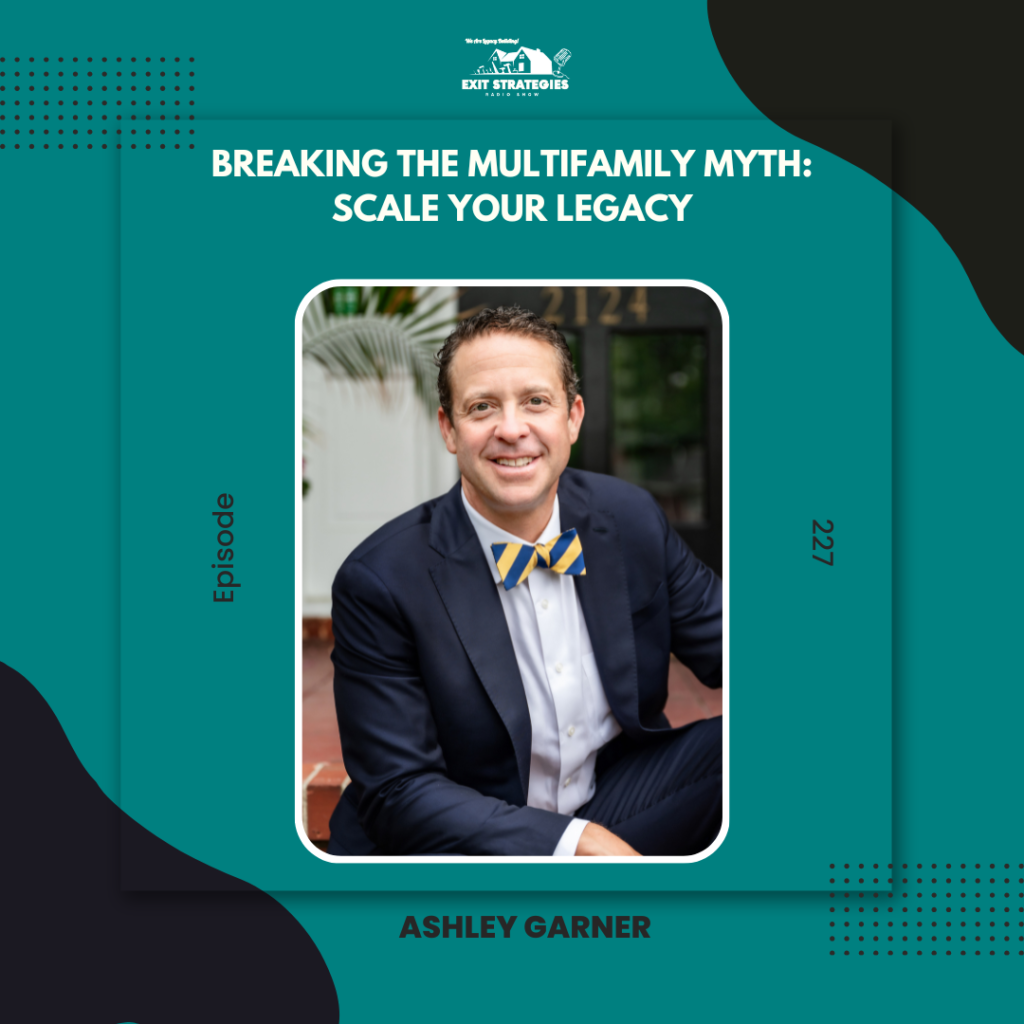


Too many aspiring investors stop short of multifamily because they think it’s out of reach.
In this episode Ashley Garner breaks down the myths that keep aspiring investors stuck—especially the belief that you must personally fund every deal.
Ashley Garner, real estate entrepreneur, founder of ABG Multifamily demystifies the transition from single-family rentals to large-scale apartment buildings. With over 30 years of experience and 300+ units under management, Ashley shares how a personal health crisis and his father’s legacy proved the life-saving power of passive real estate income. Whether you have one door or none, this conversation will give you the roadmap to stop “swimming on land” and start building a portfolio that lasts for generations.
Key Takeaways
- 0:00 – Don’t let fear stop you: The accessibility of Multifamily.
- 1:30 – Introducing Ashley Garner: 30 years of real estate expertise.
- 3:24 – The Legacy of Cacao and College Rentals: How real estate is paying for his father’s care.
- 5:51 – The 10-Unit Leap: Overcoming the fear of your first “big” deal.
- 6:14 – The Cardiac Arrest Wake-Up Call: Why rental income saved his family.
- 9:29 – Same Docs, Different Doors: Demystifying the complexity of commercial deals.
- 12:49 – Raising Capital: How to find partners who want to win with you.
- 15:18 – Understanding the Cap Stack: Partnerships, Syndications, and BRRRR.
- 22:56 – How to connect with ABG Multifamily.
- 23:27 – The Hindsight Question: What Ashley would have done differently.
Legacy Moment
Ashley explains how properties purchased decades ago are now paying for his father’s medical care—proof that the right real estate decisions today can protect your family tomorrow (3:45–4:05). Legacy isn’t built by waiting until you have “enough,” but by using the resources and relationships you already have.
Ready to Master Multifamily?” If Episode 220 with Michael Root gave you the systems to run a powerhouse, our latest episode with Ashley Garner gives you the mindset and capital strategies to get the keys. Listen to both to complete your multifamily roadmap!
Connect with Ashley:
- Website: https://www.abgmultifamily.com/
- Contact Number: 910-409-0861
Connect with Corwyn:
- Contact Number: 843-619-3005
- Linkedin: https://www.linkedin.com/in/cmelette/
Shoutout to our Sponsor: Mellifund Capital, LLC
Need funding for your next real estate flip or build? MelliFund Capital makes it fast, flexible, and investor-friendly. Visit MelliFundCapital.com and fund your future today. Again, that’s MelliFundCapital.com, M-E-L-L-I-L-U-N-D, Capital.com.
Support this podcast: https://podcasters.spotify.com/pod/show/corwyn-j-melette/support
CORWYN:
Don’t let fear or limited knowledge stop you. Multifamily is more accessible than you think, guys, and it can transform your family’s future.
Good morning, good morning, guys, and great morning. Welcome to another fabulous episode of Exit Strategies Radio Show. Hey, if you don’t know who I am, I’m about to tell you. I’m your host, Corwyn J. Melette, broker and owner of Exit Realty Low Country Group and beautiful North Charleston, South Carolina. If this is your first time listening to this show, you, sir or ma’am, are in for a treat because our mission here is very simple. That is to empower our community through financial literacy and real estate education, guys, real legacy building. That’s what we do. Gotta give a shout always faithfully to our listeners. Gotta thank Elder Pastor Evans, Vanderbilt Evans Sr. Because that guy will jack me up. He will snatch me up like I’m nothing if I don’t get that senior on that name. So I appreciate you. You know, I love you guys immensely. My mom out there in Monkey’s Corner, y’all, and everybody back to Hollywood was no good. And even my folks in the MnM, Mary Mullins, guys, I love you and appreciate you so much for tuning in. So look, today’s show, you get the opportunity on occasion, right? They say that when you get to sit at the teacher’s feet and get to take in everything that they pour into you, but you also get to experience everything that they take in as well. That is what true learning is. And I’m very fortunate today to have someone who is a leader and we’re gonna call him a teacher today in this space about multifamily. He is a real estate entrepreneur and the entrepreneur thing sometimes will get the best of you, but he is yet holding on with over 30 years in the business, licensed broker and investor with over 300 units managed across multiple states. He is known for teaching investors how to overcome fear, raise capital and confidently move transition, if you will, into multifamily deals. So I don’t wanna do a drum roll. We got a platinum carpet in the back. So we’re gonna go ahead and grab that and make sure we get that out as we introduce none other than Mr. Ashley Garner. He is the founder of ABG Multifamily. That is what he does. So Ashley, thank you so much for taking time out to be on the show with us today, man. How are you?
ASHLEY:
Hey, Corwyn, I’m great. And I must tell you that that is my all-time favorite introduction that I’ve ever had. I appreciate that.
CORWYN:
Well, look, we appreciate that. Just so you know, I’m available for hire. If you ever need me to jump to the stage or something. Yeah, I like it. Yeah, I like it. Good. So look, let me set the hook right here, Ashley, and just kind of get into this conversation. For our listeners, guys, too many aspiring investors stop short of multifamily because they think it’s out of reach. And it’s funny, I just talked about this yesterday. Ashley, you’re going to show us today how to break through those barriers and start where you are and build a legacy, if you will, one deal at a time. If you don’t mind, let’s talk about it. Give our listeners a high-level overview, Ashley, of who you are and what you do. Man, you got it.
ASHLEY:
So first of all, thanks for this opportunity. I love the mission that you have with the financial literacy and educating others and legacy building. That’s close to my personal heart. And so I love the chance to be here. I grew up kind of in this business, but in a very mom-and-pop fashion. So when I was in junior high and high school, my dad started buying large houses near the campus of West Virginia University, and then we would internally subdivide them into apartment units and then rent them out to students. And we actually still own lots of those places today. Unfortunately, my dad is not well. He’s still with us, but he’s pretty far down the road of Alzheimer’s and not down to take a detour, but he bought those houses, you know, was that 35-some years ago? And now those houses are paying for his care. We wouldn’t be able to afford to care for him if it wasn’t for that. So it’s just one of the many, many reasons to pursue investing in real estate because it really can change your life. So I grew up in that literally with a hammer in my hand, and I was doing the stuff, the plumbing, the construction, the renovation, all of it. And it went then to the financing and the acquisition and the management and all those types of things. So then when I got on my own career, you know, when I got to be adult age, if you will, and I got my broker’s license back in 1994, I’ve always been in the real estate industry in one form or fashion. Like when I was in college, I drew floor plans for a real estate appraiser. I’ve always been in that arena. So I got my career going with residential brokerage, kind of like you. I have a small team of people that works for me on a small scale. And it is a wonderful career. It was a fabulous opportunity. I loved every day of it. But I still realized that even though it wasn’t like a W-2 job where I had to go clock in, that if I didn’t show up, take a shower, comb my hair, make my phone calls, write my handwritten notes, do my open houses, then I didn’t make any money. It’s still a job. And what happened to me was I started buying single family rentals, duplexes and triplexes and in pursuit of that financial freedom. And it was working. I read all the books. I studied this stuff like crazy. And it’s working. So I’m thinking now like, all right, I like this stuff. I want to do more of it. And so my financial freedom goal kind of increased. I said, well, if I want to live the lifestyle I want to live without having to clock in, if you will, then I need more units. So I’m going to have to somehow get bigger. So I bought my first one, which was a 10 unit apartment building. And that was in 2013. And in 2013, when I bought that building, that might as well have been a New York City skyscraper to me because it was such a big difference from what I had ever done before. And I remember being scared to death. And so I got that one and then things went real well. And I didn’t buy one for a while. I was kind of still doing my brokerage business. And then in 2017, I guess God had a different plan because I had Monday morning on August 14th, I had a heart attack and cardiac arrest. They had to shock me back five different times that day. And I guess I wasn’t ready to go. I wasn’t finished yet. And it’s because I’m still here. But here’s where the reason I tell you that is because it was at that time when I was kind of in my mental and physical recovery for a couple months that I realized that my real estate investments were that’s what my family was living on. And had it not been for that, I wasn’t making any money. I wasn’t selling any houses. And that’s what kept me going. So it really then proved to me the power of having this, the income from the rentals. And that’s when I decided to try to take it a little bit bigger, even.
CORWYN:
Let’s take a short break.
AD:
Do you remember your grandma’s front porch? You know, that spot where stories were told, kisses were stolen, and sweet tea was always being sipped. Now imagine giving your family a place to make those same memories, but in a brand new, energy efficient and home that was built just for you. At Country Boy Homes, we help folks just like you find that forever feeling. Whether it’s your first home, your next home, or your, we’re done with rent forever, like, seriously, home. We specialize in affordable, and durable, manufactured and modular homes. The kind that make room for muddy boots, big dreams, and second helpings. Come see what coming home really feels like. Call 843-574-8979 today. Country Boy Homes, built to last, priced for you.
CORWYN:
So Ashley, thank you for sharing that because you just touched on a number of things that, again, I just had this conversation yesterday with a very close friend of mine, I consider him to be my brother, and just, hey, what’s the plan? How are we going to do this? How you need to get this done? Down the road, he’s a little bit younger than me, but getting to that, I’m going to say this, I’ve not said this on air before, but I’m going to say this because I’ve been internally having this 20 by 10 conversation. 20 new doors over the next 10 years, producing a minimum cash flow per door, if you will. The short of it is getting to where you’re, what you’re talking about, which is that when you age out or aging out or whatever, that you’ve set yourself so that this industry and as an entrepreneur doesn’t give you retirement. You got to build it. That’s right. I don’t want to go too far into the weeds, but because we, I want to make sure we keep this relevant with our audience. So if our audience, please bear with us. But one of the things that I imagine, you said this, so let’s start with a fear. Let’s start with a fear. Okay. How did you overcome it? And what do you tell people that, let’s say they’re mom and pop, onesie, twosie, you know, they got one or two doors, single family houses, townhouse, condo, whatever that may be, scattered site, whatever. And now it’s time, look, for us to really look at transitioning. How do you tell them over? What do you suggest? Let’s go. Gotcha.
ASHLEY:
Well, I sometimes take for granted that everybody knows real estate as well as I do because it’s all I’ve ever done, right? I think to myself, well, why don’t you just do more of that? But then when you talk, you realize, well, people think that there’s a difference between a duplex and a single family, or it’s more complicated now because we call it commercial real estate or because I can’t go get a regular mortgage from a mortgage banker. I got to go to a local bank or something or start an LLC. So in other words, it adds this layer of complexity, I think, but what it really is just more of the same thing you’re already doing. If you have a onesie or a twosie, a threesie or a foursie is no different except it has four doors instead of two. And that’s what I try to help people understand that it’s the same closing worksheet that when you buy it, it’s the same attorney. You could sit right in the same seat in the same attorney’s office and buy that four-unit property the same way you could buy that one-unit property. And so, yes, there are differences, of course, the different terminology are slightly different when you borrow money or whatever, but it’s all basically the same. And at some point, you can read all the books, you can watch all the podcasts, but at some point, you just got to take the step and give it a go. And if your numbers, I know that you help people understand the math of it all. If the math works, then give it a go. At some point, it’s just taking a dive off the high dive. You got to hold your nose and go or you never get there.
CORWYN:
Yeah, you ain’t swimming on land. Right. If you’re going to swim, that means eventually you got to get in the water. So you touched on something else in there that just I think makes sense. We overcomplicate it. So we make it more complicated because what I heard you say, you sign the same docs to buy four as you do to buy one. Ain’t like you got to sign four times. You’re going to get writer’s cramp from, if you will. No, it’s the same thing. Yeah. So let’s talk about how you get in. So you made mention of the doors and the industry. Thank you for that point. We sometimes everybody thinks and understands it like we do. What are some options for people to get in? Because people looking at, OK, well, look, I can come up with a loan for to buy this, but getting to this is way more expensive. And how do I get there? So what are some ways and strategies that you would either used or otherwise advise people on how to get that done?
ASHLEY:
Yeah, well, I’ll tell you that when you’re a hustler, when you’re like, you go out and find a deal and create an opportunity, other people want to be a part of that. And what I mean is this. It took me a long time between my one like duplexes and triplexes to get that 10 unit property. And I look back and I wish it hadn’t taken me so long. And I say, well, why did it take me so long? And I feel like there’s two reasons. One was that fear that I had. I just was it took me a while to convince myself to do it. But the other one was the money. And I thought I had to save up all the money all by myself. And it was not just saving enough, but it was saving enough that if I lost it all, I wouldn’t put my family out on the street. And so those two things took me a long time. Now, since then, I have realized that it didn’t have to be that way, that other people would join in with me and take advantage of my hard work. And what I mean by that is this. The next unit I bought after the 10 unit place was a 32 unit place. So it wasn’t three times as big. And it was about five years after that. But I got it. I found it. I got it under contract. And then I went to the bank and said, all right, how much money can I borrow? And they said, all right, you can borrow this. Turns out I needed $350,000 to buy it. Well, I mean, it might as well have been $350 billion because I didn’t have it. And to me, that sounded like more money than I could ever imagine. And so I called one of my friends, somebody I had known a long time ago, and life has been good to him. And I said, hey, I found this property. Would you like to invest in it with me? You go in with me. Initially set out to do is like, all right, I’m going to raise $50,000 from seven different people. And now I got my $350,000. When I called him and told him about this deal and shared the numbers, he’s like, yeah, I think I’d be interested in that. And I said, okay, well, how much do you think you would like to put in? He said, well, if we did it, I think we just would do it all. And I was like, whoa, what? I make one phone call and now I got all the money. And what I’ve come to realize then is not that he wasn’t doing me a favor. He wasn’t trying to help me out of a tight spot. I was trying to, I was presenting him with an opportunity that was good for him. And now we all win.
CORWYN:
I love it. So, so that that’s the thing. Cause you’re looking at our approach sometimes in that situation, what I just heard, and I’m going to echo it because I get it. You’re thinking, well, I need help with this. But really and truly what you’re doing is offering opportunity to somebody else. So, hey, look, you gonna make some money. I’m gonna make some money and, and we’ll keep doing this and continue to make more. So that brings me to the cap stack. So what you talked about a syndicate, syndicating or getting either one or two or however many more people to bring money in to show you up. So then you can either, either you can leverage it with the bank for the balance and, or you can bring all the cash in necessary to put the whole deal together. What strategies do you normally employ? I mean, you guys look at, or do you kind of employ them all? We’ve talked about Burr here on the show. The cap stack is important. And if you’re going to do a Burr method, getting in, stabilizing the property, refinancing the cash back out and going somewhere else with it. That’s huge. So what does that normally look like for you as far as trying to put together, if you will, the cap stack?
ASHLEY:
Well, one of my favorite things about this business is, you can make it look however you want. And there’s no, like in residential, there’s a standard form for everything. And this kind of stuff, you just create your own way. And so I’ve done a lot of them. The Burr method is one of my favorites. In fact, that 10 unit place I told you about, I think I’ve cashed out, refinanced that thing three times now. And that, the money, the equity that I have taken out of that place has bought me millions of dollars of real estate that I’ve used that cash to go as the down payment on something else. And I’ve owned that, then I’ve sold that and bought something else with it. And it just keeps going. And that’s, when you get into that, that’s really where it’s mind-blowing, the power of this real estate investment. It really is a special, powerful tool. So I like the Burr method. I’ve got, then I’ve just got straight partnerships, kind of 50-50 partnerships where I found the deal and the other person put in the money and we go half. I’ve done the syndication model where I’ve been the general partner and I own a smaller percentage of, in this case, 40%. And then the limited partner investors own 60%. I’ve done syndication that on a bigger scale that was where the general partners own 20% and the limited partners own 80%. I’ve kind of done it in all kinds of different ways.
CORWYN:
I love that because what you said in there is oftentimes we find limitation where opportunity exists. So what you literally have done is you get the first deal done and then from that point on, technically you’re playing with house money, so to speak. There you go. You get your, however you do when you’re playing and sitting with house money. And sometimes we as investors, new investors, we miss that because in our mind it is, the objective is to pay off the debt, right? But if you leverage the debt into additional property, then for an investor, oftentimes it’s about cashflow. So if I can leverage the debt and get into more properties, more doors, if one, I’m lowering my risk by going to more doors because if I got one door and it goes vacant, I’m toast, right? If I got 50 doors and one goes vacant, we got 49 more. So how do you have this conversation? Because I mean this, you talked about it in the beginning, your dad, prayers for him, you and the family because I can’t imagine what you guys going through. But dad had the vision early and looked down the road. So how do you have these conversations or this conversation with other potential investors about, hey, this side of this thing works, this is why you should do it. This was because you just shared your experience, your dad, as well as your own personal, how they can structure this for the long term, essentially our legacy piece. What does that look like?
ASHLEY:
I think that’s a tough conversation because everybody has that desire to be safe and secure and to leave something for the future and know that their finances are going to be okay no matter what happens. But sometimes it seems like it’s such a big mountain to climb. Where do I even start, man? I can’t, I buy one little house, what’s that going to do for me? And you buy one house and you rent it out and maybe you make $200 a month cash flow from it. And that’s a lot of money, but it’s not going to leave a legacy for your kids, right? But what the real power of it is, is that you get in and that you can do it and that it does work and then you get interested in it and you learn more and more and then you start hanging around people like Corwyn and you talk real estate and shop and then it just grows from there. To me, that’s the real power of it is to get started. And once you get started and you start hearing more people like me and you talking all the time and hearing our experiences, then that’s how you get to that next level. I don’t know. See, I’m not even close to being the smartest person in the room and I know I’m not the smartest person on this radio podcast right now. But what I realized also is I see other people out there doing this and being successful. And I’m like, man, that guy, I’m not ripping on him, but I know he’s not that much smarter than me. And if he can do it, I know I can do it. And so it’s more it’s the action that separates most people. It’s taking the action that it is having the knowledge. Most people have more knowledge than they’ll let themselves believe. It’s just that you got to walk in in that day and say, all right, I’m going to do this and not give up. Time goes fast, man. Five years goes by in the blink of an eye. And if you’ve owned a rental property, for five years and you look back and now it’s double in value, that’s pretty powerful. But if you don’t do it at all, five years goes by and you’re right back where you started.
CORWYN:
It makes perfect sense. So what you hovered on right there was mindset. And we talk about that on the show a lot, Ashley, about people and their mindset. How do they do things and their motivation and their commitment, level of commitment. But one of the other things that goes with that is you talk about the room. As I framed it yesterday, and you’ve heard this, your circle is either a circle or a cage. The people that are in it and the people that you spend your time with and that you glean and lean to and from is either a circle or a cage. And you’ve got to make sure that you focus on that. So education. And let’s kind of get to the wrap on this piece. Education. When I say that word to you in this field, in this space that you operate in, what does that resound for you? What does that mean for you?
ASHLEY:
Well, I think it’s easier. You know, it used to mean when I was starting out, it used to mean reading a lot of books. And I would read whatever book I could get my hands on and learn the math and the terminology and things like that. So I felt comfortable. So I didn’t feel like I was sounding stupid in front of people talking about it or asking questions. And then nowadays, it’s so much easier to educate yourself, which you can go on YouTube and basically take a whole college course on real estate finance and multifamily or whatever, just right on YouTube. But I listen to a lot of podcasts like yours and other people’s. I do a lot of, you know, I’m always running a spreadsheet or looking online how to run, how to calculate this or try to learn about the 1% rule or all these other things that investors will learn about. So I think education is easier now than it’s ever been. I also have been participant in local real estate investment associations through my being a broker. I was kind of always around the real estate, but by the way, on that one, I know a lot of brokers because that’s what I do, right? So I spend a lot of time educating residential brokers on how, because like you said before, as entrepreneurs, we don’t have a retirement, a 401k. There’s none of that. And I was like, look, guys, when you hang up your real estate license one day, either because you got sick or you just didn’t want to work anymore, I said, you stop selling houses, then guess what? You make zero more money. And so you need to do something like this to take care of yourself and your family. And even people that are in the business of real estate think that have a hard time making that transfer into owning an investment for yourself. When we help other people all the time with their closing statements and their inspections and all these things, and it is exactly the same to buy an investment property as it is to help a client buy a residential house.
CORWYN:
So let me ask you this, and I’m going to ask this as, one, let me get your information out. So as our listeners reach out to you, quote unquote, to come subscribe to sit at the feet of the teacher.
ASHLEY:
Yeah, I think the easiest way is just to go to our website, which is abgmultifamily.com. And once you get on there, you can find phone numbers and emails and LinkedIn and Instagram and all that stuff. But it’s abgmultifamily.com.
CORWYN:
Awesome. Awesome. I sometimes like to frame this as that hindsight question, which is if you had to do this thing all over again, knowing what you know now, I’m pretty sure I know what your response might be. But if you had to do this thing over, what would you have done differently?
ASHLEY:
I would realize that I didn’t have to do it all by myself. Growing up in this business, like I said, a very mom and pop hands on. My dad was like, look, if we need to paint the house, then grab a paintbrush. If you need to type up a lease, then grab your typewriter. So I got that mindset of doing everything myself. I carried that on to thinking that I had to raise all the money by myself and I had to do the whole transaction all by myself. And that kept me smaller than I could have been had I said, hey, Corwyn, I found a property. Would you like to go in half with me? I don’t have all the money, but I found it. It’s a good deal. Would you like to be a partner? And had I done that sooner, I feel like I could have gotten farther down the road sooner.
CORWYN:
I like that. I like it. That’s real, Ashley. That’s real. So I want to thank you for taking time out today to be on the show with us, man. And most importantly, for your insights and for telling the story, man, because it’s a very common story. I know you see it because you’ve lived it. I know you see it repeatedly as you seek to educate others on how they too can transform their lives. So I appreciate you taking time.
ASHLEY:
Yes, sir. It’s a great opportunity. I appreciate it. Keep doing what you’re doing. Thank you. Thank you.
CORWYN:
Now for our listeners, guys, look here, let me give you your action item. You’ll take away what you can go do outside or going outside just to play. Guys, look here. Don’t let fear or limited knowledge stop you. Multifamily is more accessible than you think, guys, and it can transform your family’s future. So I want you guys to take that with you and do something with it. Don’t let it fall, quote unquote, as a pastor will say at times, not let it fall on deaf ears. Let it be heard. Let it be worked upon. Guys, you know how I feel. You know what I say. You know, I always put the two of those things that I give it to you this way, which is to tell you that I love you. I love you. And we got to see you guys out there in those streets.